
When we look at the rapid evolution of industrial manufacturing, especially in the realm of high-speed fiber laser cutting and precision micromachining, the conversation almost always turns toward stability. For decades, cast iron and welded steel frames were the undisputed kings of the workshop floor. However, as laser technology pushes into micron-level accuracy and extreme acceleration, the limitations of traditional metals—thermal expansion, vibration resonance, and long lead times—have become glaring bottlenecks. This shift is exactly why more global manufacturers are asking: is an epoxy granite machine base the missing piece for the next generation of laser systems?
At ZHHIMG, we have watched this transition unfold firsthand. The demand for a mineral casting machine base isn’t just a trend; it’s a technical necessity for industries that cannot afford the “ringing” or thermal drifting associated with metal. If you are designing a laser machine intended to operate at high G-forces while maintaining a perfectly clean cut, the foundation you build upon dictates your ceiling of success.
The Physics of Silence: Why Polymer Concrete Outperforms Metal
To understand why an epoxy granite machine bed is superior, we have to look at the internal physics of the material. Traditional cast iron has a specific internal structure that, while strong, tends to act like a bell. When a laser head moves rapidly back and forth, it creates vibrations. In a steel frame, these vibrations linger, leading to “chatter” marks on the workpiece and premature wear on the motion components.
Polymer concrete, the technical cousin of epoxy granite, possesses internal damping properties that are nearly ten times better than gray cast iron. When energy enters the material, the unique composite of high-purity quartz, granite aggregates, and specialized epoxy resin absorbs that energy and converts it into trace amounts of heat rather than letting it oscillate. This “silent” foundation allows the laser to fire with incredible consistency. For a laser cutting machine, this means sharper corners, smoother edges, and the ability to push the drive motors to their limit without losing precision.
Thermal Stability: The Hidden Enemy of Precision
One of the most frustrating challenges in laser machining is thermal expansion. Metal breathes; it expands when the shop warms up and contracts when the AC kicks in. For large-format laser machines, even a few degrees of temperature fluctuation can shift the alignment of the gantry or the focus of the beam by several microns.
An epoxy granite machine base for laser machine applications offers a thermal expansion coefficient that is remarkably low and, more importantly, very slow to react to ambient changes. Because the material has high thermal inertia, it acts as a heat sink that stabilizes the entire system. This ensures that the first part cut at 8:00 AM is identical to the last part cut at 5:00 PM, providing the kind of reliability that high-end European and American manufacturers demand.
Integrated Engineering and Custom Components
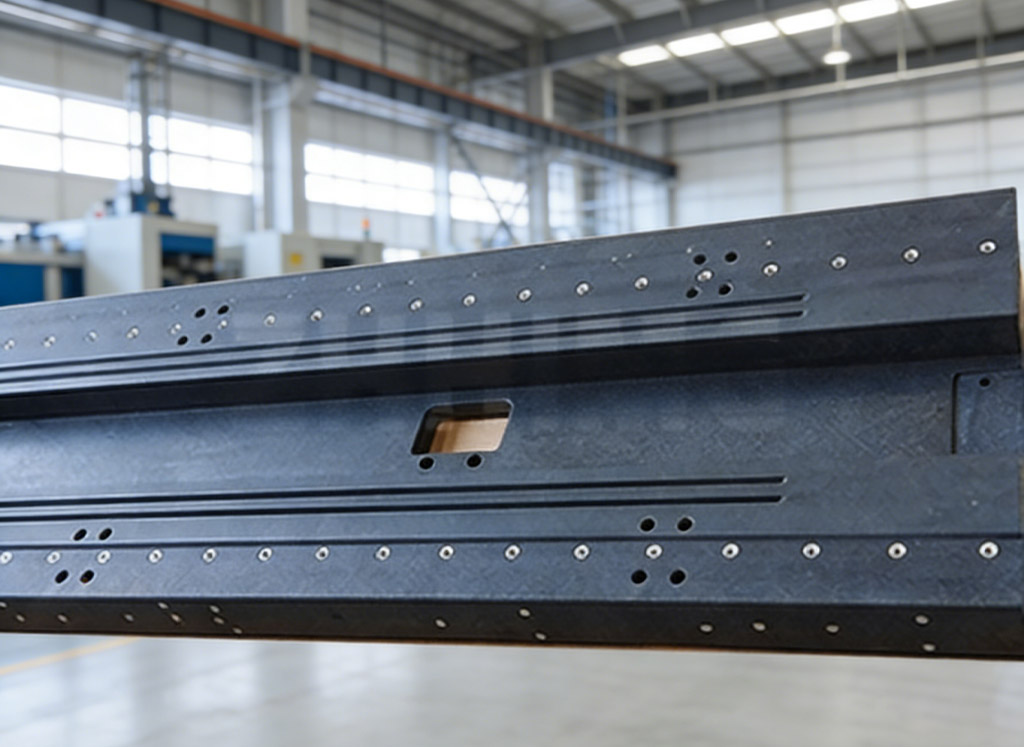
The versatility of this material extends beyond just the main bed. We are seeing a massive uptick in the use of epoxy granite machine components for the moving parts of the machine as well. By casting the bridge or the support pillars out of the same mineral composite, engineers can create a thermally matched system where every part reacts to the environment in unison.
At ZHHIMG, our casting process allows for a level of integration that is impossible with traditional machining. We can cast threaded inserts, T-slots, leveling feet, and even coolant channels directly into the mineral casting machine base. This “one-piece” philosophy eliminates the need for secondary machining and reduces the stack-up of tolerances. When the base arrives at your assembly floor, it is a finished technical component, not just a raw slab of material. This streamlined approach is why many of the world’s top ten precision machine tool builders have shifted their focus toward mineral composites.
Sustainability and the Future of Manufacturing
Beyond the mechanical advantages, there is a significant environmental and economic argument for choosing an epoxy granite machine base for laser cutting machine production. The energy required to produce a mineral casting is a fraction of what is needed to melt and pour iron or weld and stress-relieve steel. There is no need for messy sand molds that create high waste, and the cold-casting process we utilize at ZHHIMG significantly reduces the carbon footprint of the machine’s lifecycle.
Furthermore, because the material is naturally corrosion-resistant, there is no need for toxic paints or protective coatings that eventually flake off. It is a clean, modern material for a clean, modern industry.
Why ZHHIMG is Leading the Mineral Casting Revolution
Choosing a partner for your machine foundation is about more than just buying a block of stone and resin. It requires a deep understanding of aggregate grading—ensuring the stones are packed so tightly that the resin only acts as a binder, not a filler. Our proprietary mixtures are designed to maximize the Young’s modulus of the material, ensuring the stiffness required for heavy-duty industrial use.
As laser power levels climb from 10kW to 30kW and beyond, the mechanical stresses on the frame only increase. A machine is only as good as its weakest link, and in the world of high-speed photonics, that link is often the vibration of the frame. By opting for a polymer concrete solution, you are future-proofing your equipment. You are providing your customers with a machine that runs quieter, lasts longer, and maintains its “factory-new” precision for a decade or more.
The shift toward mineral casting is a reflection of a broader move in the industry: moving away from “heavy and loud” toward “stable and smart.” If you are looking to elevate your laser system’s performance, it might be time to look at what lies beneath the surface.
Would you like to see how a custom-designed mineral casting could transform your current laser machine’s vibration profile or help you achieve higher acceleration rates? Reach out to our engineering team at ZHHIMG, and let’s discuss how we can build a more stable future together.
Post time: Jan-04-2026