
In the high-stakes world of precision engineering, a fundamental shift is occurring. For decades, the structural integrity of industrial equipment was synonymous with heavy steel and cast iron. However, as CNC machines reach spindle speeds that were once unthinkable and robots achieve sub-micron repeatability, the limitations of metal have become a bottleneck for innovation. Today, engineers across the globe are asking a pivotal question: how can we maintain structural rigidity while effectively managing the vibrations inherent in high-speed motion? The answer is increasingly found in the geological stability of natural stone.
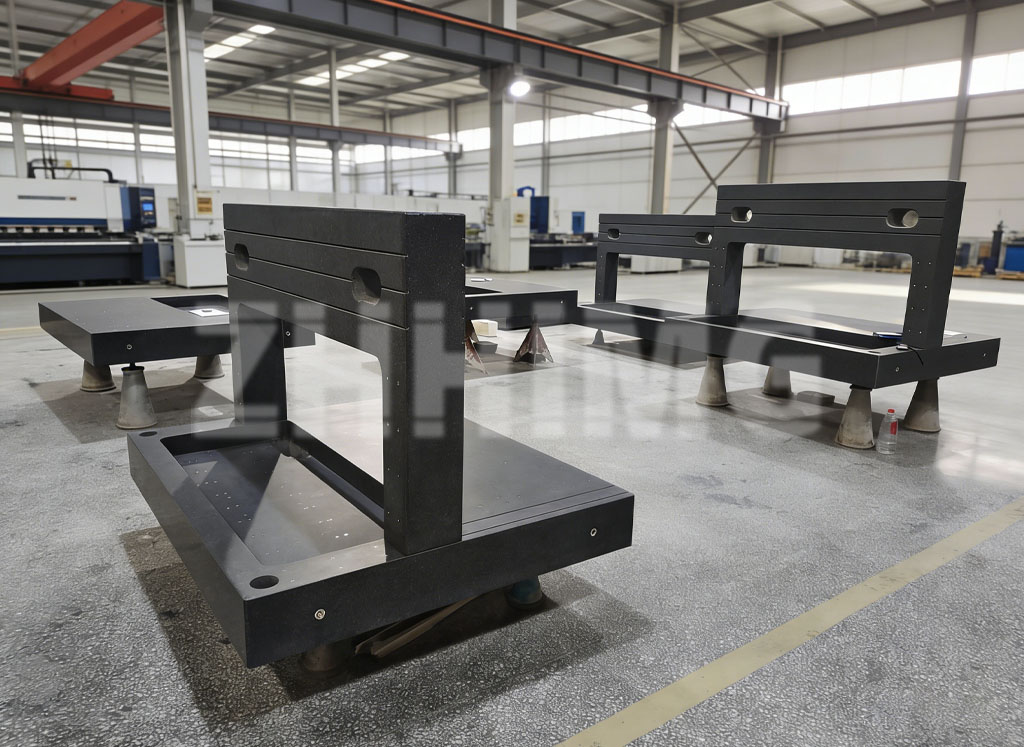
The rise of Granite for CNC Machines – Rigid & Durable Base is not merely an aesthetic choice; it is a calculated response to the demands of modern manufacturing. In an era where “near enough” is no longer acceptable, the foundation upon which a machine is built determines the ultimate precision of its output. For ZHHIMG’s partners in Europe and North America, utilizing granite is the most effective way to eliminate the thermal and mechanical variables that plague traditional metallic structures.
The Physics of Rigidity in Modern CNC Applications
The primary enemy of CNC accuracy is thermal drift. Metal, by its very nature, is highly conductive and possesses a significant coefficient of thermal expansion. As a machine operates, the heat generated by the spindle and motors causes the frame to expand and contract, leading to dimensional errors that are difficult to compensate for through software alone. Natural granite, however, possesses an incredibly low thermal expansion rate and high thermal mass.
When an OEM chooses a Granite for CNC Machines – Rigid & Durable Base, they are investing in a machine bed that remains dimensionally static throughout an entire production shift. This thermal inertia is particularly critical for high-speed milling and aerospace component manufacturing, where parts may take hours to complete. A granite base ensures that the first cut is as accurate as the last, providing a level of reliability that simply cannot be matched by steel weldments or cast iron.
The Evolution of Granite for Robots as a Stable Mounting Platform
As automation moves beyond the heavy lifting of the automotive assembly line and into the delicate realms of semiconductor handling and medical device assembly, the mounting surface for the robot has become a critical component. A Granite for Robots – Stable Mounting Platform provides the necessary mass and vibration damping to handle the high accelerations of modern delta robots and collaborative robots (cobots).
Vibration is the silent killer of robotic repeatability. Every time a robot arm stops suddenly or changes direction, it generates kinetic energy that can cause “ringing” or micro-oscillations in the base. Because granite has a damping ratio significantly higher than that of metallic alloys, these vibrations are absorbed almost instantaneously. This allows the robot to settle faster at its target coordinates, directly increasing the throughput of the production line. For Automated Optical Inspection (AOI) systems, where any camera movement can lead to a false failure, the stability of a granite platform is the difference between a productive day and a logistical nightmare.
Industry Insights: Why Material Science is Leading the Precision Revolution
The global manufacturing sector is currently witnessing a trend toward “micro-factories” and ultra-precision machining centers. In these environments, the structural integrity of the machine bed is scrutinized as much as the control software. ZHHIMG has observed that leading manufacturers are no longer looking for a simple vendor; they are looking for a material science partner who can integrate precision-lapped surfaces, air-bearing guide rails, and specialized inserts into a single, cohesive granite component.
Furthermore, the non-magnetic and corrosion-resistant properties of granite provide a cleanroom-ready solution that is essential for the semiconductor and pharmaceutical industries. Unlike cast iron, which requires constant oiling or painting to prevent oxidation, a granite base is naturally inert. This makes it the ideal candidate for vacuum environments and sterile laboratories, where chemical outgassing or rust particles could compromise a multi-million-dollar production run.
Custom Engineering for a Global Market
At ZHHIMG, we understand that a “one size fits all” approach does not work for the elite levels of the machine tool industry. Whether it is a massive foundation for a five-axis gantry mill or a compact, highly customized platform for a pick-and-place robot, our engineering team works with global clients to ensure that every base meets the specific dynamic requirements of the application.
By combining the natural benefits of Jinan Black Granite with state-of-the-art CNC stone machining and laser interferometer verification, we provide a foundation that is as sophisticated as the technology it supports. Our commitment to global standards and NIST-traceable calibration ensures that a ZHHIMG base delivered to Germany, the USA, or Japan meets the same exacting tolerances every single time.
The Bedrock of Future Innovation
As we look toward the future of manufacturing, where nanotechnology and quantum computing will demand even greater levels of isolation from the physical world, the role of granite will only expand. The stability of the ground we build on is the silent guarantor of our technological progress. By providing a Granite for CNC Machines – Rigid & Durable Base and specialized Granite for Robots – Stable Mounting Platforms, ZHHIMG is not just selling industrial components; we are providing the physical certainty required for the next generation of human innovation.
Precision is a journey, and that journey begins with the most stable material on earth. We invite our global partners to build their future on our foundation—a foundation that is as enduring as it is accurate.
Post time: Feb-28-2026