
As industries push toward the limits of the nanometer scale, engineers are increasingly looking past traditional cast iron and steel in favor of a material that has spent millions of years stabilizing under the earth’s crust. For high-end applications like Coordinate Measuring Machines (CMM) and PCB assembly, the choice of base material isn’t just a design preference—it is the fundamental limit of the machine’s potential accuracy.
The Bedrock of Precision: Granite Base for Gantry CMM
When we consider the mechanical requirements of a Gantry CMM, we are looking for a rare combination of mass, thermal stability, and vibration damping. A Granite Base for Gantry CMM serves as more than just a heavy table; it acts as a thermal heat sink and a vibration filter. Unlike metals, which expand and contract significantly with even minor fluctuations in room temperature, granite possesses an incredibly low coefficient of thermal expansion. This means that as the gantry moves across the workspace, the “map” of the machine remains constant.
In the world of metrology, “noise” is the enemy. This noise can come from floor vibrations in a factory or the mechanical resonance of the machine’s own motors. Granite’s natural internal structure is far superior to steel at absorbing these high-frequency vibrations. When a Gantry CMM utilizes a thick, hand-lapped granite base, the uncertainty of measurement drops significantly. This is why the world’s leading metrology labs don’t just prefer granite; they require it. The stone provides a level of flatness and parallelism that is nearly impossible to achieve and maintain with fabricated metal structures over long periods.
Engineering Fluidity: Granite Base Linear Motion
Beyond static stability, the interface between the base and the moving parts is where the real magic happens. This is where granite base linear motion systems redefine what is possible in high-speed positioning. In many high-precision setups, air bearings are used to float the moving components on a thin film of compressed air. For an air bearing to function correctly, the surface it travels on must be perfectly flat and non-porous.
Granite can be lapped to tolerances that are measured in light bands. Because granite is non-magnetic and non-conductive, it does not interfere with the sensitive linear motors or encoders used in modern motion control. When you integrate linear motion directly onto a granite surface, you eliminate the mechanical “stack-up” errors that occur when you bolt metal rails onto a metal frame. The result is a motion path that is exceptionally straight and smooth, allowing for sub-micron positioning that remains repeatable over millions of cycles.
The Physics of Performance: Granite Components for Dynamic Motion
As we move toward faster production cycles, the industry is seeing a shift in how we view granite components for dynamic motion. Historically, granite was seen as a “static” material—heavy and immovable. However, modern engineering has flipped this script. By using granite for the moving bridges (gantries) as well as the bases, manufacturers can ensure that every part of the machine reacts to temperature changes at the same rate. This “homogeneous” design philosophy prevents the warping that occurs when a steel gantry is bolted to a granite base.
Furthermore, the stiffness-to-weight ratio of high-quality black granite allows for high-acceleration moves without the “ringing” or oscillation found in hollow steel weldments. When a machine head stops abruptly after a high-speed traverse, the granite components help settle the system almost instantly. This reduction in settling time translates directly into higher throughput for the end user. Whether it is laser processing, optical inspection, or micro-machining, the dynamic integrity of the stone ensures that the tool point goes exactly where the software commands, every single time.
Meeting the Demands of the Digital Age: Granite Components for PCB Equipment
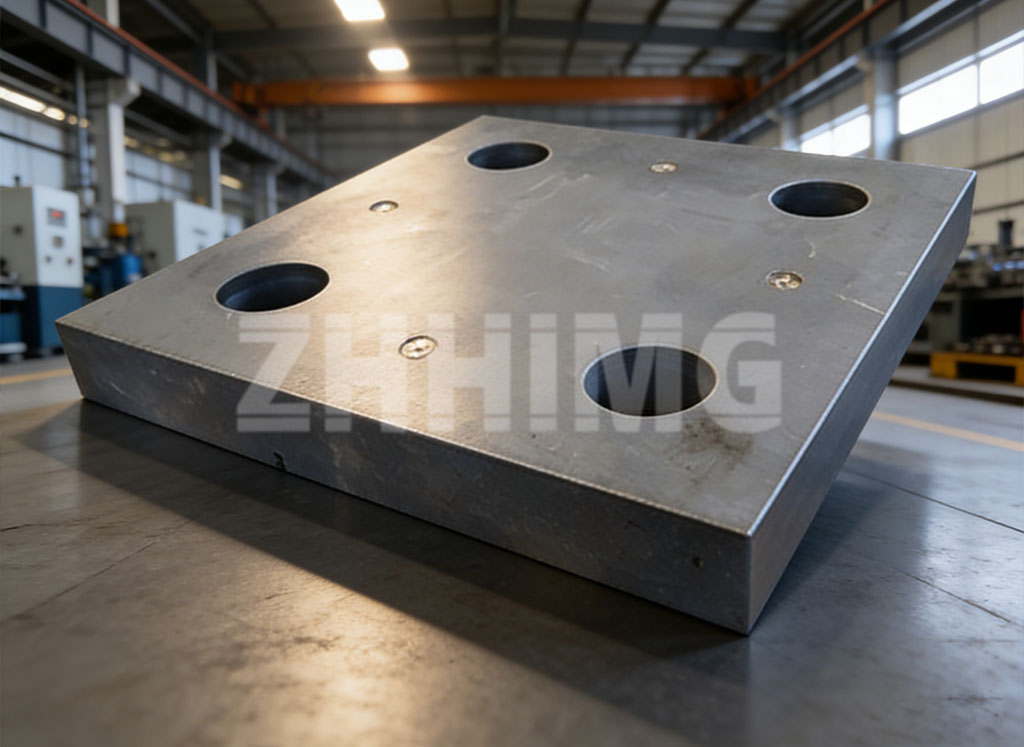
The electronics industry is perhaps the most demanding arena for precision stone. As PCBs become denser and components like 01005 surface-mount devices become standard, the equipment used to build and inspect these boards must be flawless. Granite components for PCB equipment provide the essential stability for high-speed pick-and-place machines and automated optical inspection (AOI) systems.
In PCB manufacturing, the machine is often running 24/7 at extreme accelerations. Any physical shift in the machine’s frame due to stress relaxation or thermal drift would result in misaligned components or false failures during inspection. By utilizing granite for the core structural elements, equipment manufacturers can guarantee that their machines will maintain factory-spec accuracy for decades, not just months. It is the silent partner in the production of the smartphones, medical devices, and automotive sensors that define our modern life.
Why the World’s Leading Labs Choose ZHHIMG
At ZHHIMG, we understand that we aren’t just selling stone; we are selling the foundation of your technological breakthrough. Our process begins with the careful selection of raw materials from deep-vein quarries, ensuring the highest density and lowest porosity. But the true value lies in our craftsmanship. Our technicians utilize a combination of advanced CNC machining and the ancient, irreplaceable art of hand-lapping to achieve surface geometries that sensors can barely measure.
We specialize in complex geometries, from massive bases with integrated T-slots to lightweight, hollowed-out granite beams designed for high-speed gantries. By controlling the entire process from raw block to the final calibrated component, we ensure that every piece leaving our facility is a masterpiece of industrial engineering. We don’t just meet industry standards; we set the benchmark for what “precision” actually means in the 21st century.
When you choose to build your system on a ZHHIMG foundation, you are investing in a legacy of stability. You are ensuring that your CMM, your PCB assembly line, or your linear motion stage is decoupled from the chaos of the environment and anchored in the unwavering reliability of Earth’s most stable material. In an era of rapid change, there is immense value in the things that do not move.
Post time: Jan-09-2026