
In the rapidly evolving landscape of global energy transition, the precision required in laboratory measurement has shifted from microns to nanometers. As solid-state battery technology and high-power semiconductors push the boundaries of energy density, the physical testing environment must meet unprecedented standards of stability. Laboratory managers today face a recurring technical paradox: how to guarantee absolute electrostatic safety while maintaining dimensional integrity under rigorous high-frequency thermal cycling?
Traditional laboratory benches often excel in a single physical dimension but fail when confronted with multi-variable stress. Conventional metal bases are notoriously sensitive to thermal expansion, while standard natural granite, despite its superior damping properties, lacks the necessary conductivity for controlled charge dissipation. Addressing this critical gap in material science, ZHHIMG Group has engineered a specialized anti-static granite surface for battery lab applications, designed to harmonize structural rigidity with electrical safety.
This ESD-safe granite is not merely a surface coating that could flake or degrade over time. Instead, it utilizes a proprietary structural impregnation process that maintains the stone’s near-zero coefficient of thermal expansion while providing a controlled path of least resistance for electrical charges. During the research and development of lithium-ion or solid-state cells, even a minor electrostatic discharge (ESD) can compromise sensitive electronic sensors or lead to data drift in high-impedance circuits. By utilizing a ZHHIMG anti-static surface, laboratories ensure that static charges are uniformly and safely neutralized, providing an electro-neutrally grounded base for the most delicate battery testing units.
However, electrostatic control is only one half of the modern metrology puzzle. As charge-discharge simulations increase in power density, the resulting heat accumulation becomes the primary enemy of measurement repeatability. External cooling methods—such as ambient fans or external heat sinks—often create non-uniform temperature gradients, leading to micro-deformations in the support structure. To solve this, ZHHIMG has pioneered the granite base with cooling channels for thermal test protocols.
The sophistication of this technology lies in the integration of complex fluid circulation systems directly within the monolithic granite structure. Utilizing precision deep-hole drilling and corrosion-resistant sealing, cooling media circulate through the heart of the base, actively absorbing and dissipating heat generated during the testing process. This transformation shifts the granite from a passive support to an active thermal management system. In dynamic thermal stress tests, this internal regulation maintains surface temperature fluctuations within a negligible range, ensuring that the physical dimensions of the platform remain constant and the resulting data remains untainted by structural warping.
The adoption of integrated cooling channels reflects a deep understanding of the synergy between material mechanics and thermodynamics. In the high-stakes European and American aerospace and automotive sectors, researchers increasingly recognize that solving thermal interference at the foundational level is the only way to achieve long-term observational consistency.
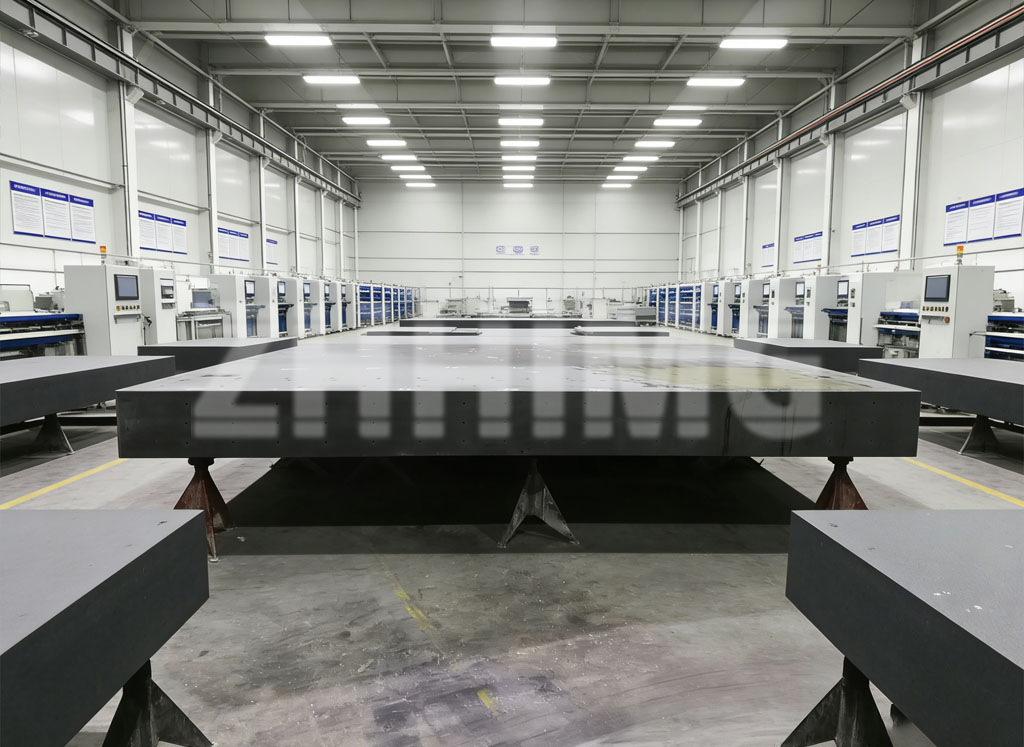
Looking at global industry trends, the future of precision laboratories lies in the convergence of “smart” materials and multifunctional integration. ZHHIMG does not merely supply high-quality stone; we provide comprehensive physical environment control solutions. In the field of large-scale energy storage system (ESS) testing, where load capacity and long-term creep resistance are paramount, the natural properties of granite—having undergone stress relief over millions of years—offer a level of temporal stability that synthetic alternatives cannot match.
By combining anti-static properties with internal thermal control circuits, ZHHIMG has successfully fused the inherent advantages of natural minerals with cutting-edge precision engineering. This does more than increase laboratory efficiency; it provides a trusted physical datum for the world’s leading scientific institutions. When researchers push the limits of energy density, they should not have to account for micron-level shifts in their baseplates or unexpected electromagnetic interference.
As the demand for testing quantum computing hardware and autonomous driving sensors accelerates, the need for high-performance platforms like the anti-static granite surface for battery lab will only intensify. ZHHIMG remains at the forefront of material science, exploring complex geometric designs and cross-disciplinary material modifications to deliver solutions that exceed global expectations. In the pursuit of scientific truth, every micron of stability counts.
Whether your facility requires specific vibration damping frequencies or resistance to specialized chemical environments, the ZHHIMG engineering team provides deep-tier technical consultation. Integrating this level of specialized hardware into your laboratory ensures that your research findings are backed by the most stable physical foundation available in modern engineering.
Post time: Mar-05-2026