
In the rapidly evolving landscape of high-precision manufacturing, the margin for error has shifted from millimeters to microns. As industries such as aerospace, semiconductor fabrication, and medical device manufacturing push the boundaries of miniaturization, the physical foundation upon which measurements are taken becomes the most critical link in the quality control chain. This raises a fundamental question for engineers and lab managers: why does natural granite remain the preferred material over advanced alloys or synthetic composites for metrology and inspection?
At ZHHIMG, we have observed a consistent trend among our European and American partners who prioritize dimensional stability above all else. The answer lies in the unique physical properties of black granite, specifically when sourced and processed with the rigor required for industrial applications.
The Physical Advantage of Geological Stability
The primary challenge in any metrology lab is environmental interference. Temperature fluctuations, however slight, can cause materials to expand or contract, rendering high-precision measurements useless. Precision granite components offer an incredibly low coefficient of thermal expansion. Unlike cast iron or steel, which react significantly to the warmth of a technician’s hand or the cycling of an HVAC system, granite maintains its structural integrity. This ensures that a Granite Table for Metrology remains flat and true throughout the workday.
Furthermore, the natural vibration damping qualities of granite are unmatched. In an inspection lab environment, internal or external vibrations—from nearby machinery or even foot traffic—can introduce noise into sensitive electronic sensors. Granite’s dense, non-porous structure absorbs these micro-vibrations, providing a “silent” platform that is essential for the high-speed scanning and probing found in modern Coordinate Measuring Machines.
Customization as a Necessity for Global Innovation
One size rarely fits all in the world of high-end engineering. While standard surface plates are the workhorses of many workshops, the demand for Precision Granite Components with custom sizes has surged. Modern metrology requires more than just a flat surface; it requires integrated solutions.
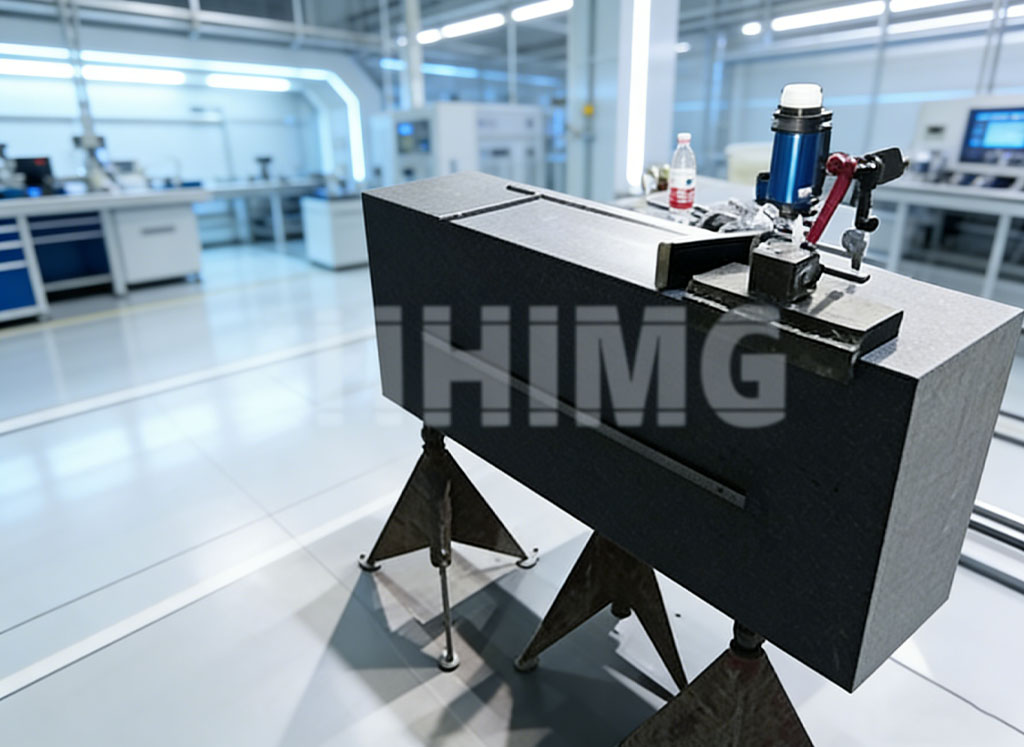
ZHHIMG specializes in engineering complex granite structures that serve as the literal backbone of specialized inspection machines. This includes the integration of threaded inserts, T-slots, and precision-lapped air bearing surfaces. For instance, in the semiconductor industry, where lithography and inspection tools must operate with nanometer precision, the granite base is not just a table—it is a sophisticated component engineered with internal galleries for cabling and vacuum systems. Our ability to provide custom-sized granite components ensures that designers are not limited by material constraints but are instead empowered to build more efficient and accurate systems.
The Superiority of Black Jinan Granite in Metrology
Not all granite is created equal. The performance of a metrology base depends heavily on the mineral composition of the stone. ZHHIMG utilizes Black Jinan Granite, renowned for its high density and uniform texture. Unlike lighter-colored granites, which may contain higher concentrations of quartz that can lead to “hot spots” or uneven wear, Black Jinan provides a consistent hardness that resists scratching and burring.
When a metal surface plate is scratched, the displaced material creates a “burr” that rises above the surface, immediately compromising the accuracy of any part placed upon it. In contrast, when granite is scratched, it simply loses a small amount of material without creating a raised edge. This “fail-safe” property preserves the flatness of the table and protects the expensive instruments being used.
Global Standards and Quality Assurance
For our clients in North America and Europe, compliance with international standards such as ISO 8512-2 or DIN 876 is non-negotiable. ZHHIMG’s manufacturing process integrates advanced lapping techniques where skilled technicians hand-finish surfaces to Grade 00 or even higher specifications. This manual precision, combined with laser interferometer verification, ensures that every piece leaving our facility meets the rigorous demands of global metrology labs.
The longevity of granite is another factor driving its dominance. When properly maintained, a precision granite component can last for decades. Its resistance to corrosion and rust—issues that plague cast iron in humid environments—means that the total cost of ownership is significantly lower. There is no need for oiling or chemical rust-prevention, which also makes granite a cleaner choice for the pristine environments of cleanrooms and laboratories.
The Future of Precision Bases
As we look toward the future, the integration of granite with carbon fiber or precision ceramics is an area of active exploration. However, the core of the assembly remains the granite base due to its reliability. Whether it is a standard inspection table or a massive, multi-ton custom base for a 3D measuring system, the stability provided by natural stone is the bedrock of modern industrial quality.
ZHHIMG remains committed to supporting the global metrology community by providing the most stable, accurately finished granite products available. By combining traditional stone-working expertise with modern CNC machining and laser measurement technology, we ensure that your inspection lab is equipped to handle the challenges of tomorrow’s manufacturing.
Post time: Feb-14-2026