
In the high-stakes world of precision manufacturing, the sound of progress is often complete silence. For decades, the clatter and hum of heavy machinery were accepted as the inevitable byproduct of industrial power. However, as we push further into the era of high-speed machining and nanometer-scale accuracy, that very vibration has become the enemy. Engineers today face a fundamental challenge: traditional metallic structures, despite their strength, act as resonators for mechanical noise and thermal instability. This realization is driving a quiet revolution across Europe and North America, leading many to ask why mineral casting mechanical components are rapidly becoming the bedrock of the world’s most advanced factories.
At ZHHIMG (ZhongHui Intelligent Manufacturing), we have spent years at the forefront of this material evolution. We have seen firsthand how the shift toward polymer concrete for CNC applications has allowed machine builders to achieve surface finishes and tool lives that were previously thought impossible. It is not just about a different way of building a machine; it is about redefining the physical limits of what a machine can do by choosing a foundation that is fundamentally superior to metal.
The Physics of Stillness: Why Damping Matters
To understand the surge in demand for mineral casting machine parts, one must look at the internal physics of the material. Traditional cast iron has a molecular structure that allows kinetic energy to travel through it like a wave. When a CNC spindle rotates at 30,000 RPM, it generates microscopic vibrations. In a metal base, these vibrations resonate, leading to “tool chatter.” This chatter is the primary culprit behind poor surface quality and premature tool wear.
Mineral casting mechanical components, by contrast, possess a damping ratio that is nearly ten times higher than that of cast iron. The composite structure—often referred to as epoxy granite for CNC—consists of high-purity granite aggregates bonded together by a specialized resin system. Because the material is non-homogeneous, the energy waves are scattered and absorbed almost instantly. When a machine operates on a mineral casting base, the cutting environment remains eerily still. This stillness translates directly into a higher “Q-factor” for the machine, allowing for more aggressive cutting parameters without sacrificing the integrity of the finished part.
Thermal Inertia: The Secret to Long-Term Accuracy
Beyond vibration, the greatest threat to precision is the thermometer. In a typical machine shop, temperatures fluctuate throughout the day as the sun moves across the roof or as other machines cycle on and off. Metals react to these changes almost impulsively; they expand and contract with a high degree of thermal conductivity. A CNC machine with a steel frame will physically grow and shrink, causing the “zero point” to drift over the course of a production shift.
Choosing polymer concrete for CNC structures offers a level of thermal stability that metals simply cannot match. Mineral casting has a very low coefficient of thermal expansion and, more importantly, high thermal inertia. It is a poor conductor of heat, meaning it reacts very slowly to environmental changes. For aerospace and medical manufacturers who must hold tolerances across long machining cycles, this thermal “laziness” is a priceless asset. It ensures that the first part made at 8:00 AM is identical to the last part made at 5:00 PM.
Design Freedom and the Integration of Intelligence
One of the most exciting aspects of working with epoxy granite for CNC is the freedom it offers to designers. Unlike traditional metal beds that must be cast and then extensively machined, mineral casting machine parts are produced in high-precision molds. This process allows for a level of structural complexity that is cost-prohibitive in metal.
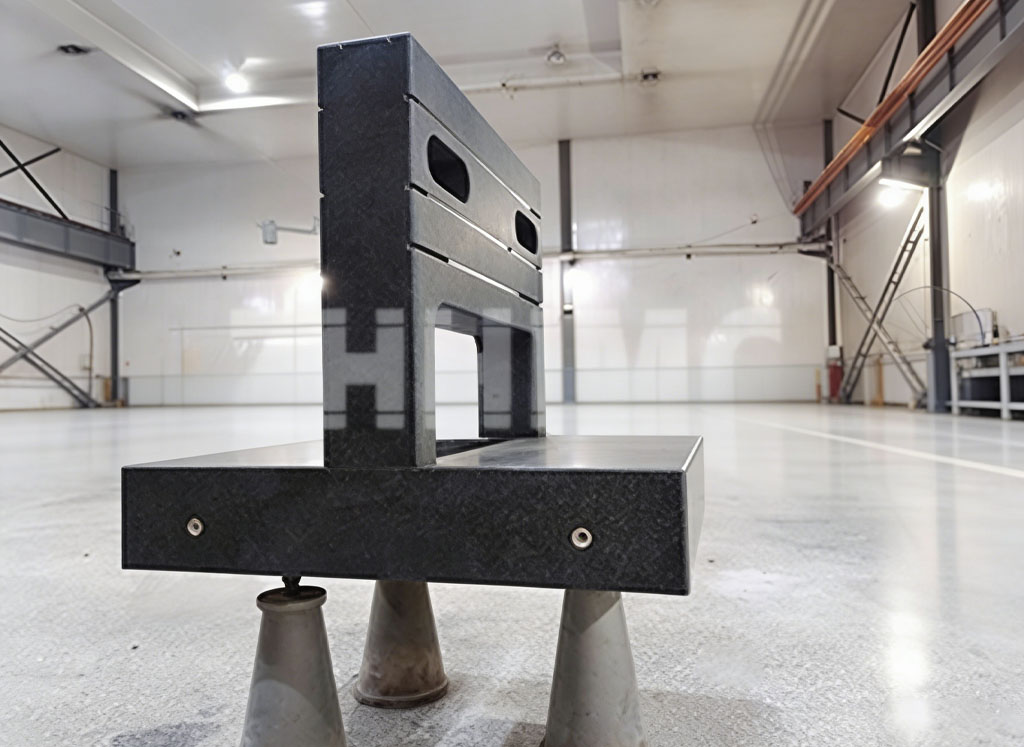
We can cast cooling pipes, cable conduits, threaded inserts, and even hydraulic reservoirs directly into the monolithic structure of the machine base. This integrated approach reduces the total part count of the machine, which in turn reduces the number of interfaces where vibration could potentially occur. At ZHHIMG, we leverage our massive production capacity—capable of pouring components up to 100 tons—to help our clients build machines that are not only more accurate but also more streamlined and easier to assemble.
Environmental Stewardship in Modern Manufacturing
As global standards for sustainability become more rigorous, the environmental impact of machine production has come under scrutiny. Producing cast iron is an energy-intensive process involving massive blast furnaces and significant carbon emissions. Mineral casting mechanical components, however, are produced using a “cold” casting process. The energy required to mix and cure the composite is a fraction of what is needed for smelting metal.
Furthermore, the longevity of epoxy granite for CNC means that the machines built on these bases stay in service longer. The material does not rust, it is resistant to modern synthetic coolants, and it does not degrade over time. By choosing polymer concrete for CNC, manufacturers are making a long-term investment in both their production quality and their environmental footprint—a factor that is increasingly important to the European and American markets.
Why ZHHIMG is the Trusted Partner for Global Leaders
ZHHIMG has emerged as one of the world’s leading authorities in non-metallic ultra-precision manufacturing because we combine raw industrial scale with the delicacy of metrology. We understand that a machine base is not just a heavy object; it is a calibrated engineering tool. Our facilities in Shandong Province are among the most advanced in the world, allowing us to maintain sub-micron tolerances over massive spans.
When you invest in mineral casting machine parts from ZHHIMG, you are benefiting from a deep understanding of material science. We don’t just pour a mixture into a mold; we optimize the aggregate grading and resin chemistry for each specific application. Whether you are building a high-speed milling center, a semiconductor inspection tool, or a large-scale laser cutter, our team works as a partner to ensure that your foundation is optimized for your specific dynamic loads.
The Future of Precision is Cast in Stone
The trajectory of the manufacturing industry is clear: we are moving toward a future where “precision” is defined by the absence of interference. As tools become faster and sensors become more sensitive, the old ways of building machine frames are reaching their physical limits. Mineral casting mechanical components offer the path forward. They provide the damping, the thermal stability, and the design flexibility that the next generation of industrial innovation requires.
At ZHHIMG, we invite you to explore the possibilities of this remarkable material at www.zhhimg.com. In an industry that is always moving, we provide the silence and stability you need to succeed. The question is no longer whether you can afford to switch to mineral casting—it is whether you can afford the cost of remaining with the vibrations of the past.
Post time: Dec-24-2025