
In the realm of precision manufacturing, the integrity and accuracy of measurement tools are crucial to ensuring the quality of the final product. Granite platforms, often used as the foundation for coordinate measuring machines (CMMs), inspection tools, and various machining setups, must maintain their precision under various load conditions. The load-bearing capacity of these platforms is not a one-size-fits-all specification, as platforms are designed to meet specific requirements based on the weight they are expected to bear. From lightweight models to heavy-duty solutions, understanding the design differences in granite platforms is key to ensuring they perform optimally in different industrial applications.
Granite platforms are essential for providing a stable reference surface, and their load-bearing capacity is critical in maintaining flatness and minimizing deformation during use. These platforms must be designed and constructed with materials, structures, and processing techniques that align with their intended applications. Whether the platform is supporting light-weight components or heavy machinery, it’s crucial to select the right design to ensure long-term accuracy.
For lightweight granite platforms, typically those under 500 kg, the design revolves around a balance of high precision and lightweight construction. These platforms are primarily used in environments where high accuracy is required, but the weight of the platform needs to be minimized. Materials like fine-grain black mica granite, with a quartz content of 30% or more, are commonly used. This material offers an optimal density range of 2.6–2.7g/cm², ensuring rigidity while reducing weight. The platform’s thickness typically ranges between 50 and 80 mm for a 1m × 1m model, and the design incorporates a hollow ribbed structure on the underside. With ribs spaced 200–300mm apart and having a width of 30mm and a height of 40mm, this design provides an ideal balance between strength and weight reduction, making it 30% lighter than solid structures. Additionally, the platform’s inherent resonance frequency is above 50Hz, which helps avoid interference from vibrations.
The design precision for these platforms is also key. The flatness of the working surface is typically controlled to less than 0.005mm/100mm, ensuring minimal deformation even under moderate loads. Lightweight granite platforms are commonly used for optical instrument assembly, small tool calibration, and similar applications where contact with the platform accounts for more than 60% of the total bearing area, preventing excessive pressure at localized points.
Medium-duty platforms, ranging from 500 kg to 5000 kg, are designed with a different set of priorities. While maintaining a high level of precision, these platforms must accommodate larger loads. For these platforms, medium-grain granite is preferred, typically with a feldspar content of 40%–50%. The density is increased to 2.7–2.8g/cm³, and the platform’s thickness is raised to 100–150mm for a 1m × 2m model. The underside features a grid-reinforced structure, where main ribs are 50mm wide, and cross ribs are 30mm wide, forming a 100×100mm grid. The stress points are rounded at the corners to reduce concentration. This grid structure ensures the platform maintains its strength and minimizes bending.
For added precision, these platforms often feature T-slots (12–16mm wide) for fixture installation, with slot spacing ranging from 100mm to 150mm. The slots are positioned to prevent weakening the platform’s strength, with a minimum distance of 30mm from the underside. During installation, adjustable supports are used to distribute the load evenly, with four support points per square meter, ensuring that load deviations remain within 5%. These platforms are typically used in coordinate measuring machines, medium-scale mold inspection, and similar applications, where the maximum allowable deflection is ≤ L/10000 (L being the length of the platform).
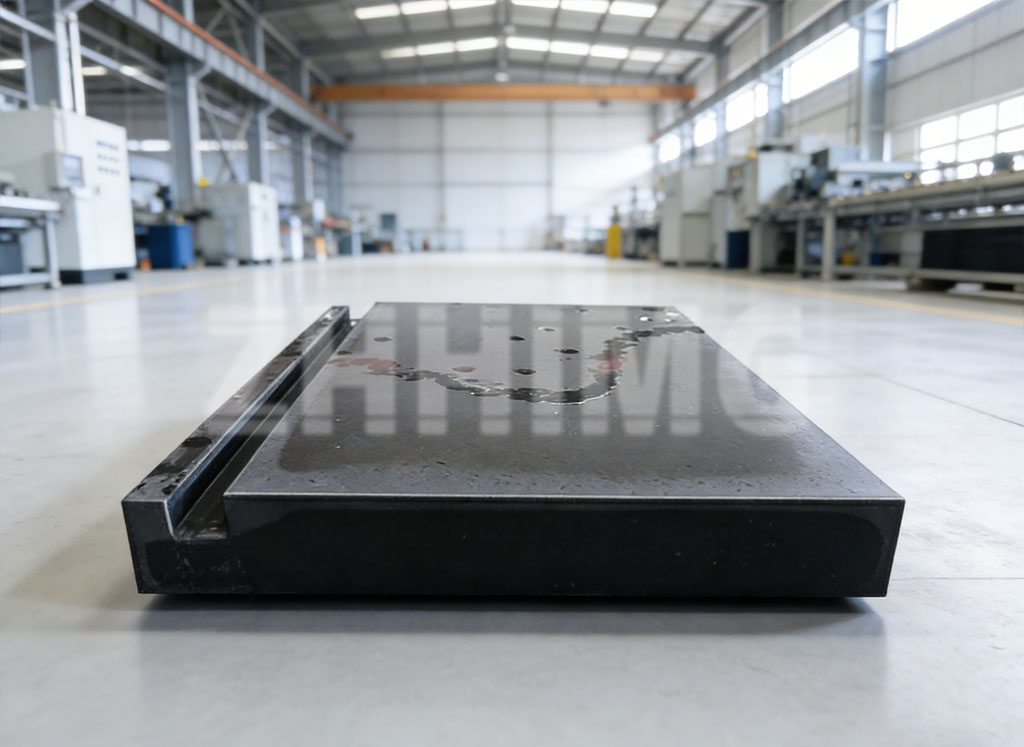
Heavy-duty platforms, designed for loads exceeding 5000 kg, are built to resist deformation under massive weights. These platforms are made from coarse-grain granite, with quartz crystals greater than 2mm, and have a density exceeding 2.8g/cm³. The compressive strength of this material is typically over 200 MPa, and the thickness of these platforms ranges from 200 to 300mm for a 2m × 3m model. The structure is solid, with a thickened base (50mm thick) that connects to the main platform through an egg-shaped base with an epoxy resin bonding (with shear strength ≥ 15 MPa).
For heavy-duty platforms, installation requires specific ground preparation. The concrete foundation should be at least 300mm thick, with embedded steel plates made from Q235 material. Between the foundation and the platform, a 3mm thick chloroprene rubber layer is used to ensure uniform stress distribution. The foundation must have a load-bearing capacity of at least 0.3 MPa. These platforms are used in applications such as heavy machine tool inspection and large casting layout, where long-term creep deformation should remain below 0.002mm per year.
The testing standards for different load-bearing granite platforms also vary significantly. Lightweight platforms undergo vibration tests (10-500Hz sweep frequency, amplitude 0.1mm) to ensure no resonance occurs. Medium-duty platforms are subjected to a static load test of 1.2 times their rated capacity, with deformation not exceeding 0.001mm after 24 hours of load application and removal. Heavy-duty platforms are tested for fatigue resistance, with 1000 load-unload cycles at 80% of their rated load to ensure no cracks appear, verified through penetrant flaw detection.
When choosing the right granite platform, it’s essential to match the design to the specific requirements of the application. For industries requiring high precision and heavy load capacities, selecting the correct platform design ensures long-term performance and reliability. ZHHIMG understands the importance of custom solutions tailored to meet the unique needs of each client, offering a range of granite platforms that provide superior precision, stability, and durability under various loading conditions.
At ZHHIMG, we provide a wide array of granite platforms, engineered to meet the needs of industries ranging from precision machining to heavy-duty inspections. Our platforms are designed with the highest quality standards to ensure exceptional performance, offering both precision and reliability, no matter the load-bearing requirements. Our commitment to innovation and quality allows us to deliver solutions that stand the test of time, offering you the ideal foundation for your precision manufacturing needs.
Post time: Dec-22-2025