
In the realm of ultra-precision manufacturing, the difference between a successful batch and a costly rejection often comes down to a few microns. As industries like semiconductor lithography, aerospace engineering, and electric vehicle (EV) powertrain production push the boundaries of tolerance, the stability of the measurement environment has become as critical as the sensors themselves.
At ZHHIMG, we understand that a Coordinate Measuring Machine (CMM) or an Optical Comparator is only as reliable as the foundation it stands upon. This article explores the evolving landscape of metrology infrastructure and why the choice between a granite machine base, cast iron, or advanced vibration isolation systems dictates the future of quality control.
The Evolution of Structural Stability in Metrology
Historically, cast iron machine bases were the industry standard. Their high dampening capacity and ease of machining made them ideal for the heavy industry era. However, as metrology moved from the workshop floor to the temperature-controlled laboratory, the inherent limitations of metal—specifically its thermal expansion coefficient and susceptibility to internal stress—became apparent.
The Rise of Natural Granite
Today, natural black granite has surpassed cast iron as the gold standard for precision surface plates and CMM structures. The reasons are rooted in physics:
-
Thermal Stability: Granite possesses a significantly lower coefficient of thermal expansion compared to steel or iron. In an environment where a 1°C shift can ruin a measurement, granite’s “thermal inertia” provides a crucial buffer.
-
Corrosion Resistance: Unlike metal, granite does not rust or corrode, ensuring that the reference plane remains pristine over decades of use without the need for oiling or chemical protection.
-
Internal Stress Relief: Natural granite has aged for millions of years under the earth’s crust, meaning it is naturally free from the internal stresses found in cast or welded structures.
Engineering the Ultimate Coordinate Measuring Machine (CMM) Foundation
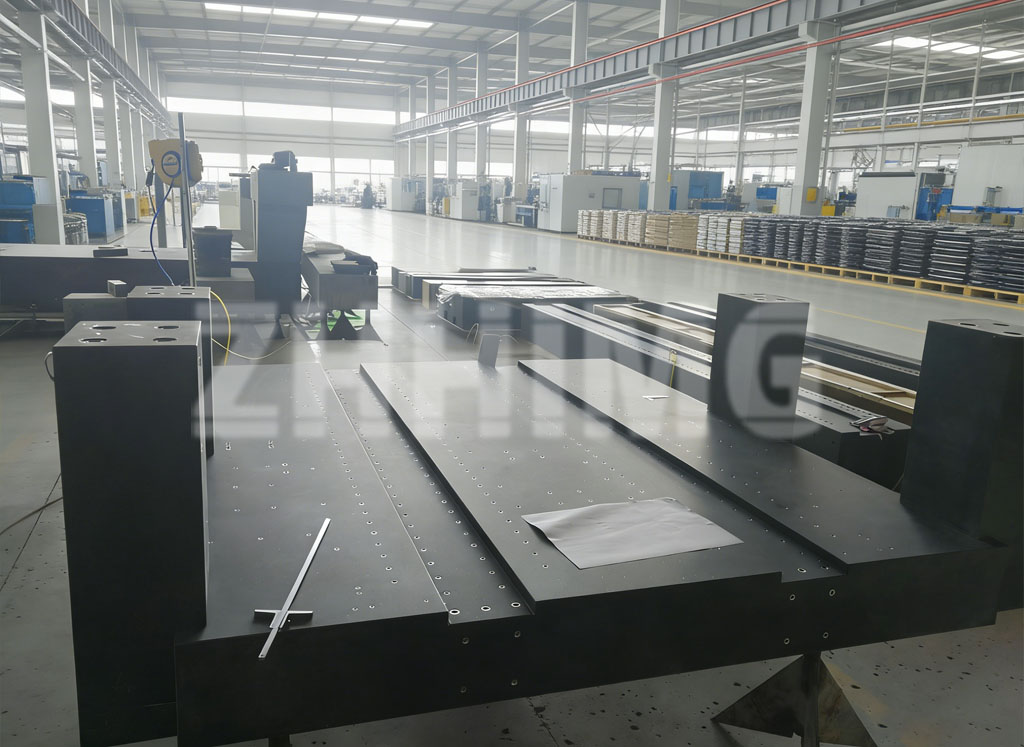
A modern Coordinate Measuring Machine requires more than just a flat surface; it requires dynamic rigidity. When a CMM bridge moves at high speeds, it generates inertial forces. If the granite machine base is not engineered with the correct mass-to-stiffness ratio, these forces translate into microscopic vibrations that degrade the “uncertainty” rating of the machine.
At ZHHIMG, our engineering team focuses on the integration of the base with the mechanical guideways. By utilizing precision-lapped granite components, we ensure that the air bearings of a CMM glide over a surface with a flatness measured in light bands.
Beyond Granite: The Case for Vibration Isolation Tables
Even the most stable granite base cannot protect against external environmental factors. For facilities located near heavy rail, highways, or heavy stamping presses, ground-borne vibration is a silent killer of accuracy.
A vibration isolation table acts as a low-pass filter for the equipment. By incorporating pneumatic or active electronic damping, these tables decouple the metrology equipment from the building’s floor. For nanotechnology and optical inspection, where measurements occur at the nanometer scale, this isolation is not an “optional upgrade”—it is a fundamental requirement.
Comparing Materials: Granite, Cast Iron, and Mineral Casting
For procurement officers and lead engineers, choosing the right material involves balancing performance with cost and weight.
| Property | Natural Granite | Cast Iron (GC25/30) | Mineral Casting |
| Density | ~3000 kg/m³ | ~7200 kg/m³ | ~2400 kg/m³ |
| Thermal Expansion | 5.5 × 10^{-6}/K | 10-12 × 10^{-6}/K | 12 ×10^{-6}/K |
| Vibration Damping | High | Medium | Excellent |
| Corrosion Risk | None | High | None |
| Precision Potential | Grade 000 | Grade 0 | Grade 1 |
While granite wins on pure precision, mineral casting is gaining traction for high-volume production machine bases due to its ability to be cast into complex shapes with integrated cooling pipes and mounting inserts. However, for the master reference—the precision surface plate—natural granite remains unrivaled.
The ZHHIMG Advantage: Crafting the Future of Metrology
Why do global leaders in the semiconductor and automotive sectors choose ZHHIMG? It comes down to our holistic approach to metrology hardware. We don’t just “cut stone”; we engineer solutions.
-
Material Selection: We source only the highest quality gabbro-diabase granite, known for its high density and low water absorption.
-
State-of-the-Art Lapping: Our technicians combine traditional hand-lapping techniques with laser interferometry to achieve surface geometries that exceed DIN and ISO standards.
-
Integrated Solutions: From the cast iron machine base used in heavy-duty milling to the vibration isolation table used in white-light interferometry, ZHHIMG provides the full spectrum of structural support.
Conclusion: Investing in Long-Term Accuracy
As the manufacturing world moves toward Industry 4.0 and beyond, the demand for “Real-time Quality Assurance” is skyrocketing. Whether you are calibrating an optical comparator or installing a new multi-axis CMM, the foundation you choose today will determine your rejection rates for the next twenty years.
Precision is not an accident; it is a deliberate engineering choice. By choosing high-stability granite components and advanced isolation technologies, you are not just buying a machine base—you are securing your brand’s reputation for quality.
Post time: Jan-29-2026