
In the world of high-precision manufacturing, the difference between a high-quality finish and a rejected part often lies beneath the surface. The base of a machine tool is its skeletal system; if it lacks rigidity or fails to absorb the micro-vibrations of the cutting process, no amount of advanced software can compensate for the resulting inaccuracies.
As global manufacturing shifts toward high-speed machining and nanometer-level tolerances, the debate between traditional materials and modern composites has intensified. At ZHHIMG, we specialize in providing the structural integrity required for the next generation of industrial equipment.
The Evolution of Machine Foundations
For decades, the choice for machine beds was binary: cast iron or welded steel. However, as requirements for thermal stability and vibration attenuation have grown, a third contender—Mineral Casting (Synthetic Granite)—has emerged as the gold standard for high-end applications.
Welded steel fabrications offer high flexibility in design and no mold costs, making them popular for large, one-off machines. However, from a physics perspective, a steel structure behaves much like a tuning fork. It tends to amplify vibrations rather than dissipate them. Even with extensive heat treatment to relieve internal stresses, steel often lacks the inherent “quietness” required for high-speed grinding or ultra-precise milling.
Cast iron, particularly gray iron, has been the industry standard for over a century. Its internal graphite structure provides a natural level of vibration dampening. Yet, cast iron is highly sensitive to temperature fluctuations and requires lengthy aging processes to prevent warping over time. In a modern “just-in-time” supply chain, these delays and the energy-intensive nature of foundries are becoming significant liabilities.
The Science of Vibration Dampening
Vibration is the silent killer of productivity. In a CNC center, vibrations originate from the spindle, the motors, and the cutting action itself. The ability of a material to dissipate this kinetic energy is known as its damping capacity.
The damping ratio of Mineral Casting is approximately six to ten times higher than that of traditional cast iron. This is not merely a marginal improvement; it is a transformative leap. When a machine base can absorb energy at this magnitude, manufacturers can achieve higher feed rates and superior surface finishes because the “noise” of the machining process is silenced at the source. This leads to longer tool life and significantly reduced maintenance costs for the end-user.
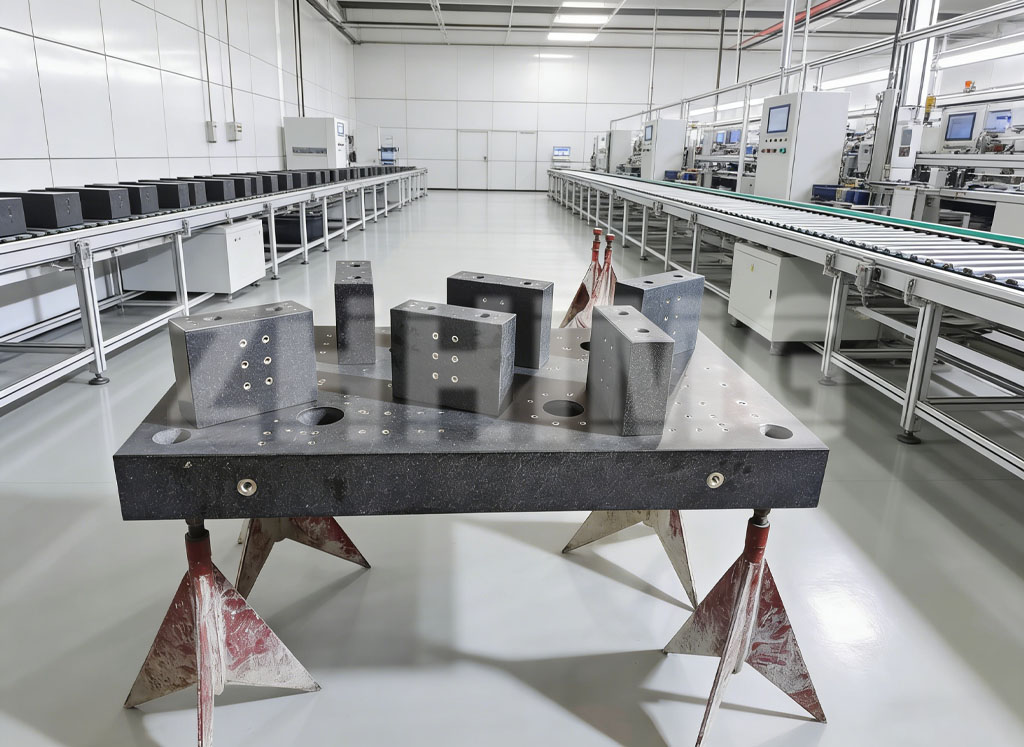
Thermal Stability and Accuracy
For engineers in the aerospace, medical, and semiconductor industries, thermal expansion is a constant challenge. Steel and iron have high thermal conductivity, meaning they react quickly to shop floor temperature changes, leading to dimensional drift.
Mineral Casting, the core of ZHHIMG’s innovation, possesses high thermal inertia and low thermal conductivity. It remains dimensionally stable even in fluctuating environments. This “thermal laziness” is why Mineral Casting is the preferred choice for Coordinate Measuring Machines (CMMs) and precision grinders where microns matter.
Integration and the Future of Manufacturing
Unlike traditional casting or welding, Mineral Casting allows for the seamless integration of secondary components. At ZHHIMG, we can embed anchor plates, cooling pipes, and electrical conduits directly into the base during the cold-casting process. This reduces the need for secondary machining and simplifies the final assembly for the machine builder.
Furthermore, the environmental impact of manufacturing has become a critical factor for European and American OEMs. Producing a cast iron base requires a blast furnace and massive energy consumption. In contrast, ZHHIMG’s Mineral Casting is a “cold” process with a significantly lower carbon footprint, aligning your brand with global sustainability goals without sacrificing performance.
A Strategic Partnership for Excellence
The transition from traditional metal bases to Mineral Casting is more than a change in material; it is a commitment to the highest standards of engineering. At ZHHIMG, we do not just supply a component; we partner with your engineering team to optimize structural geometry using Finite Element Analysis (FEA).
As the industry moves toward 2026 and beyond, the winners will be those who build their technology on the most stable foundations possible. Whether you are designing a high-speed laser cutter or a nanometer-precision lathe, the material you choose for the base will dictate the limits of what your machine can achieve.
Consult with ZHHIMG Today
Elevate your machine’s performance by leveraging the physics of Mineral Casting. Our team of experts is ready to help you transition from outdated cast iron or steel designs to a future-proof foundation.
Post time: Jan-26-2026