
In the rapidly evolving landscape of semiconductor lithography, aerospace metrology, and high-speed laser machining, the demand for sub-micron precision is no longer an outlier—it is the standard. As machine tool builders and system integrators push the boundaries of physics, the choice of structural material for the machine base and its guiding components becomes the most critical decision in the design phase. At ZHHIMG, we have dedicated decades to perfecting the application of natural granite in these high-precision environments, proving that earth’s oldest material remains the most advanced solution for tomorrow’s technology.
The Physics of Stability: Granite vs. Metallic Alternatives
For over a century, cast iron and steel were the primary materials for machine structures. However, as motion control entered the realm of nanometers, the inherent limitations of metals—specifically thermal expansion and vibration resonance—became significant bottlenecks.
Granite, specifically high-grade gabbro such as “Jinan Black,” offers a Coefficient of Thermal Expansion (CTE) that is significantly lower and more predictable than most metals. In a precision environment, even a one-degree fluctuation in temperature can cause a steel base to warp by several microns, throwing an entire optical alignment out of tolerance. Granite’s thermal inertia ensures that components remain dimensionally stable over long operational cycles, a prerequisite for Coordinated Measuring Machines (CMM) and wafer inspection tools.
Furthermore, the vibration damping properties of granite are unparalleled. The crystalline structure of natural granite acts as a natural sponge for high-frequency vibrations. When compared to cast iron, granite exhibits a damping ratio nearly ten times higher, allowing for faster settling times in high-speed pick-and-place operations and ensuring that micro-vibrations from motors do not translate into surface defects during laser etching.
Precision Engineering: From Quarry to Sub-Micron Tolerance
At ZHHIMG, our manufacturing process treats granite not as a stone, but as a high-performance ceramic. The journey of a precision component begins with rigorous raw material selection. Only stones with optimal density, low water absorption, and minimal internal stress are selected for our metrology-grade products.
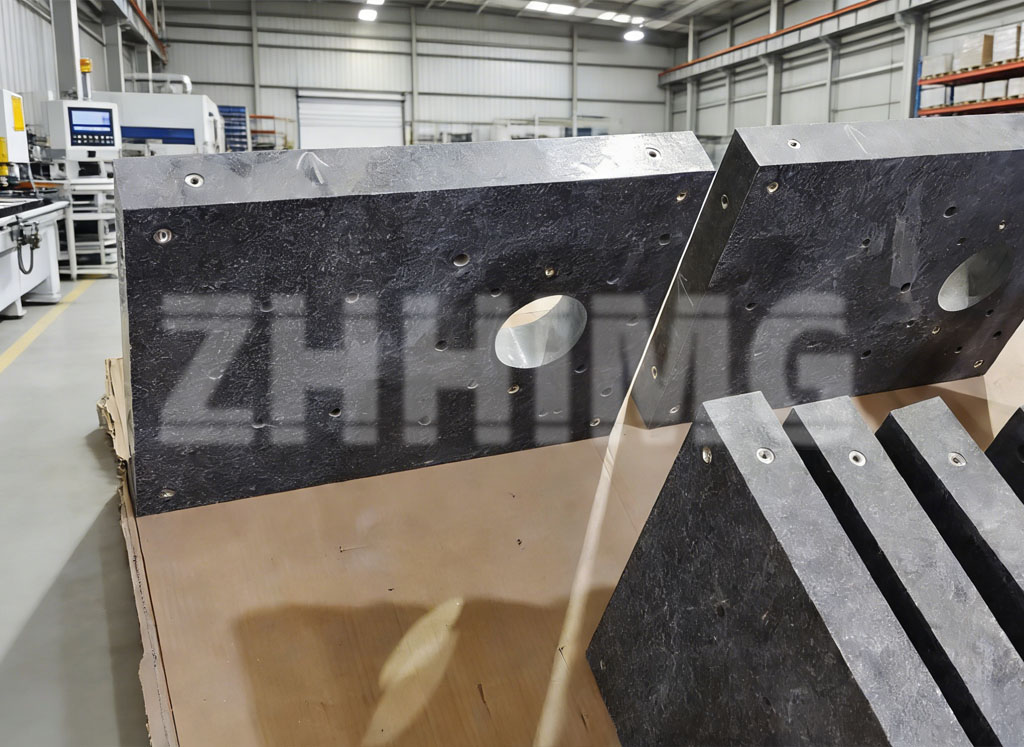
Our fabrication facilities utilize state-of-the-art CNC machining centers capable of handling massive slabs while maintaining delicate tolerances. One of the most challenging aspects of using granite in precision machinery is the integration of mechanical interfaces. ZHHIMG has mastered the technology of epoxy-bonding stainless steel threaded inserts and T-slots directly into the granite. These inserts allow for the rigid mounting of linear motors, encoders, and guideways. Through proprietary bonding techniques, we ensure that these hybrid interfaces can withstand high pull-out forces without compromising the integrity of the stone.
The final, and perhaps most crucial, stage is manual lapping. While CNC machines provide the shape, the human hand—guided by laser interferometers—provides the ultimate flatness. Our master technicians can achieve flatness tolerances that exceed DIN 876 Accuracy Grade 00, ensuring that the reference surface is virtually perfect for air-bearing stages to glide upon.
Granite in the Semiconductor and Metrology Sectors
The semiconductor industry is perhaps the most demanding consumer of ZHHIMG’s precision granite components. As wafer sizes increase and feature sizes shrink, the “base” of the lithography or inspection machine must be absolutely inert. Granite is naturally non-magnetic and non-conductive, which is essential for processes involving electron beams or sensitive magnetic sensors.
In the world of Metrology, granite is the undisputed champion. Whether it is a bridge for a large-scale CMM or a precision surface plate for a quality control lab, granite provides a surface that does not rust, does not burr when scratched, and remains flat over decades of use. Unlike cast iron, which can develop internal stresses over time leading to “creep,” granite is geologically aged for millions of years, making it one of the most stable solids known to man.
Future-Proofing Modern Machinery with ZHHIMG
As we look toward the requirements of Industry 4.0, the role of granite is expanding. We are increasingly seeing granite integrated with carbon fiber and air-bearing technology to create hybrid motion systems that combine lightweight speed with massive stability.
ZHHIMG’s commitment to innovation means we are constantly testing new ways to optimize weight-to-stiffness ratios, such as honeycombing the underside of large granite bases to reduce mass while maintaining structural rigidity. This allows our clients to design machines that are faster and more energy-efficient without sacrificing the nanometer-level accuracy that granite provides.
Conclusion: A Partnership in Precision
Choosing the right base material is about more than just a list of physical properties; it is about ensuring the reliability and longevity of a multi-million dollar piece of equipment. ZHHIMG serves as a strategic partner to global OEMs, providing not just the raw material, but the engineering expertise required to turn a block of stone into a high-performance mechanical component.
As the world moves toward the next era of micro-manufacturing, ZHHIMG remains dedicated to providing the solid foundation upon which the future is built.
Post time: Feb-04-2026