
High-speed CNC machining has fundamentally altered the manufacturing landscape, pushing spindle speeds and linear axis velocities to unprecedented levels. As cycle times shrink and tolerance windows narrow, traditional rolling-element bearings increasingly struggle to maintain the required precision. The mechanical contact inherent in ball bearings generates friction, heat, and microscopic wear at extreme rotational velocities. This physical limitation has accelerated the adoption of precision ceramic air bearings across demanding sectors like semiconductor manufacturing and aerospace.
Thermal stability dictates machining accuracy. When a spindle operates at tens of thousands of RPM, rolling friction causes rapid temperature escalation. This thermal growth shifts the spindle’s centerline, introducing geometric errors that compromise part quality. Air bearings eliminate this mechanical contact entirely. A pressurized film of gas suspends the rotating shaft, reducing friction to negligible levels. The result is near-isothermal operation. The spindle maintains its geometric integrity from the first part to the thousandth, eliminating warm-up cycles and thermal compensation routines that consume valuable production time.
Ceramic materials elevate air bearing performance beyond what traditional metals can achieve. Silicon nitride and similar advanced ceramics offer exceptional hardness, often exceeding that of bearing steel by a significant margin. This wear resistance ensures that the bearing’s micro-geometry remains stable over extended service life. Ceramics also possess low thermal expansion coefficients, meaning they resist dimensional changes even when exposed to varying thermal loads. For precision CNC machines operating in uncontrolled environments, this material stability translates directly to consistent cutting performance.
Vibration damping separates acceptable machining from exceptional surface finish. Air bearings inherently absorb high-frequency vibrations that would otherwise transmit through the spindle assembly into the workpiece. The gas film acts as a continuous damper, smoothing out micro-irregularities in rotation. This characteristic proves critical when machining hard ceramics, glass, or hardened steels. Surface roughness values improve measurably, reducing or eliminating secondary finishing operations. The reduction in vibration also extends tool life, as cutting edges experience less shock loading during engagement.
Precision manufacturing of these components demands metrological rigor. Air bearing gaps are measured in microns, requiring mating surfaces with nanometer-level flatness. Achieving this geometry requires controlled environments with strict temperature and vibration management. Facilities equipped with massive concrete foundations and isolation trenches prevent external disturbances from compromising the grinding and lapping processes. Measurement verification relies on laser interferometry and electronic level systems traceable to national standards. Without this metrological foundation, the theoretical advantages of air bearings cannot be realized in practice.
Maintenance considerations favor air bearings in high-utilization environments. Rolling bearings require periodic lubrication, seal replacement, and eventual rebuilds. Air bearings have no wearing contact surfaces and require no lubricants. Maintenance typically involves monitoring air supply quality and verifying filter integrity. Contamination remains the primary failure mode, as particulates can compromise the thin gas film. Proper filtration and regular air quality testing mitigate this risk effectively.
Cost-benefit analysis extends beyond initial purchase price. Air bearing spindles and guideways carry higher upfront costs than their rolling-element counterparts. However, total cost of ownership often favors air bearings in high-mix, high-precision applications. Extended tool life, reduced scrap rates, eliminated warm-up time, and decreased maintenance downtime accumulate into substantial savings. For shops running 24/7 operations, the return on investment can materialize within months rather than years.
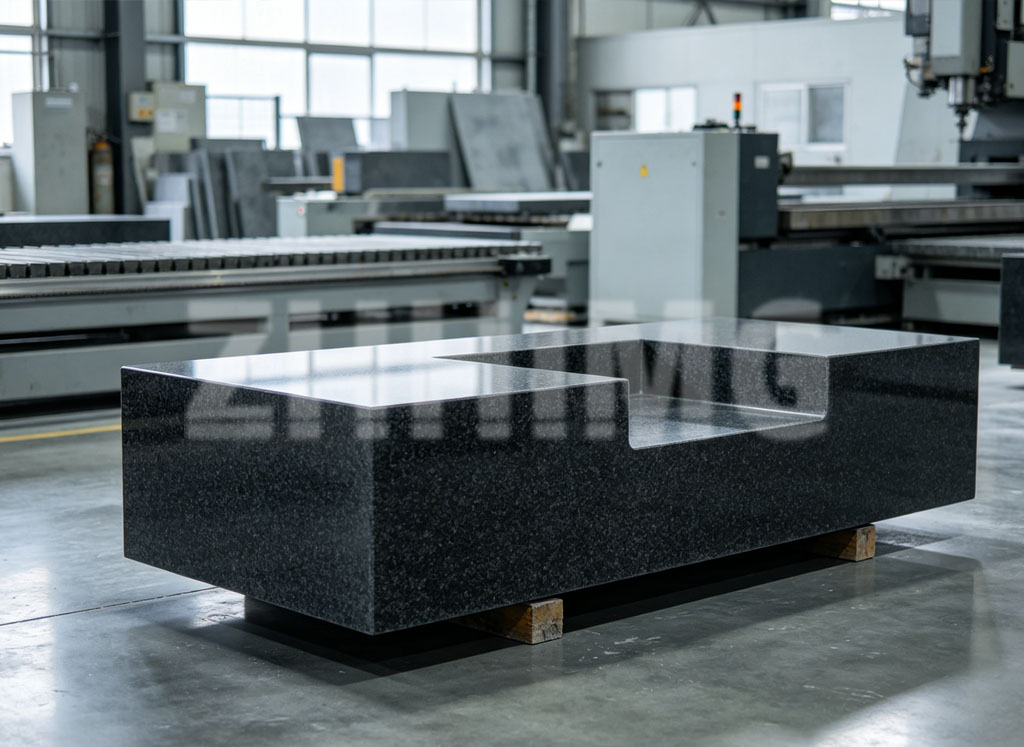
Material selection for supporting structures matters as much as the bearing itself. Granite bases provide the thermal and vibrational foundation that allows air bearings to perform optimally. High-density black granite, with its superior damping characteristics and dimensional stability, creates an ideal platform for precision air bearing assemblies. The combination of ceramic air bearings and granite structures represents a systems approach to precision, where each component amplifies the performance of the others.
Engineering purchasers evaluating this transition should request comprehensive performance data. Spindle runout specifications, thermal growth curves, and vibration signatures provide objective comparison points. Suppliers with documented experience in semiconductor and precision machining applications understand the specific demands of these environments. Traceable calibration certificates and adherence to international standards ensure measurement confidence across global supply chains.
The shift toward precision ceramic air bearings reflects an industry-wide recognition that mechanical contact imposes fundamental limits on achievable accuracy. As manufacturing continues to demand tighter tolerances and faster throughput, non-contact bearing technologies will become increasingly standard. Organizations that understand and leverage these technologies position themselves competitively in markets where precision defines market share.
Post time: Aug-12-2026