
The global display and semiconductor industries are currently navigating a significant technological shift. As the demand for high-resolution displays, such as LTPS Array (Low-Temperature Polycrystalline Silicon) panels, continues to grow, the margin for error in manufacturing has effectively shrunk to zero. At this level of precision, the success of a production line is no longer just dependent on the software or the optics of the inspection systems, but on the physical stability of the defect inspection equipment machine bed. At ZHHIMG, we have spent years perfecting the engineering behind the defect inspection equipment granite base, ensuring that manufacturers can detect micro-defects with absolute confidence.
The manufacturing of an LTPS Array involves complex multi-layer lithography and laser annealing processes. Any microscopic particle or electrical discontinuity within the pixel circuit can lead to a faulty panel. To identify these issues, inspection systems must scan vast surface areas at nanometer resolutions. This is where the choice of a defect inspection equipment machine bed becomes critical. Unlike traditional cast iron or aluminum frames, a granite bed provides the massive thermal inertia required to prevent “pixel-drift” during long scanning cycles. Because LTPS panels are often produced on large glass substrates, the inspection system must maintain a constant focal distance across the entire surface. The natural flatness of a ZHHIMG granite base ensures that the Z-axis height remains uniform, allowing high-numerical-aperture lenses to stay perfectly in focus.
Beyond the display sector, the electronics assembly industry is facing similar challenges. The evolution of PCBA Visual Inspector technology has moved toward ultra-high-speed 3D AOI (Automated Optical Inspection). Modern PCBA lines handle components so small they are barely visible to the naked eye, requiring cameras to capture images at hundreds of frames per second. Utilizing a granite machine bed for PCBA Visual Inspector units is the most effective way to combat the high-frequency vibrations caused by the rapid acceleration and deceleration of the camera gantries. By absorbing these micro-vibrations, the granite base allows for a significantly shorter settling time, which directly translates to higher throughput and more accurate defect categorization.
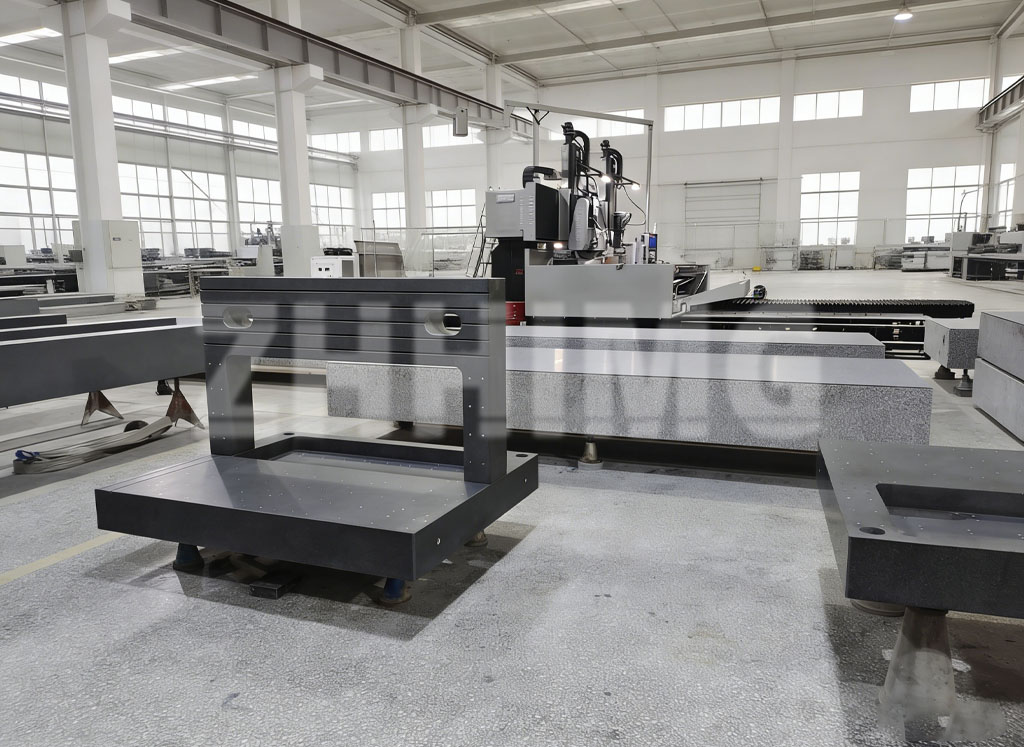
The move toward a defect inspection equipment granite base is also driven by the need for long-term dimensional stability. In the competitive landscape of 2026, manufacturers cannot afford the downtime associated with frequent machine recalibration. Metal bases, over time, undergo a process of stress relief and can warp due to seasonal temperature changes or the internal heat of the machine’s motors. Granite, having been naturally aged for millions of years, is inherently stable. When ZHHIMG processes a granite machine bed for PCBA Visual Inspector, we perform a controlled lapping process that creates a surface reference that will remain true for the life of the machine. This “set-and-forget” reliability is a major selling point for European and American OEMs who prioritize the total cost of ownership (TCO) over the initial purchase price.
Furthermore, the cleanroom compatibility of granite is a vital consideration for LTPS Array inspection. Granite does not oxidize, shed particles, or require the hazardous anti-corrosion coatings that metals do. It is an inert material that maintains its integrity even in environments where ionized air or cleaning chemicals are present. At ZHHIMG, we integrate precision mounting points and cable management channels directly into the defect inspection equipment machine bed, ensuring that the entire system remains as clean and streamlined as possible.
As we look at the trajectory of the industry, it is clear that the integration of AI-driven defect recognition software requires an equally advanced hardware foundation. Even the most sophisticated AI algorithm can be fooled by “motion blur” or “image jitter” caused by an unstable base. By investing in a high-quality defect inspection equipment granite base, manufacturers are providing their optical and software systems with the “stillness” they need to perform at their peak. ZHHIMG remains committed to pushing the boundaries of what is possible with precision granite, supporting the next generation of high-definition displays and high-density electronics through uncompromising structural excellence.
Post time: Jan-15-2026