
In the design of high-end coordinate measuring machines (CMMs), structural material selection is not a secondary consideration—it is a defining factor in measurement accuracy, long-term stability, and system reliability. Among available materials, precision granite has emerged as the preferred foundation for advanced metrology systems. This article provides a technical analysis of why granite outperforms traditional materials such as steel and cast iron, with a focus on thermal stability, vibration damping, and their direct impact on measurement precision.
The Role of the Base in CMM Accuracy
A CMM base serves as the reference platform upon which all measurements are built. Any deformation, thermal drift, or vibration at this level propagates through the entire system, introducing cumulative errors. For ultra-precision applications—such as semiconductor inspection, aerospace components, and precision tooling—these deviations are unacceptable.
Thus, the base material must exhibit:
- Exceptional dimensional stability
- Minimal thermal expansion
- High vibration damping capacity
- Long-term structural integrity
Granite vs. Steel vs. Cast Iron: A Material Comparison
Thermal Stability
One of the most critical factors in metrology environments is thermal expansion. Even minor temperature fluctuations can lead to measurable dimensional changes.
- Granite: Exhibits near zero expansion granite characteristics under controlled conditions. Its coefficient of thermal expansion (CTE) is significantly lower and more uniform compared to metals. Additionally, granite’s isotropic structure ensures consistent behavior in all directions.
- Steel: Has a relatively high CTE (~11–13 µm/m·°C), making it highly sensitive to ambient temperature changes. Thermal gradients can induce warping and internal stress.
- Cast Iron: Offers slightly better thermal stability than steel but still suffers from expansion and long-term creep effects.
Conclusion: Granite provides superior thermal stability, reducing the need for complex temperature compensation systems.
Vibration Damping Performance
CMM accuracy is highly sensitive to environmental vibrations—whether from nearby machinery, foot traffic, or building resonance.
- Granite: As one of the most effective vibration damping materials, granite naturally dissipates vibrational energy due to its heterogeneous crystalline structure. Its internal grain boundaries convert mechanical energy into heat, minimizing oscillation.
- Steel: Has low inherent damping capacity. Vibrations tend to propagate and resonate, requiring additional damping systems.
- Cast Iron: Performs better than steel due to its graphite microstructure, but still falls short compared to granite.
Conclusion: Granite significantly reduces vibration-induced measurement errors without auxiliary damping mechanisms.
Structural Integrity and Long-Term Stability
- Granite: Does not rust, is resistant to corrosion, and maintains its geometry over decades. It is also stress-relieved naturally over geological time, eliminating internal stress concerns.
- Steel & Cast Iron: Both materials are susceptible to oxidation and require protective coatings. Residual stresses from manufacturing processes can lead to gradual deformation over time.
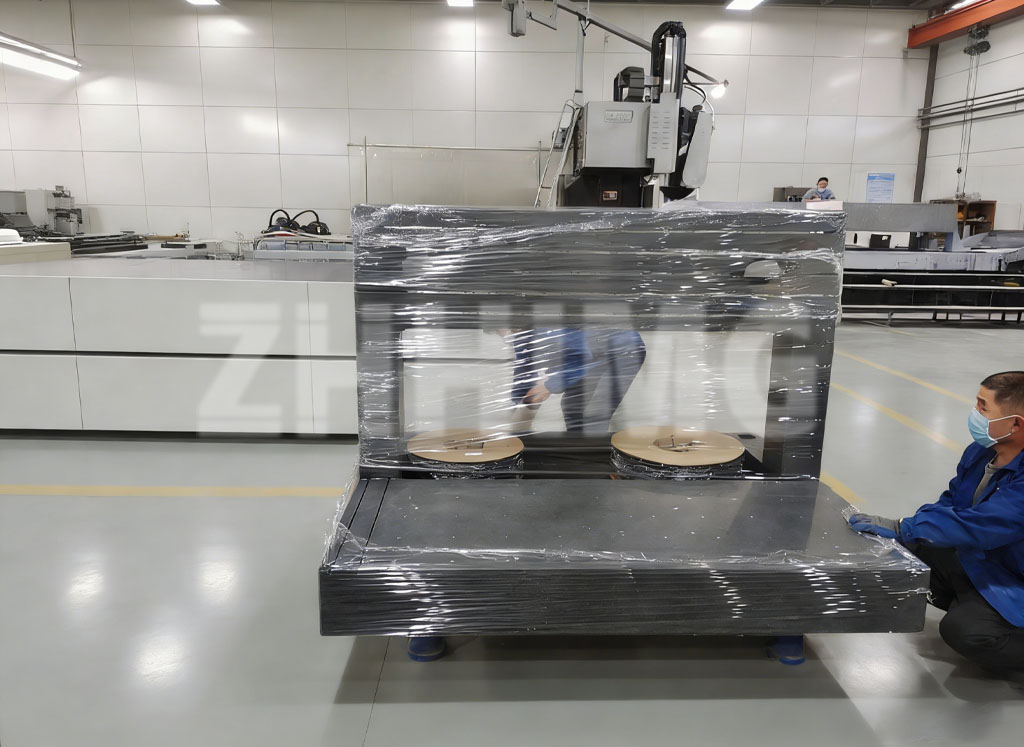
The Physics Behind Granite’s Superiority
The advantages of granite are rooted in its physical and material properties:
- Crystalline Structure
Granite is composed of interlocking mineral grains (primarily quartz, feldspar, and mica). This structure disrupts the propagation of mechanical waves, enhancing damping. - Low Thermal Conductivity
Granite heats and cools slowly, reducing thermal gradients and localized expansion effects. - High Mass and Rigidity
The density of granite contributes to a stable, inertia-rich base that resists external disturbances. - Isotropic Behavior
Unlike metals that may exhibit directional properties due to rolling or casting, granite behaves uniformly in all axes, ensuring predictable performance.
Impact on Measurement Accuracy
The combined effect of thermal stability and vibration damping directly translates into:
- Reduced measurement uncertainty
- Improved repeatability and reproducibility
- Lower system calibration frequency
- Enhanced long-term reliability
For engineers designing high-end CMM systems, these factors are not merely beneficial—they are essential.
Why Granite is the Industry Benchmark
The use of a granite base for CMM systems is no longer a niche choice but an industry standard for precision metrology. As manufacturing tolerances tighten and quality requirements increase, the demand for stable, high-performance base materials continues to grow.
Granite’s unique combination of physical properties positions it as the optimal solution for next-generation measurement systems—especially in industries where micron-level accuracy is non-negotiable.
Post time: Apr-02-2026