
In an era of nanometer-scale manufacturing, the stability of a measurement platform is not just a requirement—it is a competitive advantage. Whether it is a coordinate measuring machine (CMM) or a high-precision laser alignment system, the accuracy of the result is fundamentally limited by the material it sits upon. At ZHHIMG, we specialize in the engineering and granite fabrication of components that serve as the world’s most reliable reference planes.
The Anatomy of Precision: Why Granite?
Not all stone is created equal. For a granite surface plate to meet international standards (such as DIN 876 or ASME B89.3.7), the raw material must possess specific geological characteristics. At ZHHIMG, we primarily utilize Black Jinan granite, a gabbro-diabase known for its exceptional density and uniform structure.
Unlike common architectural granite, precision granite used in metrology must be free of fissures and inclusions. Its natural properties include:
-
Low Thermal Expansion: Crucial for maintaining flatness during shop-floor temperature cycles.
-
High Hardness: Resists scratching and wear, ensuring the surface remains “true” over years of use.
-
Non-Magnetic & Non-Conductive: Essential for sensitive electronic inspection and semiconductor processes.
Granite vs. Marble Components: A Technical Comparison
A frequent question from emerging markets is whether marble can be used as a cost-effective alternative to granite for machine components. The short answer from a metrology perspective is: No.
While marble is aesthetically pleasing and easier to machine, it lacks the structural integrity required for precision engineering. The primary difference lies in the mineral composition. Marble is a metamorphic rock composed of recrystallized carbonate minerals, which makes it significantly softer and more porous than granite.
| Property | Precision Granite (ZHHIMG) | Industrial Marble |
| Hardness (Mohs) | 6 – 7 | 3 – 4 |
| Water Absorption | < 0.1% | > 0.5% |
| Damping Capacity | Excellent | Poor |
| Chemical Resistance | High (Acid resistant) | Low (Reacts with acids) |
In a direct comparison of granite vs marble components, marble fails in “dimensional stability.” Under load, marble is prone to “creep” (permanent deformation over time), whereas granite returns to its original state. Furthermore, marble’s high thermal expansion coefficient makes it unsuitable for any environment where temperature fluctuates by even a few degrees.
Pushing Limits: Custom Ceramic Components
While granite is the king of static stability, certain high-dynamic applications—such as high-speed wafer scanning or aerospace component testing—require even lower mass and higher stiffness. This is where custom ceramic components come into play.
At ZHHIMG, we have expanded our fabrication capabilities to include Alumina (Al2O3) and Silicon Carbide (SiC). Ceramics offer a Young’s Modulus significantly higher than granite, allowing for thinner, lighter structures that do not flex under high acceleration. By combining a precision granite base for damping with ceramic moving parts for speed, we provide our OEM clients with the ultimate hybrid motion platform.
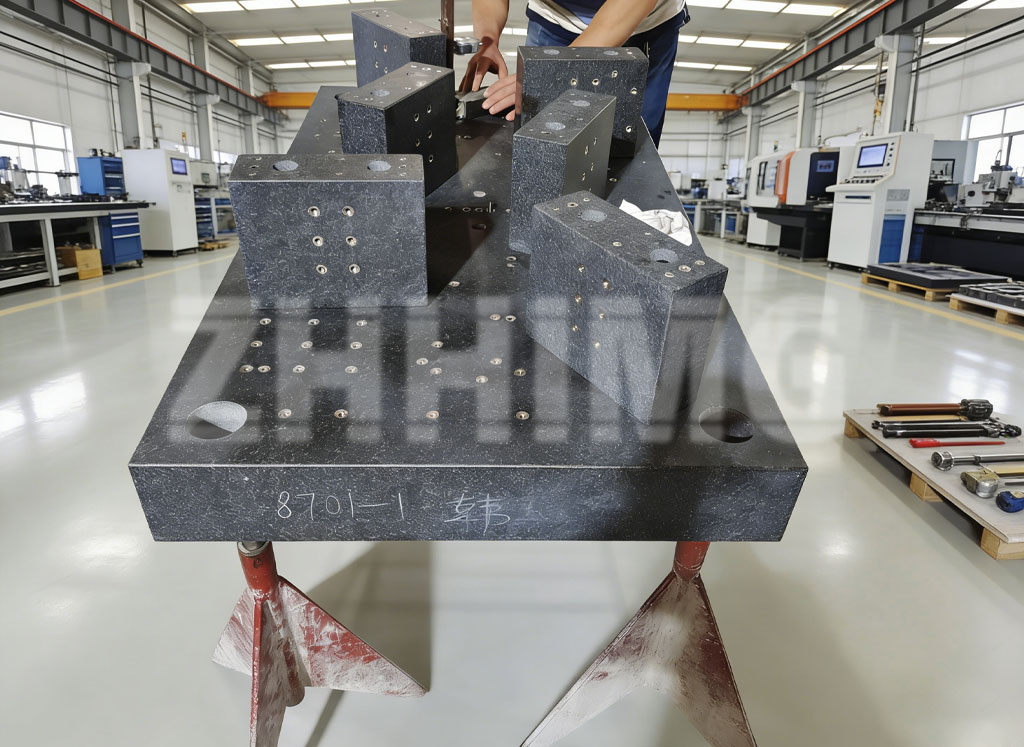
The ZHHIMG Standard in Granite Fabrication
The journey from a raw block of stone to a sub-micron granite surface plate is a process of extreme patience and skill. Our granite fabrication process involves multiple stages of mechanical grinding followed by hand-lapping—a craft that cannot be fully replicated by machines.
Hand-lapping allows our technicians to feel the surface resistance and remove material at the molecular level. This process continues until the surface achieves a flatness that meets or exceeds Grade 000 specifications. We also offer custom features, such as:
-
Threaded Inserts: High-pull-out strength stainless steel inserts for mounting linear guides.
-
T-Slots & Grooves: Precision-milled to customer drawings for modular clamping.
-
Air Bearing Surfaces: Lapped to a mirror finish to allow for frictionless motion.
Engineering for the Future
As we look toward the manufacturing challenges of 2026, the demand for stable foundations will only increase. From the inspection of EV battery cells to the assembly of satellite optics, the world relies on the silent, unwavering stability of stone.
ZHHIMG remains committed to being more than just a supplier. We are a technical partner, helping you choose the right material—be it granite, ceramic, or a composite—to ensure your equipment performs at the peak of its theoretical capability.
Do you have a specific requirement for a custom machine foundation? Contact the ZHHIMG engineering team today for a comprehensive material consultation and quote.
Post time: Jan-26-2026