
In today’s era of sub-micron defect detection—whether for semiconductor wafers, EV battery foils, or micro-optics—the performance of an optical inspection system hinges not just on cameras and algorithms, but on the physical stability of its optical path. At the heart of this stability lie ultra-precision glass components: lenses, windows, prisms, and reference flats engineered to nanometer-level tolerances and made from specialized low-expansion materials.
At ZHHIMG, we serve leading machine vision OEMs and automated optical inspection (AOI) integrators with custom glass elements that ensure thermal neutrality, wavefront fidelity, and long-term repeatability—even in high-throughput factory environments.
The Hidden Challenge: Thermal Drift in Optical Paths
Standard optical glasses (e.g., BK7) have a coefficient of thermal expansion (CTE) around 7–8 ppm/°C. In a 24/7 production line where ambient temperature fluctuates by ±3°C, this can induce focal shifts or misalignment exceeding 5 µm—enough to blur fine features or trigger false rejects.
High-end inspection systems demand low expansion glass such as:
- ULE® (Ultra-Low Expansion glass) – CTE ≈ ±0.03 ppb/°C near room temperature
- Zerodur® (Schott) – CTE < 0.1 ppb/°C over 0–50°C
- Clearceram-HS / TiO₂-doped glass-ceramics – near-zero CTE with high polishability
These materials maintain optical axis integrity across thermal cycles, ensuring consistent resolution without active recalibration.
Precision Glass Grinding: Where Microns Become Mission-Critical
It’s not enough to choose the right material—geometry must be flawless. ZHHIMG’s in-house capabilities include:
- Sub-aperture polishing & magnetorheological finishing (MRF) for λ/20 surface accuracy
- Parallelism ≤1 arcsec on window pairs for telecentric lens assemblies
- Surface roughness <0.5 nm RMS to minimize scatter in brightfield/darkfield imaging
- Custom AR coatings optimized for 405 nm, 532 nm, or SWIR wavelengths
“Switching our reference window from BK7 to Zerodur reduced stage-to-stage measurement variance by 62% in our PCB AOI system.”
— Optical Design Lead, Tier-1 Vision Equipment Manufacturer
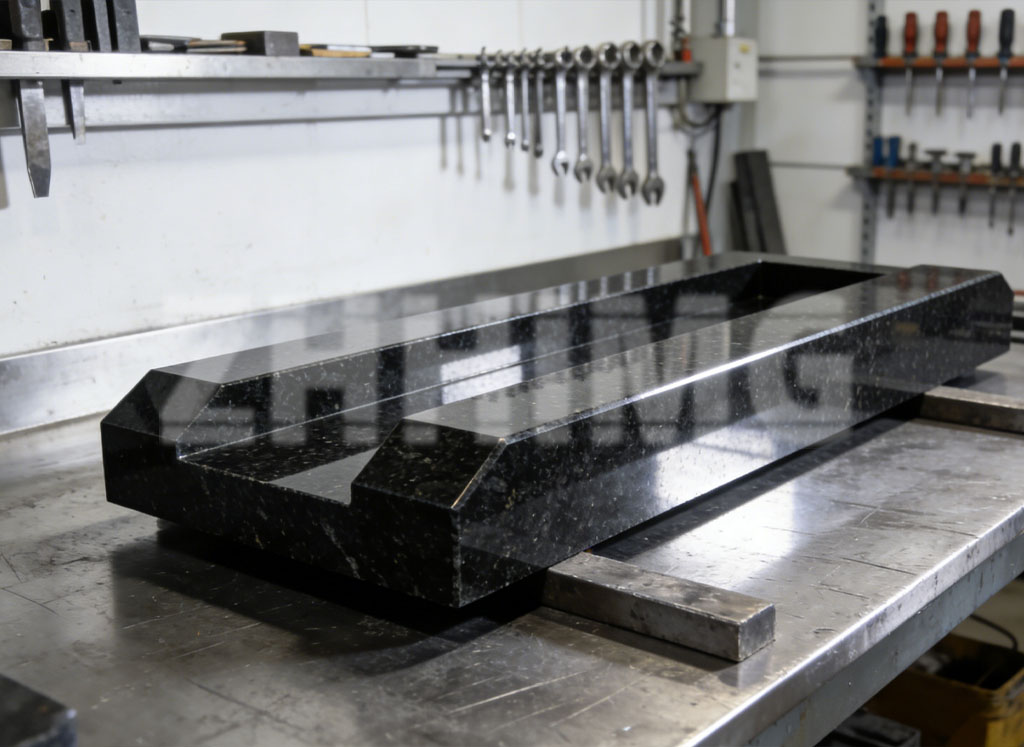
Beyond Glass: Integrated Multi-Material Solutions
What sets ZHHIMG apart is our ability to combine precision glass with metal and ceramic structures in a single assembly:
- Bonding low-expansion glass to Invar mounts for zero-stress kinematic mounting
- Integrating glass prisms into aluminum housings with matched CTE interfaces
- Co-developing hybrid optical-mechanical modules with embedded fiducials
This cross-material expertise ensures seamless integration into your existing optical engine—without compromising alignment or thermal behavior.
Applications We Support
- Semiconductor wafer and reticle inspection
- Flat panel display (FPD) defect detection
- Lithium-ion battery electrode scanning
- Precision metrology for aspheric lenses
- High-resolution 3D structured light projectors
Ready to Eliminate Thermal Drift in Your Inspection System?
ZHHIMG offers end-to-end support—from material selection and optical tolerance analysis to certified delivery with interferometric test reports.
Q2 2026 Program for Vision System Builders:
→ Free sample of low-expansion glass (Zerodur or equivalent)
→ Tolerance feasibility review within 48 hours
→ Lead time as short as 12 days for standard plano components
→ Free sample of low-expansion glass (Zerodur or equivalent)
→ Tolerance feasibility review within 48 hours
→ Lead time as short as 12 days for standard plano components
Stabilize your optics. Sharpen your insights.
ZHHIMG – Precision Glass Engineered for the Eye of the Machine.
Post time: Mar-20-2026