
Engineers ask us the same question at least once a month. “We need a base for a measuring machine. Your black granite looks like the marble slab we can buy locally, and that one is cheaper. Why should we pay more?”
It is a fair question. From a distance, marble and black granite are both dark, heavy stones. Up close, they are two different materials with two different jobs. Marble belongs in a lobby. Black granite belongs under a CMM, a laser system, or a semiconductor stage. Here is why.
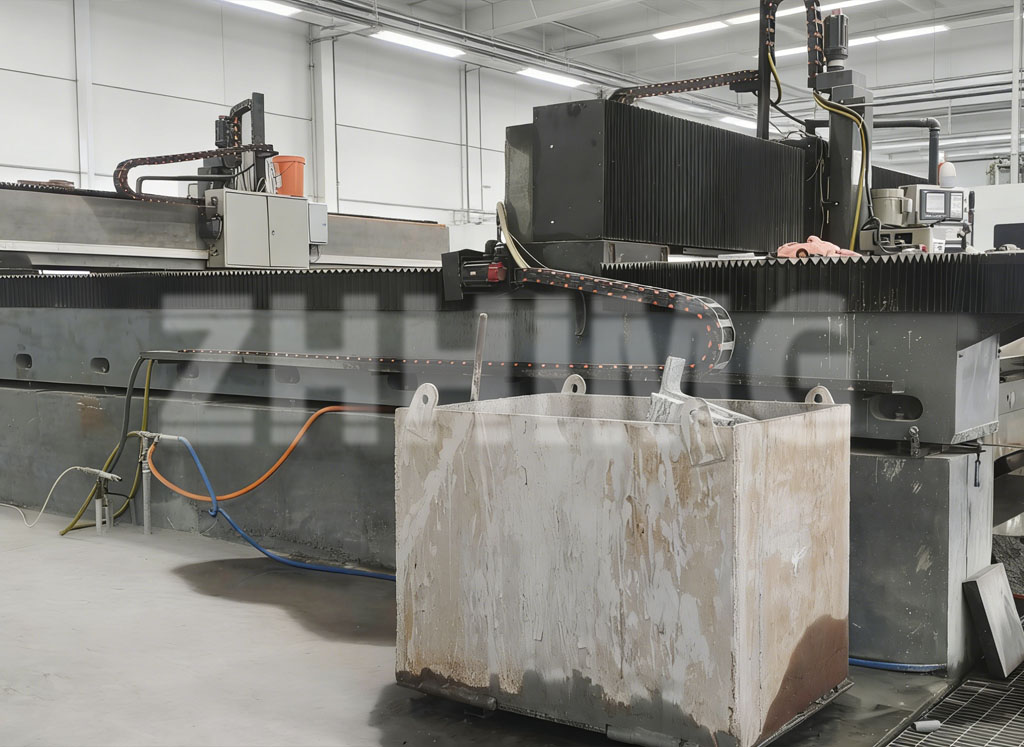
Lapping and finishing a large granite base at the ZHHIMG plant — the last step that sets the flatness.
Granite and Marble Are Not the Same Rock
Marble is mostly calcite. Calcite is soft — around 3 to 4 on the Mohs scale. Black granite is mostly quartz and feldspar, which sit at 6 to 7. That difference decides almost everything that follows.
Soft material scars. It dents. It wears away where the probe or the carriage slides. A precision base has to hold its geometry for years, not months. Granite does that. Marble does not.
Density and Porosity: The 3,100 kg/m³ Advantage
ZHHIMG black granite runs at a density of roughly 3,100 kg/m³. High density means low porosity. Low porosity means the stone does not absorb moisture, does not swell, and does not stain.
Marble is more porous and more absorbent. It takes in oil, coolant and humidity. When a material absorbs moisture, its dimensions move. On a measuring machine, moving dimensions are simply errors.
Thermal Stability Where It Counts
Every precision machine fights heat — from motors, from the workpiece, from the room. Granite expands far less than most metals, and the material’s low thermal conductivity means heat stays local instead of spreading through the frame.
Marble’s higher porosity and softer structure make it less predictable under the same conditions. For a stable reference plane, predictability is the whole point.
Vibration Damping and Non-Magnetic Behaviour
Granite damps vibration well. The material’s internal structure turns vibration into heat instead of letting it ring through the machine. That is why a probe stops cleanly and a laser head holds focus.
Black granite is also non-magnetic. It will not interfere with magnetic sensors or precision metrology. Add that it does not rust, and you have a base that behaves the same in year ten as it did on day one.
The Finishing Is Where the Accuracy Lives
A raw slab is not a precision component. What turns stone into a reference surface is lapping — and lapping is still a human skill at ZHHIMG. Our master hand-lappers have practiced for up to thirty years. They feel flatness at the micron level, with hands that read the surface the way an instrument does.
That craft is checked, not trusted blindly. Our inspection line includes equipment from Mahr (Germany), WYLER (Switzerland) and Renishaw (UK). Every critical surface is measured for flatness, parallelism and roughness before it ships. We do not guess. We measure.
Certified, Patented, and Built to Be Verified
ZHHIMG is the only company in the sector that holds ISO 9001, ISO 45001, ISO 14001 and CE certification at the same time, backed by more than 20 international patents. When a customer runs due diligence, we would rather they check. No cheating, no concealment, no misleading — that is how we work.
The same precision granite is used by companies such as GE, Samsung and Oracle, and researched with institutions like the National University of Singapore and national metrology institutes in the UK, Germany and the US. If the material is good enough for a national metrology lab, it is good enough for your machine.
When to Choose Black Granite
Choose black granite when the base defines the accuracy of everything on top of it — CMMs, optical inspection systems, laser cutting and marking machines, semiconductor equipment, and granite gantry systems. Choose marble when the only requirement is that it looks heavy.
If you are sizing a base for a new machine, send us the load, the travel and the accuracy budget. Our engineers will recommend the right granite grade, thickness and insert layout — and you can compare the numbers before you commit. Explore our precision granite components to start.
Post time: Sep-17-2026