
Many precision equipment engineers hold a common belief: machine bases can maintain permanent dimensional stability as long as the workshop keeps a constant temperature. However, even in temperature-controlled environments, some machines gradually lose precision after running for a period. Constant temperature only suppresses instantaneous deformation caused by temperature fluctuations, yet it cannot resolve slow deformation triggered by the release of internal residual stress. Whether CNC granite bases change dimensions in a long-term constant-temperature workshop mainly depends on raw stone quality, stress-relief aging procedures, machining & lapping environments, and finished product inspection standards. Not all granite delivers stable performance.
1. What a constant-temperature workshop can and cannot achieve
A constant-temperature workshop mainly restrains thermal expansion and contraction induced by ambient temperature swings. For metal beds or ordinary stone bases, temperature differences and continuous heat from machine operation cause repeated expansion and contraction, leading to positioning errors. Stable ambient temperature can reduce such thermal deformation to a low level.
Nevertheless, constant temperature cannot eliminate residual stress inside materials. Internal stress inside castings or roughly processed stone releases slowly over years and causes slight distortion or warping of the base. This aging deformation has nothing to do with ambient temperature. Even with steady workshop temperature, stress keeps releasing and gradually degrading machine geometric accuracy. This explains why many cast iron machine tools suffer precision decline after years of operation, even inside constant-temperature rooms.
2. Low-grade granite bases: dimensions still drift slowly even in constant-temperature workshops
Many low-cost granite components on the market adopt inferior stone or skip lengthy natural aging to shorten production cycles. Stone blanks are directly cut after quarrying without sufficient stress relief. New machining stress is introduced during cutting and grinding.
Such bases pass precision inspection at the time of delivery. But as internal stress releases gradually over time, flatness and parallelism of the base shift quietly. Machine straightness and squareness drift accordingly. Regular disassembly and recalibration become mandatory, lowering equipment uptime and raising maintenance costs. Many buyers mistakenly believe constant-temperature environments can guarantee stable performance, only to face persistent precision issues.
3. Dimensional performance of ZHHIMG high-density black granite bases in permanent constant-temperature workshops
ZHHIMG selects high-density black granite. Formed over millions of years, the raw stone has fully released its native internal stress. After quarrying, blanks go through prolonged natural aging plus artificial stress relief. Potential internal stress is removed before fine machining and lapping to prevent rebound deformation after delivery.
When these granite bases are installed in permanent constant-temperature workshops:
- Thermal dimensional change caused by steady temperature is negligible;
- Internal material stress is pre-released, so slow deformation seen in cast iron and low-grade stone will not occur;
- The material boasts excellent physical properties and creep resistance, resisting deformation under long-term load of machine assemblies.
One objective note: no solid material can achieve absolutely zero deformation. Tiny changes may occur under extreme working conditions such as continuous heavy shock, vibration or chemical corrosion. Under normal conditions in constant-temperature workshops without impact or corrosion, ZHHIMG granite bases maintain micron or sub-micron dimensional stability. Key indicators including flatness, squareness and origin position barely degrade after years of continuous operation, greatly extending recalibration cycles.
4. Machining and lapping processes further secure long-term stability
Quality raw material is only the foundation. Stress can also be introduced during machining and undermine long-term stability of finished parts. ZHHIMG carries out fine machining and manual lapping inside vibration-isolated constant-temperature & constant-humidity workshops. Vibration isolation trenches and silent overhead cranes block external vibration and avoid generating new stress during processing.
Seasoned craftsmen with over 30 years of experience supervise lapping work. Machining and verification follow multiple global metrology standards. Finished products undergo multi-dimensional geometric inspection using world-class measuring instruments including Mahr, Wyler and Renishaw. All test data can be traced back to national metrology institutes. Components with hidden stress risks or substandard precision are screened out before shipment, ensuring long-term stability. 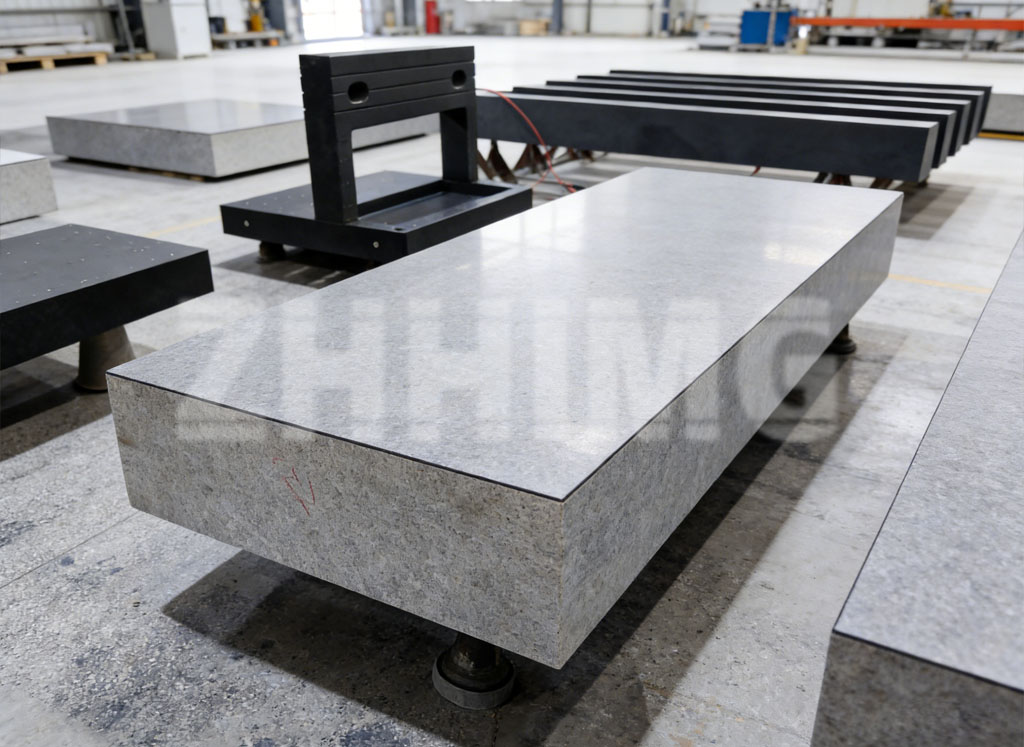
5. Application scenarios for CNC machines requiring long-term precision stability
CNC equipment for semiconductor parts, optical components, precision molds and new energy inspection parts often runs nonstop year-round. Shutdown for calibration interrupts production, bringing throughput losses and adjustment errors.
For these applications, a constant-temperature workshop alone is not enough. Fully aged premium granite bases work together with temperature-controlled environments. Constant temperature eliminates temperature fluctuation interference, while granite bases avoid stress-induced slow deformation. The dual guarantee maintains stable machine geometric accuracy and cuts downtime for maintenance.
6. Conclusion: constant temperature offers external protection; low-stress material forms the core of stable precision
A constant-temperature workshop provides external support for CNC precision by handling temperature fluctuations, yet it cannot resolve deformation from material stress.
- Cast iron and non-aged ordinary stone: still deform slowly even inside long-term constant-temperature workshops;
- ZHHIMG fully aged high-density black granite bases: minimal dimensional drift under normal operation in permanent constant-temperature workshops, sustaining consistent machine geometric accuracy.
When selecting granite bases, buyers should not only check precision readings at delivery. Raw material quality, complete aging processes and strict metrology inspection systems are essential for ultra-precision equipment to operate reliably over the long run.
Post time: Sep-18-2026