
Large precision equipment needs a foundation that can remain stable under heavy loads, long travel distances, changing temperatures, and continuous production cycles. For manufacturers of gantry machining centers, laser cutting machines, PCB drilling equipment, coordinate measuring machines, semiconductor inspection systems, and large-format automation platforms, the granite base is often one of the most important components in the entire machine.
A machine base does much more than support weight. It influences guideway alignment, motion accuracy, vibration behavior, assembly precision, optical-path stability, and long-term repeatability. When a machine structure reaches several meters in length, a minor deviation in flatness or straightness can affect every component installed above it.
This is why the ability to manufacture granite components up to 100 tons per piece and up to 20 meters long is significant. Large dimensions alone are not enough. The real requirement is to maintain controlled geometry, material integrity, inspection traceability, and safe handling throughout the entire manufacturing process.
ZHHIMG®, located in Jinan, China, manufactures ultra-precision industrial components and solutions for applications including precision machinery, metrology, semiconductor equipment, CNC systems, advanced laser equipment, and automated inspection platforms. Its precision granite product range includes granite machine bases, granite structural components, granite surface plates, granite measuring tools, granite air-bearing structures, and customized large-format granite assemblies.
Large Granite Bases Are Engineering Components, Not Simple Stone Structures
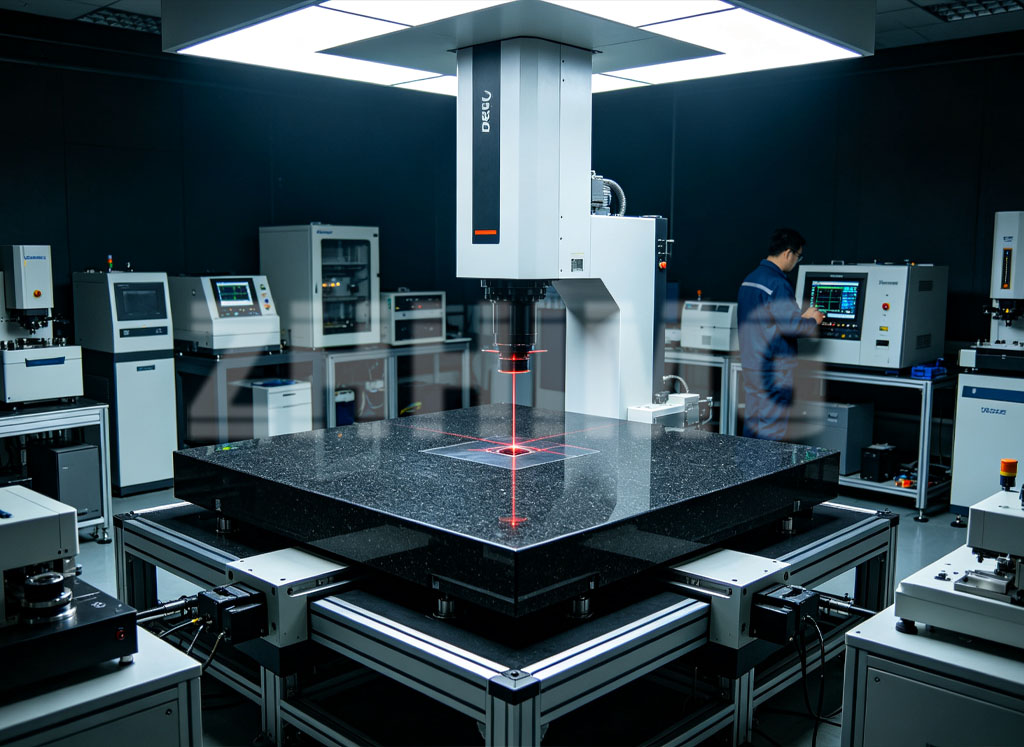
A large granite machine base may support linear guideways, motors, bearings, rails, precision sensors, optical assemblies, air bearings, fixtures, worktables, and moving gantry structures. The granite becomes a functional part of the equipment’s accuracy chain.
For a small measurement tool, flatness and squareness are important. For a large machine base, the same requirements become more complex because the component must maintain its geometry across a much longer distance and under much higher load.
A long granite base may require precise mounting surfaces for rails and motors. It may also include threaded inserts, precision holes, embedded metal parts, cable channels, assembly interfaces, air-bearing surfaces, and reference datums for machine installation. Each of these features must remain correctly positioned relative to the others.
For example, a large laser cutting machine may require long guideway mounting surfaces with controlled straightness. A coordinate measuring machine may require highly accurate flatness and perpendicularity between its base, columns, and bridge structure. A PCB drilling machine may need a rigid and stable platform to maintain high-speed positioning accuracy.
In these applications, the granite base cannot be treated as a general structural stone product. It must be designed, machined, measured, handled, and installed as a precision engineering component.
Why 100 Tons and 20 Meters Matter
The ability to process a single component weighing up to 100 tons and reaching 20 meters in length indicates that a manufacturer must manage several capabilities at the same time.
First, the factory must have the physical capacity to receive, store, transport, lift, and position large blocks of granite safely. Heavy components require cranes, machining equipment, stable work areas, and carefully planned support methods.
Second, the manufacturer must control geometry across a long distance. Flatness, straightness, parallelism, and perpendicularity become more difficult to achieve and inspect as the size of the component increases.
Third, the manufacturer must manage the effects of handling and transportation. A 20-meter granite structure can be affected by lifting positions, support points, shipping vibration, packaging, and temperature differences. The component must be protected not only during machining but also during delivery and installation.
Finally, the manufacturer must provide a practical inspection method. Buyers need to know how long guideway surfaces, mounting pads, and functional datums are measured. For large granite structures, this may involve electronic levels, laser interferometry, precision indicators, straightness measurement systems, or other specialized metrology equipment.
The size of a granite base is meaningful only when the supplier can demonstrate control over the complete process.
Material Selection Is the First Step in Precision
The quality of a precision granite component begins with the raw material. Granite is widely used in metrology and high-precision machinery because it is naturally stable, corrosion-resistant, non-magnetic, and suitable for precision grinding and lapping.
However, not all stones described as granite offer the same performance. Density, mineral composition, hardness, internal structure, porosity, thermal behavior, and long-term stability can vary from one material source to another.
ZHHIMG uses high-density black granite with a stated density of approximately 3100 kg/m³ for precision applications. This level of density is important because it contributes to the mass and stability of large structural components. For machine bases, high density can help create a robust foundation for systems that require reliable motion, stable geometry, and controlled vibration behavior.
Material selection should never be based only on color or appearance. A dark stone surface may look similar to precision granite, but the actual engineering value depends on the material’s verified properties and the performance of the finished component.
Before approving a granite supplier, buyers should ask for material information that is relevant to the application. This may include density, thermal expansion data, surface quality requirements, inspection documentation, and the supplier’s experience with large structural granite components.
For large equipment, it is also important to define where the granite component will be installed. A base used in a temperature-controlled metrology laboratory may have different requirements from one used in a factory environment with continuous machine operation and changing ambient conditions.
Thermal Stability and Long-Term Accuracy
Temperature is one of the most important factors affecting precision equipment. All materials change dimension as temperature changes. On a small component, the effect may be limited. On a long granite structure, even a small temperature difference can influence the measured geometry of the base.
For this reason, large granite components should be manufactured and inspected under controlled conditions whenever possible. Buyers should also consider the intended operating environment of the final machine.
A granite base used in a precision inspection system may require stable conditions during calibration and operation. A laser machine base may require good thermal behavior to support optical alignment and motion accuracy. A semiconductor inspection platform may require stable mounting surfaces for precision stages, cameras, sensors, and measuring systems.
The coefficient of thermal expansion is therefore an important material property. Rather than relying on general granite data, buyers should request information related to the actual black granite material used for the project. The supplier should also understand the machine’s operating temperature range, heat sources, payload, and support arrangement.
Thermal stability is not determined by the granite alone. It also depends on the design of the complete machine. Proper support, good environmental control, correct installation, machine warm-up procedures, and measurement compensation all contribute to final performance.
Precision Grinding, Inspection, and DIN 876 Requirements
The manufacturing process for a large granite base usually includes material cutting, rough machining, precision grinding, drilling, insert installation, bonding, cleaning, hand finishing, and final inspection.
The final requirements depend on the customer’s drawing and the intended function of the component. A granite base may need high flatness for a mounting surface, high straightness for guideway pads, controlled parallelism between planes, or accurate perpendicularity between vertical and horizontal assembly surfaces.
For granite surface plates and granite measuring tools, DIN 876 is commonly used as a reference standard. It defines accuracy grades for granite surface plates and is widely recognized in metrology environments.
However, a large custom granite machine base often requires specifications beyond a standard DIN 876 reference. The customer should define the critical dimensions and tolerances in the drawing. These may include flatness, straightness, parallelism, perpendicularity, hole position, insert location, mounting pad height, and interface geometry.
The inspection method should be discussed before production begins. For a large granite component, the supplier and buyer should agree on how the critical features will be measured and reported.
A complete inspection process may include verification of critical mounting surfaces, guideway straightness, insert positions, hole locations, parallelism, perpendicularity, surface condition, and overall dimensions. The inspection report should be linked to the delivered component and should identify the measurement equipment used.
For QC engineers and laboratory managers, measurement traceability is especially important. Inspection instruments should be calibrated, and the supplier should be able to provide relevant calibration records when required.
What Buyers Should Confirm Before Ordering
When sourcing a large precision granite base, it is important to evaluate the supplier’s complete capability rather than focusing only on price or maximum dimensions.
Buyers should confirm that the supplier can process the required length, width, thickness, and weight of the component. They should also verify that the supplier has appropriate lifting equipment, machining capacity, grinding capability, and inspection systems.
The buyer should provide a clear technical drawing showing all critical dimensions, tolerances, reference datums, inserts, hole patterns, load conditions, and assembly interfaces. If the component will support rails, air bearings, linear motors, optical systems, or measurement equipment, these interfaces should be identified at the design stage.
It is also important to discuss packaging and shipment. A 100-ton granite component requires a carefully planned logistics solution. The supplier should provide information about lifting points, support points, packaging protection, shipping orientation, and installation recommendations.
ZHHIMG is located in Jinan, Shandong Province, with access to Qingdao Seaport for international logistics. The company’s website presents precision granite, precision ceramic, precision metal, precision glass, and mineral casting solutions for industrial customers that require ultra-precision manufacturing and machining support.
Conclusion
Large precision granite components are essential for equipment that requires long travel distances, high structural stability, and reliable geometric accuracy. A 20-meter granite base or a 100-ton granite component requires more than a large workshop. It requires controlled material selection, heavy-duty handling, precision machining, detailed inspection, safe logistics, and close engineering communication.
For industrial buyers, the key question is not only whether a manufacturer can produce a large granite structure. The more important question is whether the supplier can control quality from raw material selection through final inspection and delivery.
ZHHIMG provides custom precision granite bases, granite structural components, granite surface plates, granite measuring tools, and granite air-bearing solutions for applications in CMM systems, semiconductor equipment, laser machinery, PCB drilling systems, precision automation, and industrial metrology.
To learn more about large precision granite manufacturing capabilities or to discuss a custom granite base project, visit www.zhhimg.com. Providing a drawing, tolerance specification, loading condition, and installation requirement will help the engineering team evaluate the most suitable manufacturing solution.
Post time: Sep-14-2026