
Modern production facilities present a fundamental conflict of physics. High-speed CNC machining centers, stamping presses, and heavy overhead cranes share factory floor space with sub-micron coordinate measuring machines (CMMs), optical inspection systems, and semiconductor photolithography equipment.
Environmental micro-vibrations—often unfelt by human operators—travel through concrete floor slabs. When these low-frequency oscillations reach sensitive inspection equipment, they distort measurement probes, cause optical blurring, and corrupt point-cloud repeatability. Protecting precision equipment requires selecting an anti-vibration strategy suited to your facility’s frequency profile and load demands.
Mapping the Source: Internal vs. External Vibration
Before selecting isolation hardware, quality managers must identify how dynamic forces enter the measurement system. Vibration interference generally falls into two distinct mechanical categories:
-
Source Isolation (Direct Damping): Eliminating internal forces generated by the machine itself, such as rapidly accelerating linear motors, reciprocating stages, or rotating spindles.
-
Receiver Isolation (Environmental Shielding): Shielding an ultra-precise instrument from incoming ambient floor vibrations caused by external shop floor traffic, HVAC compressors, or nearby rail lines.
[ External Floor Vibration (0.5 - 50 Hz) ]
                   │
                   ▼
[ Foundation Isolation / Trench Damping ]
                   │
                   ▼
[ Active / Passive Anti-Vibration Mounts ]
                   │
                   ▼
[ High-Mass Granite Base & Air Bearings ]  <-- Attenuates residual high-frequency noise
Core Anti-Vibration Technologies Compared
Selecting an isolation system depends primarily on the disturbing frequency (measured in Hertz) and the payload weight. Matching technology to frequency ranges avoids accidental resonance amplification.
| Isolation Technology | Typical Frequency Range | Primary Mechanism | Best Suited Applications |
| Elastomeric Pads & Rubber Mounts | High Frequency (> 15 Hz) | Material elasticity & internal hysteresis | General shop floor machinery, small pumps, low-magnification optical benches |
| Passive Air Springs (Pneumatic) | Mid-to-High Frequency (2 to 10 Hz) | Compressed air column damping with self-leveling valves | Standard CMMs, surface roughness testers, optical comparator tables |
| Active Vibration Control (Piezo/Magnetic) | Low Frequency (0.6 to 50 Hz) | Inertial sensors detect motion; actuators generate equal-opposite forces | Scanning electron microscopes (SEM), atomic force microscopes, sub-micron wafer inspection |
| Isolated Foundation Blocks (Mass Damping) | Low Frequency (< 5 Hz) | Heavy concrete/granite inertia mass decoupled via perimeter trenches | Heavy gantry CMMs, 100-ton machine bases, large-scale optical inspection beds |
Key Selection Criteria for Engineering Purchasers
Selecting an anti-vibration solution based solely on cost often leads to poor performance. If an isolation system’s natural frequency sits too close to the floor’s dominant vibration frequency, the isolator will amplify the movement rather than dampen it.
1. Natural Frequency Ratio
For effective isolation, the ratio between the incoming disturbance frequency (fd) and the isolator’s natural frequency (fₙ) must be greater than √2 (roughly 1.41). In practice, targeting a ratio between 3 and 4 delivers over 80% to 90% vibration reduction.
2. Settling Time and Dynamic Stiffness
While soft pneumatic isolators block floor vibration effectively, they can sway when machine axes accelerate rapidly. Highly dynamic positioning systems require active vibration control or heavy inertia bases to reduce settling times, keeping throughput high without sacrificing positioning accuracy.
3. Civil Foundation Planning
For heavy industrial equipment, mounting isolators directly on a standard 150mm factory floor slab is insufficient. Severe environments call for a dedicated concrete inertia block poured into an isolated pit, lined with anti-vibration elastomeric dampening mats and separated from the surrounding factory floor by perimeter vibration-isolation trenches.
Environmental Integration and Engineering Standards
Effective vibration control requires a complete system design, combining proper civil foundation work with the machine’s internal structural material.
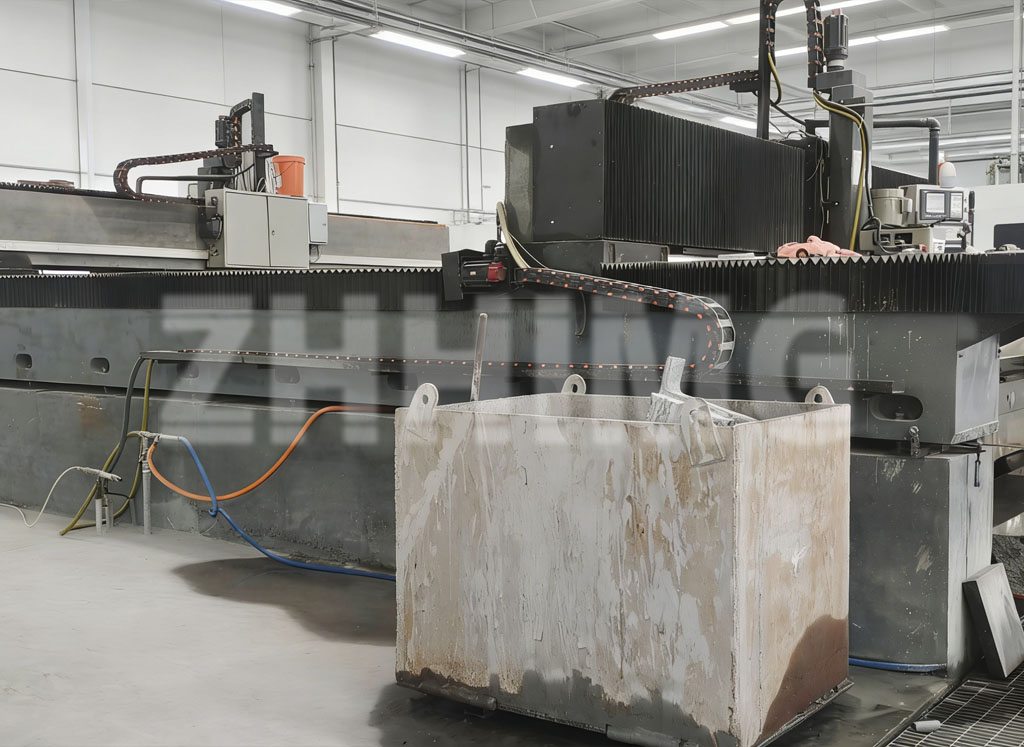
At ZHONGHUI Group (ZHHIMG®), we build measurement stability from the ground up. Our 10,000 ㎡ climate-controlled assembly halls feature military-grade, 1000mm-thick reinforced concrete floors lined with 500mm-wide by 2000mm-deep perimeter anti-vibration trenches. Combined with silent overhead cranes, this design isolates our heavy assembly zones from external shocks.
By integrating these isolated foundations with high-density ZHHIMG® black granite beds (approx. 3,100 kg/m³) and quiet air bearing structures, we help global metrology and semiconductor equipment manufacturers maintain sub-micron accuracy, even on busy industrial shop floors.
Post time: Aug-24-2026