
For metrological calibration, granite cubes serve as physical reference artifacts, and their geometric stability directly determines the credibility of long-term calibration results. Many reference blocks pass all inspection indicators upon delivery, yet gradually develop deviations in parallelism and squareness after a period of use in laboratories. Many attribute this issue to lapping defects, but the root cause lies in invisible residual stress trapped inside the blank. During quarrying, sawing and rough machining of natural granite, original geostress is disrupted and locked within the stone. Without aging treatment to release stress, subsequent ambient temperature fluctuations and external disturbances will trigger gradual stress release, inducing micro-deformation of the cube and drifting benchmark accuracy. Professional aging treatment for granite cubes releases internal residual stress in advance, mitigating the risk of later deformation of finished products from the source.
Aging is not simply static storage, but a controlled stress-releasing process. Many ordinary manufacturers only store blanks for a short period, leaving stress insufficiently released and residual stress retained after machining. For high-precision metrological reference artifacts such as granite cubes, ZHHIMG arranges aging after rough machining and before final fine lapping. After material removal in rough cutting, the stress distribution inside the blank rebalances. At this point, the blank enters the aging cycle. Under stable environmental conditions, internal stress of the stone is released slowly and progressively, so deformation will not occur after the finished product is delivered to customers.
Environmental control during aging is critical. Sharp temperature swings disrupt the rhythm of stress release and may even introduce new additional stress. We place the granite cube blanks for aging in spaces with mild temperature variation, avoiding direct sunlight and alternating hot/cold airflows in workshops. Environmental parameters are continuously monitored throughout the aging cycle. Meanwhile, geometric dimensional changes of blanks are sampled periodically. The aging process is only deemed complete when the deformation trend of the component stabilizes and no continuous stress release is confirmed, before moving on to the next stage of ultra-precision lapping.
Many customers wonder why aging procedures can be simplified for common granite components, while granite reference cubes require strict implementation. A cube is a six-face linked benchmark. Tiny deformation on any single face will compromise squareness between adjacent faces and parallelism of opposite faces. Ordinary machine tool beds allow a small margin of deformation tolerance, whereas metrological granite cubes have almost no precision allowance. Even micron-level slow deformation directly impairs three-axis orthogonality calibration and distorts metrological data of the whole equipment. Therefore, aging treatment is not an optional process for reference cubes; it is a necessary step to guarantee long-term precision.
Completion of aging does not directly qualify the blank for finish machining. ZHHIMG carries out a full re-inspection on aged cube blanks, rechecking flatness and linear dimensions, and checking for newly formed microcracks or surface profile deviation during aging. If testing reveals unstable deformation, the aging cycle will be extended, and the blank will not proceed to fine lapping. Through this re-inspection checkpoint, blanks with stable stress status are screened and then sent to a constant-temperature dust-free workshop for alternating six-face lapping, ensuring long-term geometric stability after forming. 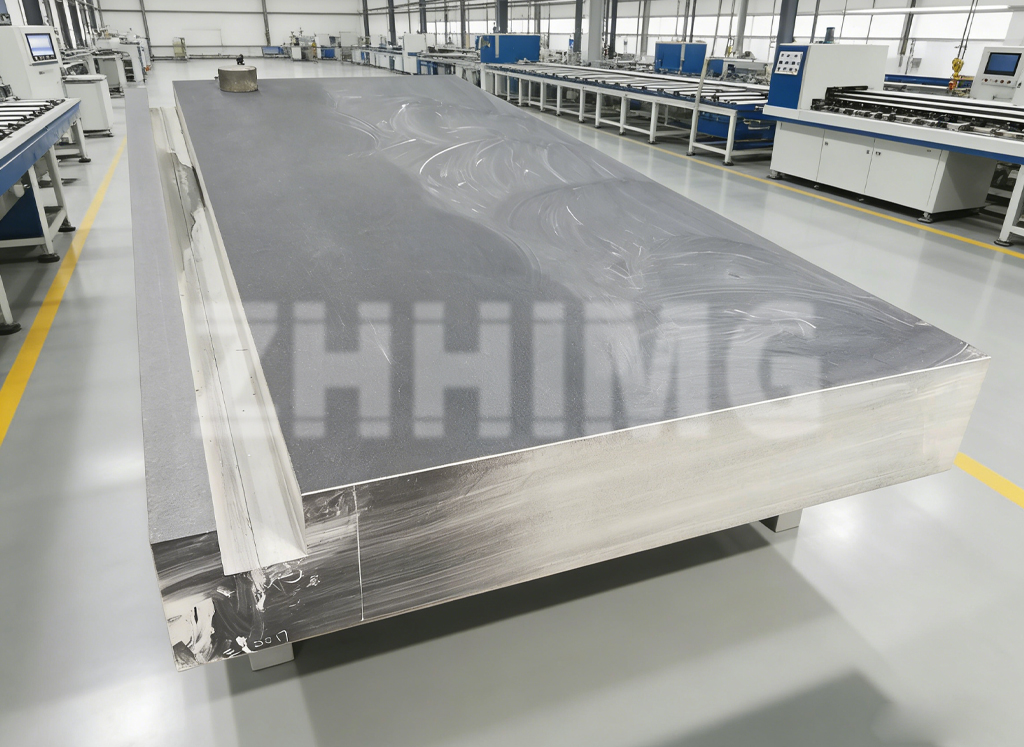
Even with complete aging treatment, basic maintenance during later use is required to preserve stability. Granite cubes should be kept away from prolonged sunlight exposure and local heat sources to prevent extra stress caused by partial temperature differences. Avoid single-point impact during handling and store them on flat platforms with minor temperature and humidity fluctuations. Proper storage maximizes retention of the stress stabilization achieved by aging and maintains geometric benchmark accuracy.
ZHHIMG can supply granite cubes of various specifications after aging treatment. All finished products come with complete inspection reports, suitable for metrology laboratories and precision equipment calibration stations. Beyond granite reference cubes, we can also develop customized aging schemes for various high-precision granite squares, inspection platforms and machine tool beds to control long-term deformation risks of components.
The core purpose of aging treatment is to release all potential deformation inside granite cubes at the factory stage in advance. Through standardized aging management and multiple rounds of pre- and post-inspection, the internal stress state of stone is locked to prevent slow deformation during customer application. This allows granite cubes to maintain stable geometric benchmarks for years and ensures consistent and reliable metrological calibration work.
Post time: Sep-17-2026