
In scenarios such as precision mechanical inspection, metrological calibration and high-end component quality control, granite V-blocks serve as essential benchmark measuring tools that guarantee the centering accuracy of shaft and cylindrical workpieces. A common industry phenomenon lies in the huge performance gap among V-blocks with identical specifications: ordinary products suffer centering deviation and fluctuating inspection data after short-term use, while high-end models maintain sub-micron precision steadily throughout long service cycles. Beyond processing differences, the fundamental cause lies in material quality. Precision is the appearance, while material performance determines the underlying foundation. Based on professional manufacturing experience, ZHHIMG thoroughly analyzes the core quality logic of granite V-blocks from material characteristics, strict selection criteria, material-precision correlation and industrial precision grading, correcting widespread industry misunderstandings.
1. Why Only Granite Is Adopted for Precision Metrology
Common V-block materials include cast iron, ordinary marble and high-density black granite, which differ fundamentally in precision ceiling, structural stability and applicable scenarios. Cast iron is magnetizable, rust-prone and features large thermal deformation with continuous stress creep, making it incapable of meeting micron-level precision testing requirements. Ordinary marble has loose grains, high porosity and low hardness, prone to micro crushing and surface abrasion under pressure, thus only suitable for conventional rough inspection with poor precision retention.
In contrast, high-density black granite offers irreplaceable material advantages and has become the exclusive preferred substrate for precision V-blocks. Formed through hundreds of millions of years of natural geological aging, it features compact, uniform grain structure and nearly zero residual stress, fundamentally eliminating natural deformation. Its ultra-low thermal expansion coefficient ensures negligible dimensional variation under normal workshop temperature and humidity fluctuations, far superior to metal and ordinary stone materials. In addition, it is naturally non-magnetic, acid and alkali resistant, and does not absorb metal dust. It causes no interference in magnet-sensitive testing and cleanroom environments, perfectly adapting to rigorous scenarios including semiconductor manufacturing, femtosecond laser processing and high-precision motor inspection.
2. Material Selection Gap Between High-End and Ordinary Granite
Many purchasers hold a misconception that all granite materials deliver equivalent precision. In fact, huge gaps exist between ordinary civil granite and professional metrology-grade granite, forming the invisible threshold that distinguishes 000 ultra-high-precision V-blocks from ordinary industrial products.
ZHHIMG adheres to stringent material selection standards, eliminating low-density miscellaneous granite and exclusively adopting high-density black granite with a stable density of 3100kg/m³. The selected stone features compact grain arrangement without internal cracks, interlayers or loose pores. After entering the factory, raw materials undergo long-term yard standing for secondary stress relief and ultrasonic flaw detection to eliminate blanks with hidden defects and uneven mineral distribution. This rigorous screening endows the substrate with excellent dimensional stability, wear resistance and deformation resistance, laying a solid foundation for ultra-high precision in V-groove symmetry, angle accuracy and generatrix straightness — a core quality advantage unmatched by low-cost ordinary manufacturers.
3. How Material Characteristics Determine Core Precision Indicators
The key precision indicators of granite V-blocks cover V-groove angle accuracy, generatrix straightness, double-inclined surface symmetry, base flatness and overall coaxial positioning accuracy. The stability of these core parameters is fundamentally supported by material performance. Machining crafts realize precision shaping, while material quality defines the ultimate precision ceiling.
Compact and uniform material ensures consistent stress distribution on polished V-groove inclined surfaces, achieving perfect workpiece fitting without virtual contact or swinging. It avoids local abrasion and surface deformation caused by uneven material hardness, maintaining stable centering performance for years. Its low-deformation material property prevents V-groove angle offset and base warpage under continuous load, temperature variation and minor vibration, ensuring repeatable and consistent inspection data. Furthermore, its non-magnetic and corrosion-resistant features prevent precision loss caused by dust adhesion and chemical erosion, enabling long-term stable high-precision output without performance degradation. 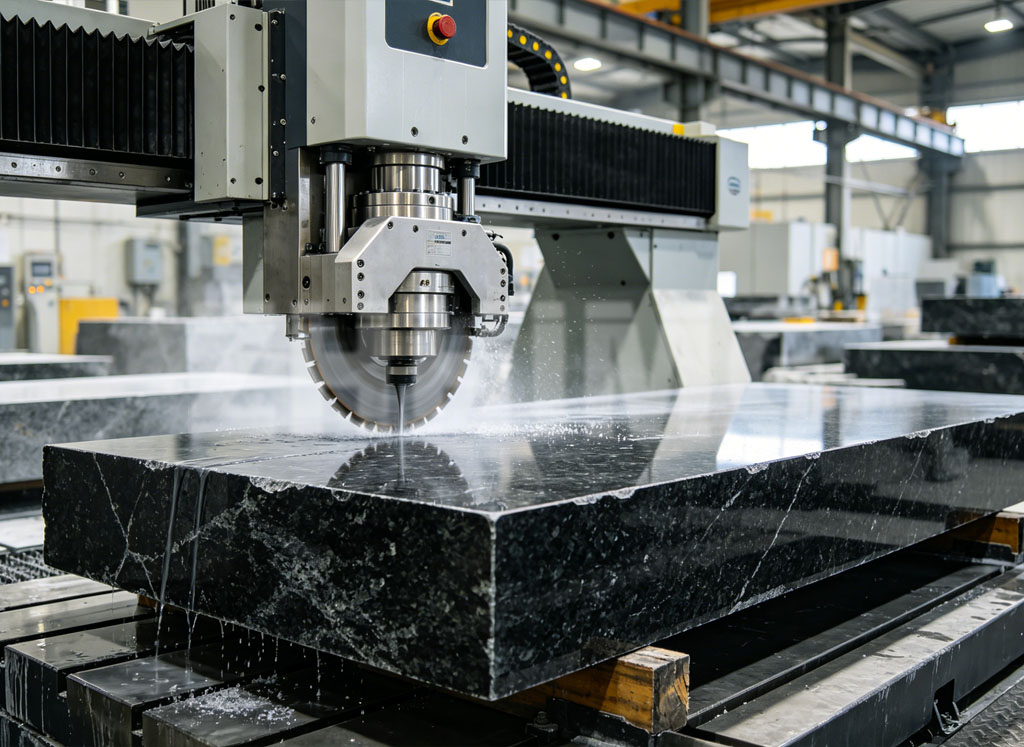
4. Industrial Precision Grading: Matching Material Grade with Accuracy
Current industrial precision standards for granite V-blocks strictly comply with DIN, ASME and GB international metrology regulations, categorized into four grades: 000, 00, 0 and 1, with accuracy decreasing sequentially. Each grade corresponds to dedicated material standards and application scenarios, and ultra-high precision can never be achieved with low-grade stone materials.
As the highest industrial grade, Class 000 ultra-precision V-blocks are exclusively manufactured from high-quality dense black granite and processed in constant-temperature, constant-humidity and vibration-proof workshops. They are widely applied in national metrology institutes, university laboratories and semiconductor precision calibration. Class 00 and Class 0 products serve precision machining, CMM testing and motor rotor calibration, while Class 1 is only used for conventional rough detection. ZHHIMG provides full-grade granite V-blocks with fully traceable and authentic precision data. Equipped with German Mahr, Swiss WYLER and British Renishaw high-precision testing instruments, the company issues standardized inspection reports for every product, eliminating false parameter labeling and shoddy high-grade products prevalent in the industry.
5. Dual Empowerment of Premium Material and Systematic Manufacturing
High-quality material forms the foundation of precision, while a complete manufacturing system guarantees stable precision delivery. Backed by a 200,000-square-meter production base and professional dust-free, constant-temperature and vibration-proof workshops, ZHHIMG maximizes the inherent advantages of premium granite materials. Through refined stress relief, unified benchmark processing, nano-level manual lapping and full-process segmented metrology verification, the superior material performance is fully converted into stable product precision, completely solving common pain points of ordinary V-blocks such as precision drift, easy abrasion and poor stability.
With ISO three-system certifications, CE certification and more than 20 international patents and trademarks, ZHHIMG granite V-blocks are exported worldwide, serving Fortune 500 enterprises, national metrology institutions and top research universities. With rigorous material selection and standardized ultra-precision manufacturing systems, ZHHIMG has set new benchmarks for the quality and precision of industrial granite V-blocks.
Summary: The precision of granite V-blocks relies 70% on material quality and 30% on processing technology. Material performance determines the precision ceiling and long-term stability, while craftsmanship realizes accurate finished precision. Product evaluation should focus not only on superficial precision data but also on core material indicators including stone density, grain uniformity and structural stability. Only premium dedicated granite combined with standardized precision manufacturing can produce durable, ultra-precise V-block measuring tools with long-term stable accuracy.
Post time: Aug-19-2026