
In high‑end testing scenarios such as sensor calibration, semiconductor wafer inspection, electromagnetic component verification and magnetic‑related scientific experiments, stray static or alternating magnetic fields are generated by on‑site motors, linear motors, excitation coils and magnetic tooling. Such magnetic interference is usually concealed. It will not directly damage hardware equipment, yet it can perturb sensor readings and distort local magnetic‑field distribution, resulting in poor measurement repeatability, zero‑point drift and distorted test data. In many project design phases, sufficient attention is paid to sensors and signal acquisition modules, while magnetic contamination introduced by the reference platform supporting workpieces and instruments is frequently overlooked. Traditional cast‑iron and steel reference components are ferromagnetic materials. Once magnetized by external magnetic fields, they will alter magnetic‑field patterns within testing zones and become secondary interference sources. Even with additional magnetic shielding devices, systematic errors originating from base substrates can hardly be fully eliminated. Targeting test conditions subject to magnetic‑field interference, ZHHIMG continuously researches material screening, processing and validation technologies for non‑magnetic granite surface plates. It unlocks the unique application value of non‑magnetic benchmarks under complex electromagnetic environments and builds a pure reference foundation for ultra‑precision inspection.
Non‑magnetic performance is not an inherent property of all natural granite. Some ordinary granite veins contain mixed ferromagnetic mineral particles, leaving weak residual magnetism on finished plates, which still triggers magnetic‑field distortion under weak‑magnetic test conditions. Certain suppliers on the market deliver ordinary stone falsely labelled as non‑magnetic granite without mineral‑component screening. End‑users only identify error sources during weak‑magnetic experiments, leading to test rework and project delays. ZHHIMG implements mineral‑component screening and magnetic‑susceptibility testing procedures for incoming raw blocks. It selectively adopts high‑density black granite raw materials with extremely low ferromagnetic‑impurity content. Boasting a density of 3100 kg/m³, the material is mainly composed of quartz and feldspar with barely any ferromagnetic phases. It achieves low magnetic susceptibility intrinsically. It will not be magnetized by external magnetic fields nor retain residual magnetism, preventing the reference platform itself from becoming a magnetic interference source.
Compared with metallic reference platforms, qualified non‑magnetic granite surface plates possess two core merits. Firstly, they will not generate extra magnetic fields excited by outside magnetism and preserve genuine and complete magnetic‑field signals of measured objects without distorting original magnetic‑field distribution within test areas. Secondly, as dielectric insulators, they produce no eddy‑current effects under alternating magnetic fields, avoiding secondary magnetic‑field noise induced by eddy currents. This is particularly critical for faint magnetic‑signal acquisition, Hall‑sensor calibration and magnetic‑component performance testing. Under magnetic‑field‑interference test conditions, the reference platform is more than a simple mechanical bearing plane; it serves as a key unit maintaining magnetic cleanness of test environments. Even with stray magnetic fields introduced by on‑site motors and linear motors, non‑magnetic granite surface plates maintain both geometric precision and stable magnetic surroundings. They are free from magnetostrictive deformation commonly seen on metal platforms, so that micro dimensional variations caused by magnetic fields will not be superimposed into measurement errors.
To satisfy stringent requirements of magnetic‑disturbed working conditions, ZHHIMG integrates non‑magnetic performance verification into the full quality‑control workflow instead of merely relying on raw‑material screening. Semi‑finished workpieces undergo re‑testing for magnetic susceptibility after rough machining, and blanks with locally aggregated magnetic impurities are rejected. Subsequent ultra‑precision lapping is completed inside the 10 000 m² constant‑temperature‑humidity workshop to obtain nano‑level flatness. Meanwhile, residual processing accessories and tooling debris that may introduce foreign magnetic particles are strictly kept off plates. Equipped with world‑class metrology tools including German Mahr dial gauges, British Renishaw laser interferometers and Swiss WYLER electronic levels, all testing instruments hold traceable calibration certificates. Apart from verifying flatness and geometric tolerances of plates, comprehensive simulation tests under different magnetic‑field intensities are carried out to validate precision retention performance under magnetic exposure. Leveraging technical teams with over 30‑year manual lapping experience and familiar with global metrology standards, ZHHIMG meets both geometric‑accuracy and non‑magnetic‑property specifications simultaneously. 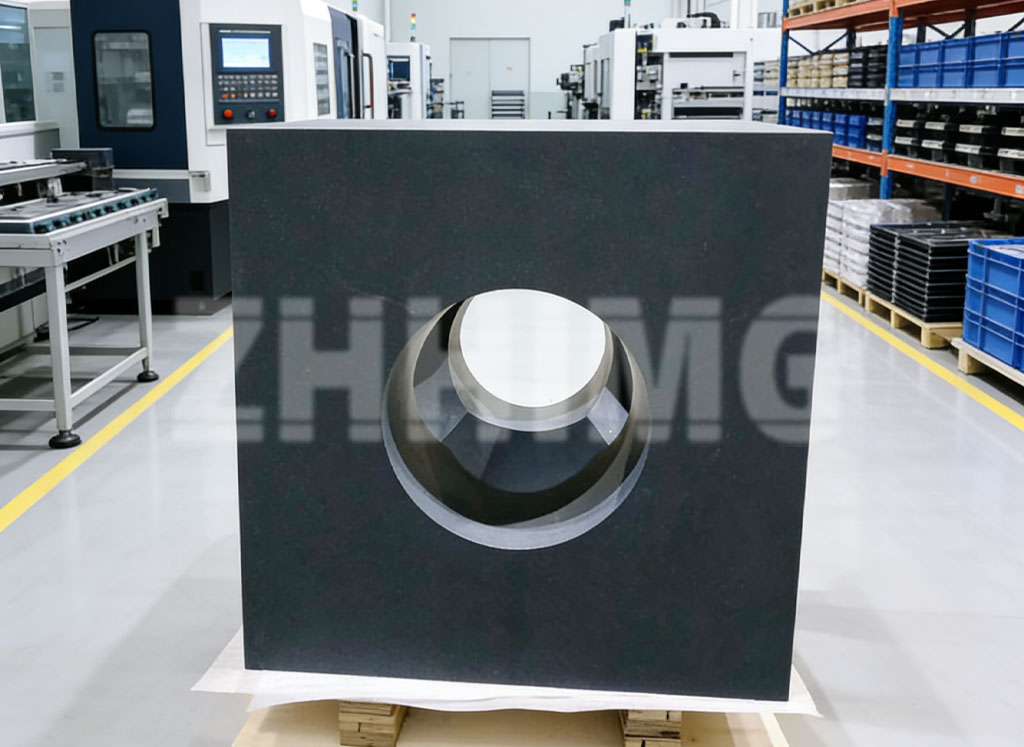
Industry‑university‑research joint experiments further deepen understandings on non‑magnetic granite surface plates applied under magnetic‑field‑interference conditions. ZHHIMG conducts comparative tests in cooperation with multiple overseas metrology institutes and university laboratories. It simulates various‑grade stray‑magnetic‑field industrial environments, compares sensor‑reading fluctuation and data dispersion between metal benchmarks and non‑magnetic granite benchmarks, accumulates abundant working‑condition databases, and optimizes material‑selection principles, dimension design and assembly guidelines for non‑magnetic plates. Owning more than 20 international trademarks and patents, as well as full ISO9001, ISO45001, ISO14001 and CE certifications, ZHHIMG abides by its customer commitment: no cheating, no concealment, no misleading. It draws a clear line between ordinary granite and non‑magnetic granite and rejects mis‑labelling ordinary stone as non‑magnetic products.
Nowadays, non‑magnetic granite surface plates are widely deployed in practical scenarios with multiple co‑existing magnetic disturbances: semiconductor optical inspection, AOI equipment bases, magnetic‑component testing, IMU sensor calibration, CMM inspection for magnetic parts, precision benchmarks for perovskite‑related equipment, weak‑magnetic laboratories and so forth. Pure electromagnetic shielding solutions are costly and have inherent limitations for complex industrial sites. Adopting non‑magnetic granite surface plates eliminates magnetic‑interference sources at the benchmark end and complements shielding solutions. It effectively lowers calibration difficulty for inspection systems and improves data reproducibility. Upholding its quality policy “For precision‑oriented business, no pursuit of perfection is excessive”, ZHHIMG keeps exploring application potential of non‑magnetic non‑metallic benchmark materials. It helps downstream customers tackle precision‑testing challenges brought by magnetic interference and facilitates high‑quality development of the ultra‑precision inspection industry.
Post time: Sep-07-2026