
1. High Damping for Vibration Suppression to Avoid Optical Imaging Interference
Automated optical equipment integrates linear motors, high‑speed motion modules and rotary mechanisms. Frequent start‑stop movements generate continuous excitation vibration. Vibration transmitted to lenses, cameras and light sources will cause image blurring and smearing, undermining inspection accuracy.
Thanks to its dense crystalline interior, black granite delivers outstanding damping capacity and fast vibration dissipation to restrain resonance. Jitters induced by motion‑unit start‑stop are quickly absorbed by the base, shortening system settling time and improving inspection throughput. Compared with metals, granite avoids continuous vibration transfer toward optical assemblies. Versus carbon‑fiber materials, it realizes faster residual‑vibration decay, which is critical for stations requiring continuous image capture and high‑speed frame acquisition.
2. Low Thermal Deformation Prevents Focus Drift Caused by Temperature Variation
Factory workshops rarely maintain absolutely constant temperature. Long‑time continuous operation also builds internal heat sources inside equipment. Thermal expansion and contraction‑driven base deformation shifts the distance between lens and workpiece, resulting in defocus and coordinate offset.
High‑grade black granite features a low thermal‑expansion coefficient and isotropic thermal behavior. Deformation remains uniform under temperature change without local warpage. Even with moderate workshop temperature fluctuations, dimensional variation stays minimal, keeping relative optical‑path positions stable. This is particularly vital for 2‑D video metrology, 3‑D profile scanning and AOI visual inspection, ensuring stable imaging benchmarks during full‑day mass‑production testing.
3. Directly‑Ground Nano‑Level Reference Surfaces Ensure Consistent Assembly Datums
Automated optical equipment imposes strict requirements on assembly references. Cameras, light sources, linear guides and motion axes are positioned relying on base datums. Some alternative materials can only offer reference surfaces via bonded metal inserts, where bonding and fastening interfaces introduce extra error sources.
Black granite can be precision‑ground to achieve exceptional flatness and straightness directly on the beam itself, eliminating numerous transition inserts. Optical modules and linear guides can be mounted directly onto granite reference planes, reducing cumulative errors from multi‑layer assembly. Relative optical‑path positions maintain good consistency after factory assembly, easing factory‑side debugging and lowering on‑site recalibration workload for end‑users.
4. Non‑magnetic and Rust‑proof for Complex Optical‑shop Environments
Optical workshops commonly face motor‑generated magnetic fields, moisture and volatile cutting‑fluid mist. Steel and cast‑iron bases tend to magnetize and corrode. Rust particles may contaminate lenses and workpieces; magnetization can also interfere with optical sensors and delicate electronic components.
Black granite is non‑magnetic and oxidation‑free. It resists moisture and common industrial oil contamination. No corrosive metal debris will pollute optical lenses, lowering risks of component damage. Even operating long‑term under harsh conditions inside semiconductor and PCB plants, the material suffers no chemical performance degradation. 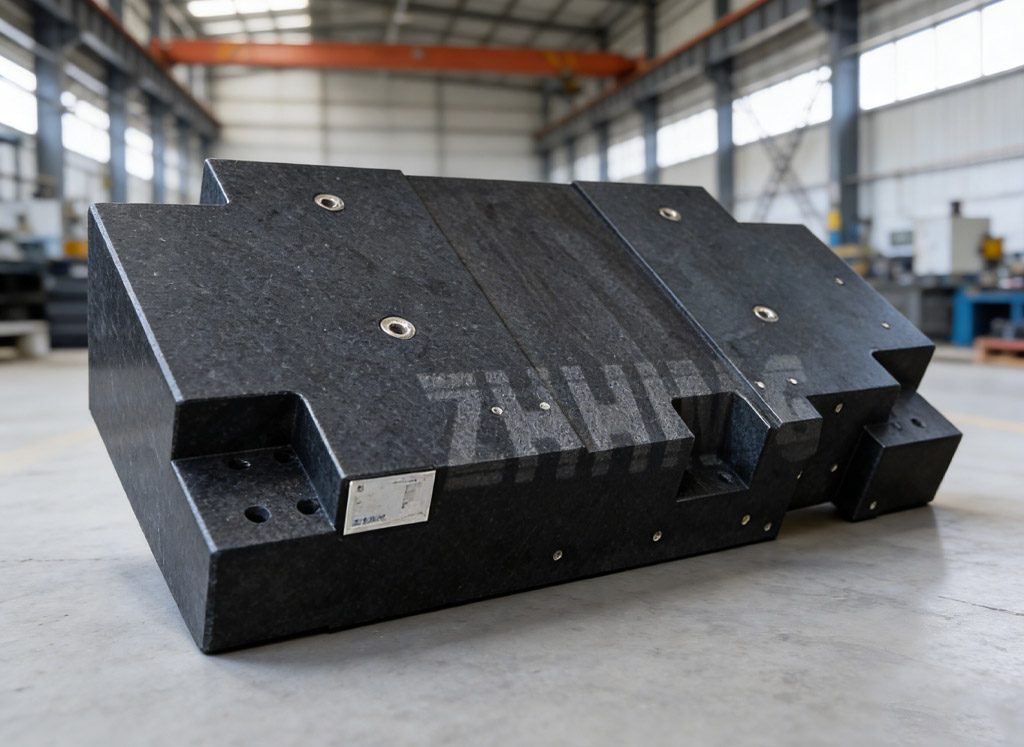
5. Superior Long‑term Dimensional Stability Reduces Maintenance Frequency
Many automated optical systems run 7×24 hours. Equipment manufacturers attach great importance to long‑term base‑accuracy retention. Composite materials may creep under sustained load; metal structures slowly deform due to internal‑stress release, calling for frequent optical‑path recalibration.
Fully stress‑relieved black granite shows zero creep and no gradual deformation under continuous loading. Provided impact damage is avoided, datum accuracy can be preserved over long service cycles. Longer calibration intervals reduce on‑site service visits and cut overall operating costs for end‑customers.
6. Large‑size Monolithic Machining for Wide‑field‑of‑view Optical Equipment
Large‑format automated optical inspection machines, such as large‑size PCB testers, wide‑format AOI and long‑travel video measuring systems, demand long‑span base structures. Spliced bases inevitably bring seam‑induced errors and break datum continuity.
Black granite supports monolithic processing of long‑span beams without splicing. Continuous reference surfaces satisfy assembly requirements for large‑field‑of‑view and long‑travel optical devices. Multiple cameras and light channels can be mounted on a single granite beam to guarantee relative‑position accuracy, well‑suited for wide‑format mass‑inspection machine development.
Material Selection Reminder
Some suppliers substitute ordinary marble for premium black granite. Loose marble delivers poor damping and thermal stability. Although performance may seem acceptable in short‑term use, accuracy gradually drifts over time and raises false‑alert rates for optical inspection. During R&D material selection, engineers should carefully verify raw‑stone properties and prioritize high‑density black granite with stable physical indices.
Conclusion
Black granite mechanical beams well match the multi‑fold requirements of automated optical equipment for vibration suppression, thermal‑drift resistance, datum precision and long‑term stability. Its high damping suppresses imaging jitter; low thermal expansion stabilizes optical paths under temperature swings; in‑situ ground ultra‑precision datums eliminate inserts; non‑corrosive non‑magnetic properties suit industrial environments; plus monolithic large‑size capability. All these make it a preferred base solution for high‑end automated optical equipment.
As machine‑vision, semiconductor optical inspection and laser‑metrology industries keep evolving, substrate material selection has become one key differentiator of equipment performance. Black granite mechanical beams are gaining wider adoption across premium automated optical machinery.
Post time: Aug-07-2026