
In high-end equipment sectors such as precision optical inspection, semiconductor packaging and laser micro-machining, vibration during equipment operation is a core issue that affects production yield and measurement repeatability. Many equipment manufacturers adopt external vibration isolators and passive dampers to mitigate vibration. However, most of these solutions are post-vibration treatments. They only attenuate vibration after it occurs and cannot eliminate disturbances originating from vibration sources. Many engineers wonder: can granite machine bases reduce equipment operating vibration from the source? The answer requires comprehensive analysis from three dimensions: vibration generation mechanism, material damping properties and base structural design.
First, one concept needs to be clarified. Granite bases cannot completely eliminate vibration generated by moving components such as motion modules, spindles and linear motors. The start-stop and high-speed reciprocating motion of moving mechanisms inherently excite dynamic disturbances, and vibration sources come from internal moving parts of the equipment. Stone bases cannot make vibration sources disappear. Nevertheless, ZHHIMG granite bases rely on the inherent physical properties of high-density black granite blanks. They suppress vibration amplification, block vibration transmission paths and weaken the spread of vibration inside the whole machine. In other words, they cut off the vibration propagation chain at the structural level and prevent tiny vibrations from being amplified. This is their core advantage over ordinary shock-absorbing accessories.
Metal bases have low damping coefficients. Once excited, vibrations keep reflecting inside the structure and trigger resonance. Minor vibrations get continuously amplified and transmitted to inspection lenses and machining actuators. In contrast, ZHHIMG granite reaches a density of 3100kg/m³ with dense and uniform texture and excellent natural damping performance. When micro-vibrations are generated by linear motors and sliding table movements, the granite substrate quickly absorbs vibration energy and converts kinetic energy into heat for dissipation. This prevents continuous reflection and superposition of vibration within the machine structure. Such inherent vibration damping capacity of the material is unmatched by cast iron and aluminum alloy bases. It effectively suppresses overall machine resonance and stops vibration amplification from interfering with precision operations.
Besides the material’s damping characteristics, the self-weight of the base and integrated structural design are key to further restraining vibration transmission. ZHHIMG can fabricate large-size monolithic granite bases. The heavy weight of the solid stone stabilizes the center of gravity of the whole machine. When excitation force is produced by internal moving components, the heavy-duty base is less prone to shaking under excitation, greatly reducing the amplitude of the whole machine. Compared with spliced bases or thin-walled metal bases, one-piece granite bases have no assembly gaps for vibration transmission, avoiding repeated scattering and amplification of vibration at splicing interfaces. Combined with a reasonable layout of support points, they can isolate external vibration from the ground and suppress vibration interference both internally and externally. 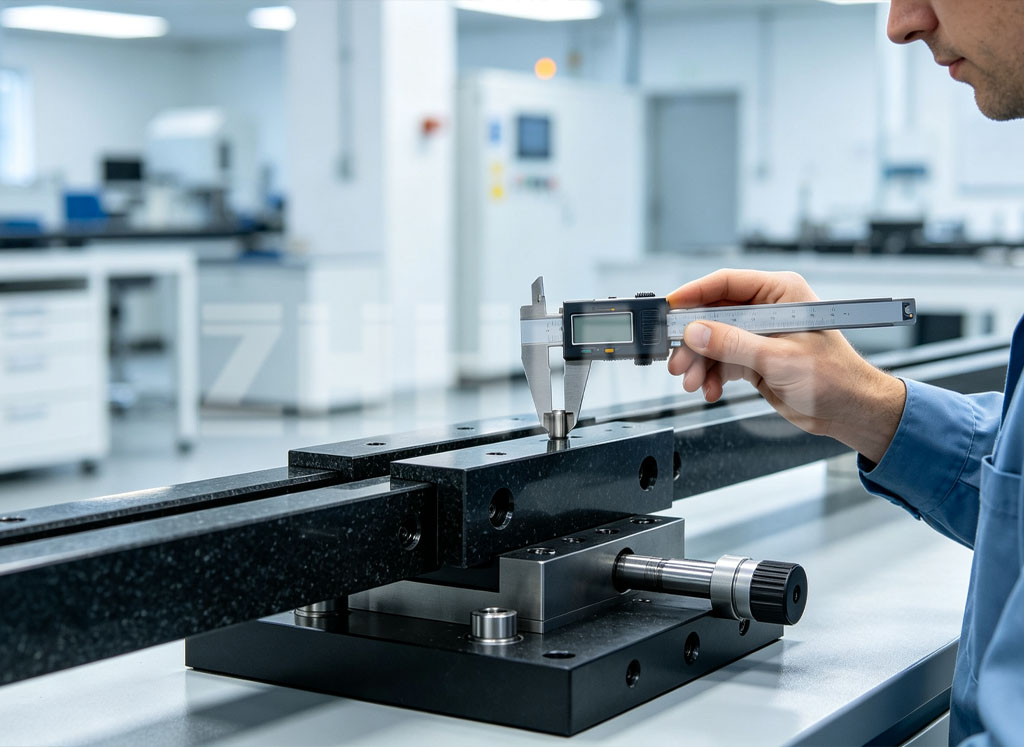
Objectively speaking, the vibration damping capability of the material is not omnipotent. If there is strong low-frequency vibration on the workshop floor or the equipment itself has design defects leading to sustained large excitation, granite bases alone cannot fully eliminate vibration. Under such working conditions, ZHHIMG technical team will combine granite bases with independent anti-vibration foundations and anti-vibration trench solutions according to on-site working conditions to build a complete anti-vibration system. The granite bases, ultra-precision ground in a constant temperature and humidity workshop, have undergone sufficient aging for stress relief. Their structures are stable without internal stress and will not deform under long-term alternating vibration, maintaining outstanding vibration suppression performance continuously. Finished bases are inspected by precision metrology instruments including Mahr (Germany), Wyler (Switzerland) and Renishaw (UK) with traceable accuracy to guarantee stable structural benchmarks.
In practical applications, for coordinate measuring machines, semiconductor inspection equipment and femtosecond laser processing machines equipped with ZHHIMG granite bases, micro-vibrations generated during movement dissipate rapidly. Optical lenses and inspection probes maintain stable posture with smaller fluctuations in measurement data and significantly improved consistency of machined contours. That is why many metrology institutes and Fortune 500 enterprises prefer granite bases as the benchmark load-bearing components for ultra-precision equipment development.
In conclusion, granite machine bases cannot completely eliminate the original vibration generated by moving parts of equipment, but they can suppress vibration amplification from the structural source, block vibration transmission and prevent micro-vibration from evolving into harmful disturbances that impair precision. With high damping, large inertia and a stable integrated structure, they achieve native vibration suppression effects. When matched with proper on-site foundation anti-vibration schemes, they create a stable operating environment for the whole machine and deliver reliable anti-vibration benchmark support for various ultra-precision equipment.
Post time: Sep-15-2026