
Frame material decisions for machine tools and precision equipment tend to get made early in a project and rarely revisited, which is unfortunate, because the trade-offs between cast iron, steel weldment, and mineral casting are significant enough to affect a machine’s performance for its entire service life. None of the three is universally better. Each solves a different combination of problems, and the wrong choice usually doesn’t show up as a failure — it shows up as a machine that’s slightly noisier, slightly less accurate, or slightly more expensive to build than it needed to be.
Cast iron: the traditional answer, still relevant
Cast iron has been the default machine tool frame material for over a century, and it earned that position honestly. Its graphite flake structure gives it genuinely good internal damping — better than steel — which matters for machining centers where cutting vibration needs to be absorbed rather than transmitted through the structure. It’s also relatively cheap in volume production, and foundries have a century of process knowledge behind casting complex geometries reliably.
The downsides are real, though. Tooling for a cast iron frame is expensive and slow — a new pattern and mold can take months before the first casting comes off, which makes cast iron a poor fit for low-volume or one-off projects. Casting also introduces internal stress that needs proper aging or heat treatment before final machining, or the frame will move slightly as stresses relax after installation. Skipping that step is a common shortcut among lower-cost suppliers, and it’s the kind of defect that doesn’t show up until a customer notices geometry drift months into operation.
Steel weldment: speed and geometry flexibility
Welded steel frames solve the tooling problem directly — no pattern, no mold, just plate and structural steel cut, fit, and welded to a fabrication drawing. Lead times are typically much shorter than cast iron, and design changes mid-project are far less costly since there’s no mold to modify. For low-volume runs, prototypes, or large structures where casting simply isn’t practical at that size, weldment is often the only realistic option.
The trade-off is damping and residual stress. Welded steel has less internal damping than cast iron, so vibration transmits more readily through the structure — a real consideration for high-speed or high-precision applications. Welding also introduces localized heat-affected zones and residual stress around every weld, and without proper stress-relief (typically thermal, sometimes vibratory), a weldment frame can distort over time as those stresses release, sometimes months after machining. A shop that skips stress relief to save a production cycle is trading a short-term schedule win for a long-term accuracy problem the customer inherits.
Mineral casting: a newer answer to an old problem
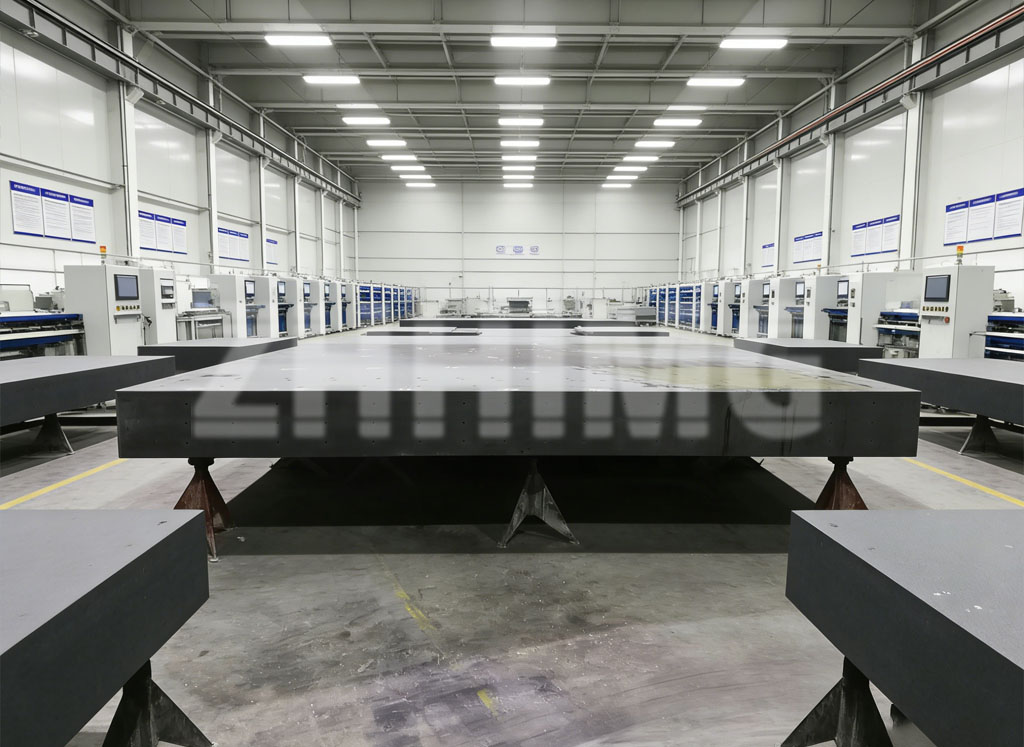
Mineral casting — crushed granite or quartz aggregate bound in an epoxy resin, cast into a mold much like cast iron but at room temperature — has grown from a niche material into a mainstream option over the past two decades, particularly for grinding machines, coordinate measuring equipment, and precision assembly frames. Its damping coefficient is typically several times better than cast iron, which noticeably reduces vibration-related surface finish issues on grinding and high-speed applications. Because the casting process doesn’t require melting metal, it’s also possible to cast in mounting inserts, cooling channels, and cable routing directly into the mold, features that would need to be machined afterward on a metal frame.
Cost and lead time sit between the other two options in most cases — cheaper tooling than cast iron, though mold design still takes real engineering time up front, so it doesn’t suit true one-off prototypes as well as weldment does. Where mineral casting genuinely outperforms both alternatives is thermal stability; its coefficient of thermal expansion is lower than either cast iron or steel, closer to natural granite, which matters for equipment operating in variable-temperature shop environments rather than a climate-controlled lab.
Matching material to the actual failure mode
In practice, the decision comes down to which failure mode a project can least afford. A high-volume production machine tool where damping and long-term wear resistance dominate still points toward cast iron more often than not. A custom or low-volume structure needing fast turnaround points toward weldment, provided the stress-relief step isn’t skipped. A grinding machine, CMM, or thermally sensitive precision frame increasingly points toward mineral casting — it’s a material we work with directly alongside granite, and the projects where it earns its premium are consistently the ones where vibration and thermal drift, not raw stiffness, were the limiting factor.
Questions worth asking before specifying a frame material
- What’s the actual vibration source and frequency range the frame needs to damp, not just a general “high precision” requirement
- How is residual stress managed — natural aging, thermal stress relief, or vibratory stress relief — and for how long
- What’s the realistic lead time including stress relief and final machining, not just casting or welding time
- For mineral casting, what’s the mold amortization structure for the expected production volume
- Whether the supplier can provide dimensional stability data after a stress-relief cycle, not just as-built numbers
No single frame material wins across every application. Matching the material to the dominant failure risk — vibration, thermal drift, or schedule — tends to matter more than any single property listed on a datasheet.
Post time: Aug-20-2026