
In the ultra-precision equipment industry, most people focus on the final flatness of finished granite components, yet they often overlook a hidden factor: residual stress inside the material. Even if a granite workpiece meets precision standards upon factory inspection, insufficient stress release will trigger subtle deformation over time under long-term operation and fluctuating temperature and humidity. The original geometric tolerances will gradually drift and reduce the positioning accuracy of the whole machine. For equipment with stringent stability requirements such as semiconductor inspection systems, laser processors and coordinate measuring machines, losses caused by this slow deformation can hardly be estimated. This explains why stress relief aging serves as an essential process to guarantee the long-term precision stability of CNC granite components.
Natural granite accumulates internal stress during ore formation, quarrying, cutting and rough machining. Stone parts after simple cutting and grinding may look precise on the surface, while internal stress remains in temporary equilibrium. Once mounted on machinery, external factors including assembly clamping force, cyclic temperature change and continuous vibration will break this balance and induce invisible slow deformation. Many low-end manufacturers skip complete aging procedures and deliver products merely after short natural storage. Their products show good test results at first, but precision drifts after weeks or months of service.
ZHHIMG has developed a dedicated stress relief aging system for CNC granite parts, which is far more than simple natural placement. The first aging cycle starts at the blank stage. Raw blocks are stored in a temperature-stabilized and vibration-isolated yard for extended periods to release primary stress generated during quarrying and sawing. After rough CNC machining, grooving and drilling, secondary aging is carried out to eliminate new residual stress introduced by cutting. Multiple progressive aging cycles fully release internal stress and bring the material into a stable equilibrium state before ultra-precision lapping and final finishing.
The whole aging process is implemented in a workshop with controlled temperature and vibration to minimize later deformation risks caused by stress. After aging treatment, granite components undergo nano-precision manual lapping and comprehensive metrology inspection. Flatness, hole positions and geometric tolerances of grooves are locked in place. Even under year-round non-stop operation with temperature fluctuations and continuous dynamic loads, the workpiece dimensions and reference surfaces retain original precision without gradual deformation.
Compared with cast iron structures, metal parts still creep under thermal cycling even after artificial aging. Untreated granite components carry potential deformation risks. ZHHIMG granite parts with full stress relief aging avoid both drawbacks. The material’s low expansion and high damping properties, combined with stress release processes, deliver dual guarantees for datum stability. 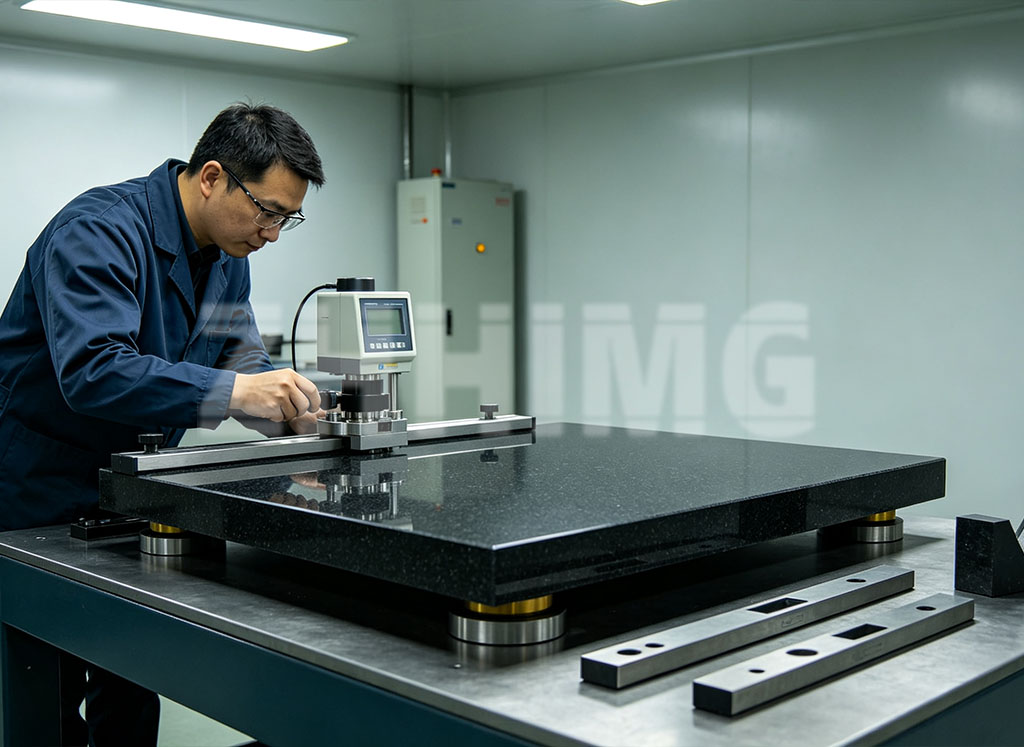
These aged CNC granite components are widely applied in linear motor stages, precision CNC machine beds, AOI optical inspection bases, femtosecond laser equipment frames and other high-end machinery. Equipment manufacturers can greatly reduce calibration frequency and downtime while maintaining long-term repeat positioning performance. For exported precision machines and metrology instruments running continuously, stress-stabilized granite bases act as the fundamental guarantee for reliable overall precision.
In conclusion, excellent inherent physical properties of granite only lay the foundation. Adequate stress relief aging is the key to locking in precision. Only by releasing residual stress inside the material in advance can CNC granite components maintain stable precision over time and satisfy strict long-service requirements of global ultra-precision equipment.
Post time: Sep-21-2026