
If you design ultra-precision motion stages, optical inspection machines, or metrology equipment, you have probably faced the same decision: how do you move a payload across a work zone with sub-micron straightness, no stick-slip, and no wear? For a growing number of machine builders, the answer is a granite air bearing system. This article explains how air bearings actually work, why granite is the ideal guide surface material, and what you should consider before specifying an air bearing stage — written for the engineers who will draw the CAD, not just the ones who read brochures.
1. How Air Bearings Work: The Film That Replaces Contact
A hydrostatic air bearing feeds filtered, pressurized air through small orifices or a porous restrictor into an extremely thin gap — typically in the range of a few microns — between the bearing pad and the guide surface. The escaping air builds a pressure field that floats the carriage completely off the rail. There is no metal-to-metal contact, no lubricant, and in theory no mechanical wear at all.
What this delivers in practice:
- Friction approaches zero. No static friction means no stick-slip, so the servo can resolve nanometre-scale moves and hold position without dithering.
- Motion error drops dramatically. Because the carriage rides on an averaged pressure film rather than on rolling elements, the straightness of travel is governed largely by the quality of the guide surface — which is exactly where granite excels.
- Silent, clean operation. No grease to attract particles, no ball-bearing noise — a natural fit for cleanroom and optical environments.
- Essentially infinite life. With no contact during motion, there is nothing to fatigue, pit, or wear out.
The trade-off is that the system is only as good as its weakest element: the air supply must be clean and stable, and the guide surface must be geometrically excellent. A perfect bearing on a poor rail still produces poor motion.
2. Why Granite Is the Ideal Guide Surface for Air Bearings
Air bearings amplify the qualities of whatever they ride on. Granite — specifically the fine-grained black granite ZHHIMG® machines — has a property set that matches the physics of air film guidance almost perfectly:
- Lapped flatness at the micron level. Granite can be hand-lapped to flatness grades that rolling guides cannot match over long travel, because the surface is finished as one continuous plane rather than assembled from segments.
- Thermal stability. The thermal expansion coefficient of granite is a small fraction of that of steel, so a granite guide holds its geometry through shop and lab temperature swings far better than a steel rail ever will.
- High damping. Granite dissipates vibration quickly. The same property that makes it a superb granite machine base material also damps micro-vibration in the air film, improving scan stability.
- No corrosion, no magnetism. No rust under humidity, no magnetic signature near sensitive sensors or electron optics, and no need for coatings that could outgas or flake.
- Scratch tolerance and edge integrity. A nick in a steel rail can crash a bearing; granite’s hardness and the ability to re-lap a damaged region make service and recovery realistic.
One more practical point: because granite is machined rather than ground from standardized profiles, guide rails can be supplied with integrated datum surfaces, reference steps, inserts and mounting features directly lapped into the part — fewer interfaces, fewer error stacks.
3. Design Considerations When Specifying an Air Bearing Stage
Engineers new to air-bearing stages often underestimate how many decisions sit around the bearing itself. From ZHHIMG®’s experience supporting semiconductor and inspection equipment builders, these are the points that matter most:
3.1 Order the bearing and the guide as one matched set
Gap tolerance is typically just a few microns. If the bearing is sourced from one vendor and the granite rail from another, neither party owns the gap. Specify the bearing pads and the granite guideway as a matched assembly, with the preload, gap and flow measured together on the finished parts.
3.2 Air supply quality is part of the design
Plan for filtered, dry, pressure-regulated air from day one — particles or pressure pulses in the supply translate directly into motion error or, worse, a pad touching down. Define cleanliness class, dew point and regulation tolerance in your machine specification.
3.3 Structure: stiff, symmetric, thermally quiet
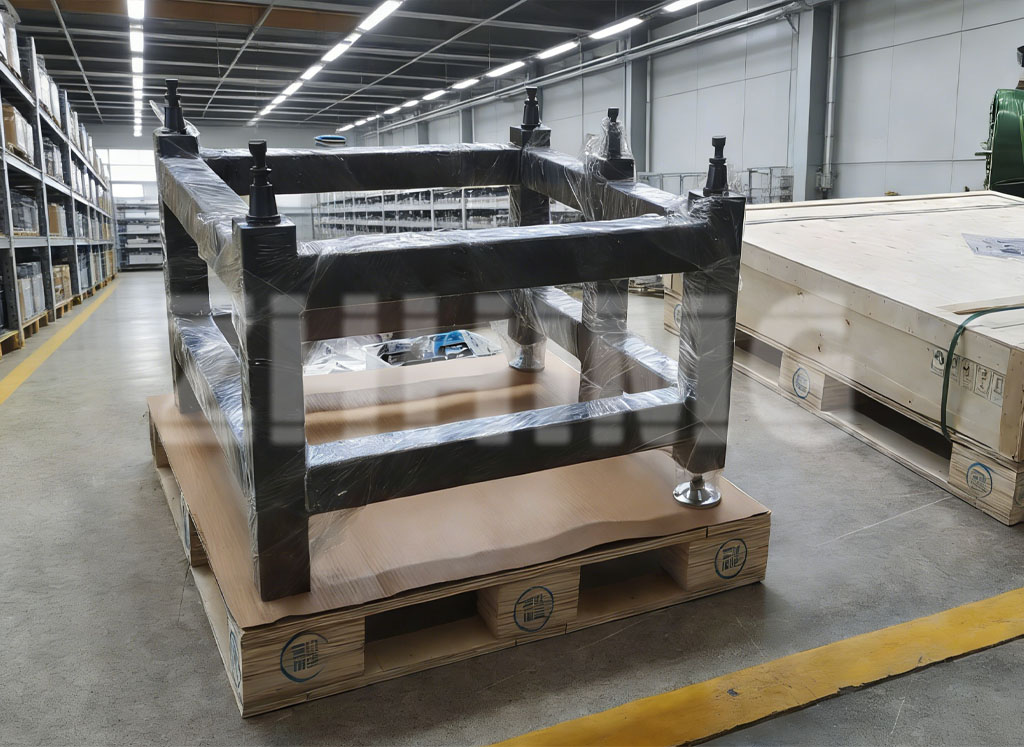
The granite rail must be mounted on a base that is at least as stable as the rail itself. Structural frames — like the granite component shown in this article, supplied with machined levelling mounts for fine in-situ alignment — should provide symmetric support to avoid induced bending, and isolation from floor vibration. A granite guide bolted to a flexible weldment throws away most of its potential.
3.4 Payload, moment loads and preload
Air films have limited stiffness by nature. Map your payload’s centre of gravity, acceleration forces and moment loads against the bearing’s stiffness and load capacity curves, and use opposed (preloaded) pad configurations where the application demands higher stiffness or inverted travel.
3.5 Plan the metrology path
Straightness, angular errors and dynamic performance should be measured with laser interferometry on the assembled stage. Choose a supplier who can iterate: re-lapping a granite rail is a normal, repeatable process, not a warranty claim.
4. Assembly Environment: What It Takes to Build Air Bearing Systems Properly
An air bearing stage that performs perfectly in the lab can fail qualification if it was assembled in the wrong environment. Final assembly and lapping of precision granite components belong in a temperature-controlled, low-particulate workshop: stable temperature so that lapped geometry measured in-house matches the geometry the customer receives; clean air and controlled handling so that no particles migrate into finished surfaces; and calibrated levelling and torque procedures so that no stress is introduced into the granite during mounting.
This is also why leading builders of ultra-precision granite solutions integrate assembly, calibration and inspection in-house. When the same facility laps the surfaces, assembles the bearings and runs the final metrology, errors are caught where they are created — not at your acceptance test.
5. When Should You Choose Granite Air Bearings?
A simple rule set for your next architecture review:
- Choose granite air bearings when you need sub-micron straightness, nanometre-level positioning, long travel with low motion error, cleanroom compatibility, or scan stability for optical and semiconductor metrology.
- Consider alternatives when loads are heavy and shocks are frequent, when air supply is genuinely unavailable, or when cost targets cannot support the supporting infrastructure (filtration, stable base, controlled environment).
If your product roadmap includes lithography-adjacent motion, wafer and panel inspection, or next-generation CMM architectures, granite air bearing technology is very likely in your future — and it is worth building the supply chain for it early.
Talk to ZHHIMG® About Your Air Bearing Application
ZHHIMG® manufactures precision granite components including air bearing guides, machine bases and structural frames from fine-grained black granite (density approx. 3100 kg/m³), with in-house lapping, assembly, calibration and inspection, and full control of the material from quarry blocks to finished, certified parts. Send us your travel range, payload, required straightness and throughput targets — our engineers will reply with a practical proposal for precision granite mechanical components matched to your stage architecture.
Post time: Sep-21-2026