
In precision metrology, where tolerances reach sub-micron levels, selecting the appropriate gauge material directly determines measurement accuracy, equipment lifespan, and product quality. Ceramic gauges and granite gauges represent two dominant material approaches in modern precision measurement, each offering distinct advantages rooted in their fundamental material properties.
As industries from semiconductor manufacturing to aerospace push dimensional tolerances to unprecedented levels, this comprehensive gauge comparison examines the technical specifications, application suitability, and economic factors that should guide your decision when selecting measurement tools for specific precision requirements.
Both materials have proven their worth in metrology laboratories worldwide, but their performance characteristics diverge significantly when subjected to thermal fluctuations, mechanical wear, chemical exposure, and dynamic measurement conditions.
Material Properties: In-Depth Comparison
Thermal Expansion Coefficient and Impact on Measurement Accuracy
Temperature stability represents one of the most critical factors in precision measurement. Granite demonstrates a coefficient of thermal expansion of approximately 6.5 × 10⁻⁶/°C, which closely matches that of many steel components in manufacturing environments.
Ceramic gauges exhibit different thermal characteristics depending on composition. Alumina ceramics typically show 7.2 × 10⁻⁶/°C, while silicon carbide ceramics offer superior stability at just 2.5 × 10⁻⁶/°C. For comparison, conventional steel gauges measure at 11.5 × 10⁻⁶/°C.
In environments with ±2°C temperature variation, a 100mm granite gauge experiences dimensional change of approximately 1.3μm, while an equivalent silicon carbide ceramic gauge shifts by only 0.5μm. Both materials outperform steel significantly, but silicon carbide ceramics offer substantially better thermal stability for stringent temperature control requirements.
Hardness and Wear Resistance: Impact on Service Life
Wear resistance directly determines how long gauges maintain calibrated dimensions under repetitive use. Granite measures 6-7 on the Mohs hardness scale, providing substantial resistance to surface scratches from its quartz-feldspar-mica mineral composition naturally stress-relieved over millions of years.
Ceramic gauges, particularly zirconia and alumina formulations, achieve significantly higher hardness at HRA 88-92, translating to Vickers hardness of 1200-1450 HV1, exceeding both granite and steel (HRC 58-62). The practical consequence: ceramic gauges demonstrate wear resistance 10-100 times that of steel gauges, while granite offers approximately 5-10 times steel’s wear resistance. In high-volume inspection environments, ceramic components maintain calibrated dimensions far longer than granite counterparts.
Vibration Damping Characteristics for Dynamic Measurement
Vibration damping becomes crucial in dynamic measurement scenarios involving coordinate measuring machines (CMMs) and automated inspection stations. Granite excels in this category, with natural damping ratio of 0.012-0.015 compared to approximately 0.001 for both cast iron and ceramics. This translates to 95% vibration attenuation at 50-500Hz frequencies, making granite particularly valuable as a measurement base material.
Ceramic materials transmit vibrations rather than absorbing them, making them less suitable for large surface plate applications. However, this presents fewer issues for smaller gauge blocks, pin gauges, and ring gauges where contact occurs at localized points.
Chemical Stability and Corrosion Resistance
Both ceramic and granite gauges offer excellent chemical resistance compared to steel alternatives. Granite demonstrates inherent resistance to most oils, coolants, and mild chemicals with pH stability range spanning 1-14.
Ceramic gauges provide exceptional chemical inertness, resisting virtually all acids, alkalis, and organic solvents. Advanced ceramic formulations achieve near-zero porosity, preventing fluid absorption and potential dimensional changes from moisture uptake. In electronics manufacturing environments with flux residues and cleaners, ceramic gauges maintain their surface finish and dimensional integrity far better than granite.
Non-Magnetic Properties Comparison
Both ceramic and granite gauges provide non-magnetic measurement solutions. Granite exhibits inherently low magnetic susceptibility suitable for most general-purpose applications. Ceramic gauges offer essentially zero magnetic susceptibility and complete electrical insulation—critical for applications involving Hall effect sensors, electromagnetic test equipment, or semiconductor manufacturing where minimal magnetic interference could corrupt results.
Performance Parameters: Systematic Comparison
Accuracy Grade and Measurement Uncertainty
Both ceramic and granite gauges achieve the highest precision grades. Granite gauge blocks typically achieve ±0.03μm accuracy at K-grade specifications, with surface flatness reaching sub-micron levels. Ceramic gauge blocks achieve even tighter tolerances at ±0.02μm through advanced manufacturing processes including isostatic pressing, high-temperature sintering at 1600-1700°C, and precision lapping.
The controlled material properties of ceramics allow for more consistent dimensional accuracy across production batches compared to naturally occurring granite, which inherently exhibits slight variations between quarry sources.
Long-Term Stability and Dimensional Retention
Granite possesses remarkable natural stability from millions of years of geological formation and internal stress relief. High-quality granite gauges maintain dimensional stability for decades with minimal drift. Ceramic gauges exhibit equally impressive long-term stability, with dimensional changes limited primarily to thermal effects rather than inherent material relaxation. Both materials demonstrate exceptional long-term dimensional retention, vastly outperforming steel gauges.
Surface Quality and Optical Reflection Characteristics
High-quality granite surfaces achieve Ra values of 0.1-0.4μm through diamond polishing. Ceramic gauges achieve superior surface finishes typically reaching Ra ≤ 0.1μm. This extremely smooth surface enhances wringing performance for gauge block assemblies, reduces friction during pin gauge insertion, minimizes component scratching, and provides consistent optical properties for vision-based measurement systems.
Impact Resistance and Breakage Resistance
Granite exhibits natural toughness from its interlocking crystalline structure, making it relatively resistant to chipping from minor impacts. Ceramic materials, despite exceptional hardness, exhibit brittleness that can lead to catastrophic fracture under impact loading. Advanced ceramic formulations provide improved fracture toughness (6-8 MPa·m½), but ceramics remain more susceptible to chipping and cracking from drops than granite, making proper handling procedures particularly important.
Application Scenario Analysis: Optimal Selection
Semiconductor and Nanometer-Level Manufacturing
Recommended Choice: Ceramic Gauges
In semiconductor manufacturing where tolerances reach nanometer levels, ceramic gauges are superior. Their combination of extremely low thermal expansion coefficients, non-magnetic properties, electrical insulation, and exceptional chemical resistance addresses the most demanding requirements of IC fabrication, wafer inspection, and photolithography calibration. Ceramic pin gauges reliably inspect micro-vias below 0.3mm without causing electrical shorts, while ceramic gauge blocks provide reference standards for calibration labs.
General Precision Manufacturing and Quality Control
Recommended Choice: Application-Dependent
High-volume inspection operations with repetitive contact cycles benefit significantly from ceramic’s superior wear resistance, reducing replacement frequency and calibration costs. For measurement bases, surface plates, and larger reference surfaces where vibration damping matters, granite provides superior performance and often better cost-effectiveness. Many quality control departments effectively deploy both materials.
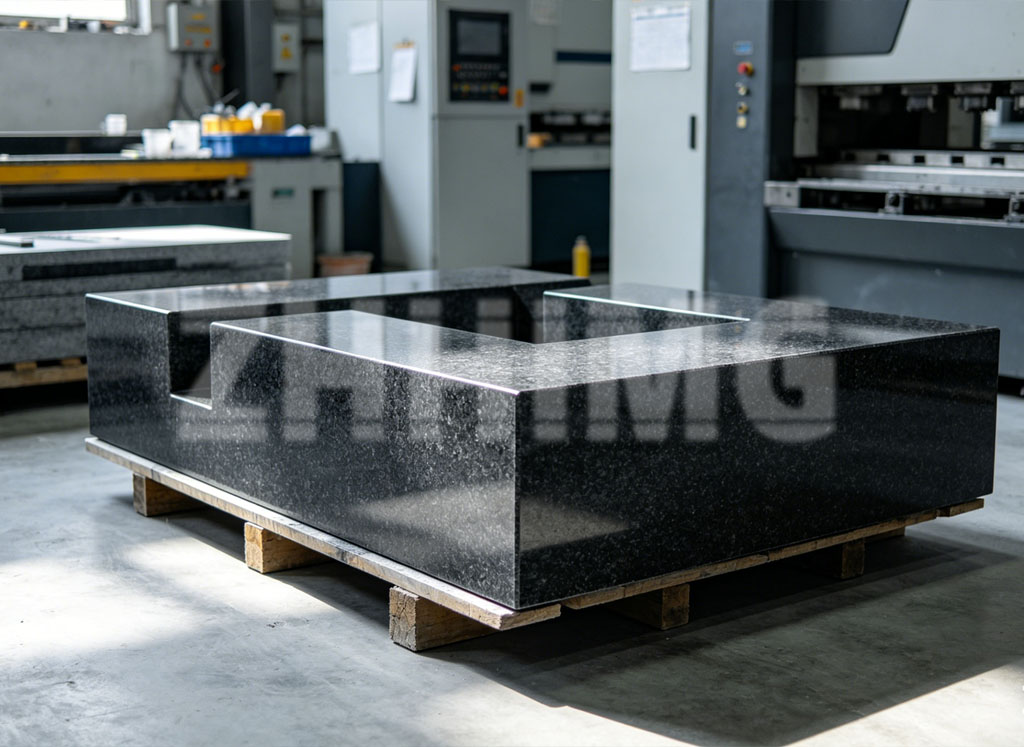
Large Components and Large-Dimension Measurement
Recommended Choice: Granite Gauges and Surface Plates
For large-dimension measurement applications including large CMM bases and assembly fixtures, granite represents the clear choice. Its excellent vibration damping, proven dimensional stability in large cross-sections, and cost-effectiveness at scale make it ideal. Manufacturing granite components up to several meters presents fewer challenges than producing equivalent large ceramic structures, which face technical limitations related to sintering uniformity.
Harsh Environments and Specialized Industries
Recommended Choice: Ceramic Gauges
In harsh operating environments including chemical processing and pharmaceutical production, ceramic gauges provide definitive advantages. Their complete corrosion resistance, non-porous surface, ease of cleaning, and resistance to chemical attack ensure measurement accuracy remains unaffected. Certain ceramic formulations maintain stability at temperatures up to 1000°C, far exceeding granite’s practical limit of approximately 350°C.
Cost and Return on Investment Analysis
Initial Acquisition Cost
Ceramic gauges typically cost 2-3 times equivalent granite gauges and 3-5 times comparable steel gauges. This premium reflects the complex manufacturing processes required for advanced ceramic materials. Granite gauges, while more expensive than steel, offer a more moderate cost premium that reflects quarrying, selection, aging, and precision finishing processes. For large-format components, the cost differential becomes even more pronounced.
Service Life Expectancy
Properly maintained granite gauges demonstrate service lives of 30-40 years, with some precision granite plates remaining in service for half a century. Ceramic gauges typically provide 20-30 years of service life under normal operating conditions, though this can be significantly shorter if impact damage occurs. For comparison, steel gauge blocks typically require replacement every 5-10 years.
Maintenance and Replacement Costs
Granite requires periodic cleaning, occasional surface reconditioning, and regular calibration. Ceramic gauges require similar cleaning protocols but rarely need surface reconditioning due to exceptional hardness. However, when ceramic gauges suffer damage from impact, they typically require complete replacement, whereas granite components can often be reworked and re-lapped. Both materials require calibration intervals of 1-2 years.
Maintenance and Care Requirements Comparison
Ceramic gauges demand particular attention to impact protection due to inherent brittleness, requiring individual protective cases and careful handling. Granite gauges, while more impact-tolerant, can chip at edges and require proper support to prevent flexural stress. Both benefit from temperature-stabilized storage.
Cleaning protocols differ based on porosity characteristics: granite requires non-porous-infiltrating cleaners, while ceramics tolerate a wider range of cleaning agents including ultrasonic cleaning. Both materials follow similar calibration schedules with essentially identical procedures following ISO 3650 or ASME B89.1.9 standards.
Industry Standards and Certification Compatibility
Both ceramic and granite gauges fully comply with international metrology standards including ISO 3650, ISO 8512, ASME B89 series, DIN, and JIS specifications. Both materials achieve the same precision grades—K, 0, 1, and 2—ensuring complete interchangeability in measurement systems. NIST-traceable calibration certificates are readily available for both material types.
Practical Case Studies: Industry Selection Experience
A major PCB manufacturer switching from steel to zirconia ceramic pin gauges extended service life from 8,000 to over 100,000 cycles while maintaining ±1μm accuracy, reducing annual gauge costs by 65% and eliminating false rejects. An automotive engine plant successfully deploys granite for CMM bases and ceramic for high-volume bore inspection tools, reporting a 40% reduction in gauge-related measurement errors. An ISO 17025-accredited laboratory uses ceramic for primary reference standards while maintaining granite surface plates for working measurements.
Selection Decision Framework and Expert Recommendations
When choosing between ceramic and granite gauges, prioritize: application environment (chemical exposure, magnetic sensitivity, temperature fluctuations), usage frequency and wear exposure, tolerance requirements, gauge size and format, handling conditions, and budget considerations.
For most precision manufacturing organizations, an optimal strategy combines both materials. Deploy granite for large surface plates, CMM bases, and general-purpose measurement surfaces where vibration damping and cost-effectiveness matter most. Specify ceramic gauges for high-wear applications including pin gauges, ring gauges, gauge blocks used in daily production inspection, and any application involving magnetic or chemical sensitivity.
Conclusion: Comprehensive Comparison and Final Recommendation
The choice between ceramic and granite gauges represents not universal superiority but application-specific optimization. Both represent significant upgrades from steel, but their characteristics diverge enough to create clear selection criteria.
Ceramic gauges excel in wear resistance, thermal stability, chemical inertness, non-magnetic properties, and achievable surface finish quality, making them ideal for high-volume measurement, harsh environments, semiconductor manufacturing, and nanometer-level precision. The primary tradeoffs are higher initial cost and greater susceptibility to impact damage.
Granite gauges offer superior vibration damping, better fracture toughness, cost-effectiveness at large dimensions, and proven long-term stability, making them the standard for surface plates, CMM bases, and large-format metrology structures. Limitations relate to porosity concerns, slightly lower achievable accuracy compared to advanced ceramics, and higher wear rates under extreme repetitive use.
Final Recommendation: Implement a mixed-material gauge strategy that deploys each material where it provides maximum value. Specify ceramic gauges for high-wear contact tools, reference standards requiring the highest accuracy, and applications involving chemical or magnetic sensitivity. Select granite gauges for measurement surfaces, structural metrology components, and large-format applications where vibration damping and cost-effectiveness are paramount.
By matching material properties to application requirements rather than defaulting to a single material choice, organizations can achieve measurement excellence while optimizing capital expenditure and long-term operating costs in their metrology operations.
Post time: May-08-2026