
Many precision equipment manufacturers overlook the erosion risk posed by ambient media to structural substrates. In workshops for lithium‑battery processing, perovskite R&D, semiconductor packaging and chemical inspection, trace acid‑alkali mist and volatile cleaning agents often linger in the air. Though there is no splashing of highly corrosive liquids, such substances gradually erode equipment bases and gantry components day after day. Numerous project feedback shows that even with spray or electroplated anti‑corrosion finishes, metal gantries still suffer coating aging, pitting corrosion and rust peeling under long‑term exposure to trace acid‑alkali atmosphere. Rust debris contaminates optical components, linear motors and grating measuring assemblies. In severe cases, overall equipment accuracy drifts, requiring frequent disassembly and maintenance and raising comprehensive operating costs.
Conventional solutions mainly focus on adding protective coatings to metal parts. However, as an extra surface layer, coatings have inherent drawbacks including wear‑off and aging failure, and cannot fundamentally resolve substrate corrosion under trace acid‑alkali conditions. Against this backdrop, gantries made of high‑density natural black granite, thanks to its intrinsic chemical inertness, are emerging as a preferred structural option for workshops with corrosion risks. Targeting such special working conditions, ZHHIMG optimizes the full set of machining and surface sealing processes to further leverage granite’s natural resistance to trace acid‑alkali erosion.
Not all granite grades are suitable for acid‑alkali‑prone environments. Some low‑cost stone materials available on the market are actually marble with high calcium carbonate content. They chemically react with weak acid volatiles, resulting in surface chalking and pitting together with rapid accuracy degradation. The core qualification for granite gantries deployed in trace acid‑alkali workshops lies in mineral composition. High‑density black granite features high silica content and stable chemical properties, and barely reacts with weak acid or weak‑alkali agents. Nevertheless, raw stone still contains micro capillary pores. Without sealing treatment, corrosive mist can penetrate inward and cause surface damage over time.
Therefore, corrosion resistance cannot rely solely on stone material itself, and matching surface sealing procedures are critical. Different from ordinary machining that only pursues planar accuracy, granite gantries for trace acid‑alkali conditions undergo dedicated pore‑sealing treatment after ultra‑precision grinding of reference surfaces. Without altering original geometric accuracy or covering mating assembly surfaces, penetrating sealing treatment is applied to all exposed non‑mating surfaces to block micro capillary channels inside stone and stop inward penetration of acid‑alkali mist. The whole manufacturing process follows multiple international metrology standards. After machining, flatness and sealing performance are verified with complete metrology instruments to ensure anti‑corrosion treatment does not compromise gantry assembly reference accuracy. 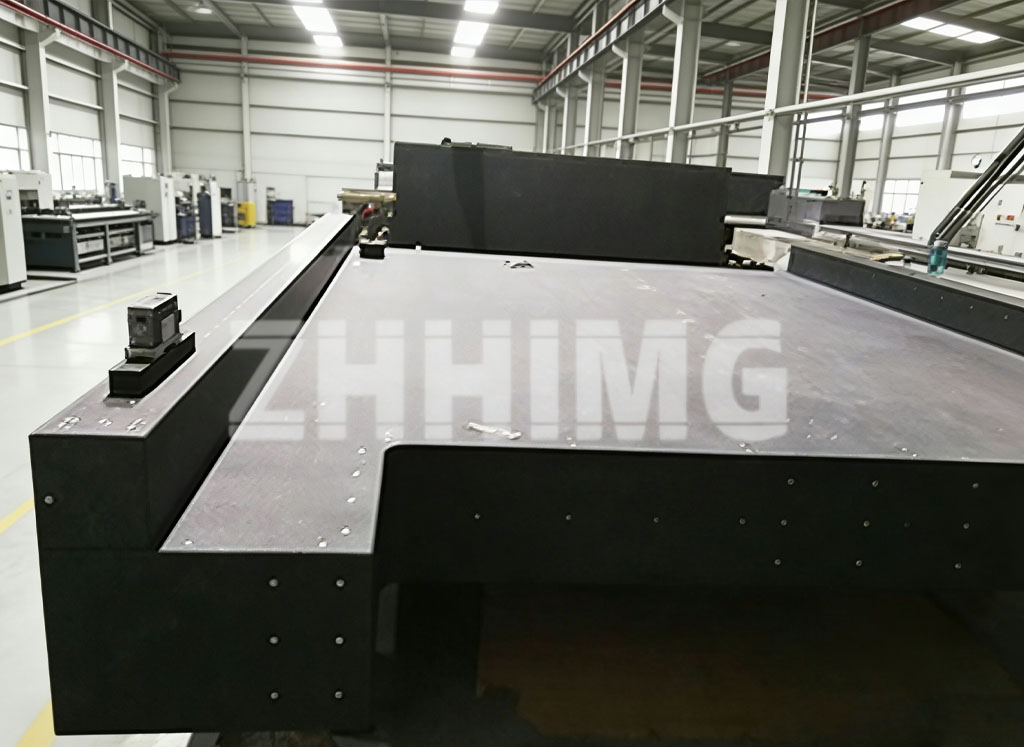
Gantries processed with this technology are free from metal‑related rusting and coating peeling. Trace acid‑alkali volatiles floating in the workshop only act on outer surfaces and hardly penetrate into substrates, generating no corrosive flaking dust and protecting paired optical modules, inspection sensors and motion actuators from contamination. Equipment can run continuously year‑round with greatly reduced shutdown maintenance and component replacement frequency, securing continuous production.
Such corrosion‑resistant granite gantries are mass‑applied to lithium‑battery inspection equipment, perovskite coating machines, semiconductor chemical‑processing devices, industrial CT systems and chemical metrology instruments. For equipment manufacturers, adopting these gantries not only solves short‑term corrosion problems but also helps end‑users cope with complex workshop environments, mitigating accuracy drift caused by environmental factors and improving market reputation and competitiveness of complete equipment under special working conditions.
Metal structures achieve corrosion resistance via post‑applied coatings, representing passive protection. Qualified granite gantries deliver dual protection combining intrinsic material chemical inertness and pore‑sealing surface treatment. Both solutions have their respective application scenarios. Nevertheless, corrosion‑resistant granite gantries demonstrate irreplaceable practical value for precision production lines with trace acid‑alkali volatiles and low‑maintenance requirements. ZHHIMG provides customized corrosion‑resistant granite gantries, beams and bases in various sizes and load ratings for global clients to support ultra‑precision equipment development under complex working conditions.
Post time: Aug-13-2026