
As the geometric reference carrier of complete ultra-precision equipment, the success of custom granite machine base projects is often determined before production commences. Many projects encounter issues such as inaccessible delivery, assembly interference or unsatisfactory precision only after the base is manufactured and delivered to the site. Most of these problems stem from insufficient verification of installation conditions in the early stage. When undertaking custom granite base projects, ZHHIMG guides customers to sort out on-site installation conditions item by item to avoid various risks during later installation and commissioning.
First of all, it is necessary to confirm the foundation bearing capacity and vibration isolation conditions on site. Granite machine bases have heavy dead weight. Together with the main machine and motion modules, the total load is fully applied to the ground. Ordinary concrete workshop floors are often unreinforced and prone to uneven settlement under long-term pressure, which directly damages the plane reference of the base. In the early project phase, it is required to provide the ground structure, floor slab thickness and foundation load-bearing parameters of the installation area, and survey surrounding vibration sources such as air compressors, stamping equipment and production lines. If the amplitude of external vibration is high, independent foundations, anti-vibration trenches or matching vibration damping components need to be planned in advance. ZHHIMG engineers will propose support layout suggestions for the base based on on-site vibration data to reduce interference of external vibration on equipment precision at the foundation level.
The second is confirmation of environmental working parameters. Although granite features a low thermal expansion coefficient, local temperature differences and direct air flow can still cause tiny deformation and affect the repeated positioning accuracy of equipment. In the early stage, confirm the temperature control capacity of the workshop, temperature fluctuation range, temperature field uniformity and the position of air conditioning outlets to prevent one-way air flow scouring the base. Meanwhile, confirm workshop humidity and dust level. For clean workshops used in semiconductor and optical inspection applications, clarify the cleanliness level to decide whether the base adopts dust-free grinding and protection processes. If a small amount of chemical liquid or cutting fluid splashes during production, inform us in advance so that surface protection solutions can be considered at the design stage.
Third, confirm the assembly interfaces and load distribution of the whole machine. This is the core part of custom base design. It is necessary to collect the weight distribution and center of gravity of the whole machine, distinguish concentrated loads from distributed loads, and plan support points of the base to avoid stress deformation of the stone caused by improper support. Also confirm all mounting interfaces: positions, dimensional tolerances of threaded holes, counterbore holes, locating pin holes, T-slots, cable grooves and pipeline escape holes. Granite is a brittle material. Modifying holes or grooves after finishing is extremely difficult and may easily lead to scrapping. Therefore, all hole positions and groove structures must be finalized before material cutting and machining. The equipment assembly sequence and space for tool disassembly and assembly also need to be confirmed synchronously to prevent insufficient assembly space after the base is formed.
Hoisting, transportation and on-site positioning conditions cannot be ignored. Large-size granite bases are heavy components. In the early stage, confirm the width and height of workshop gates and passages, the rated lifting capacity of overhead cranes or forklifts, and the load capacity of factory elevators. According to on-site handling conditions, determine whether the base is integrally processed or split into segmented parts for on-site assembly. The positioning area should also reserve leveling space and operating space for metrology inspection, facilitating subsequent precision re-inspection with electronic levels and laser interferometers. If the on-site passage is narrow and the tonnage of lifting equipment is insufficient, the overall dimension and segmentation scheme of the base need to be adjusted at the design stage. 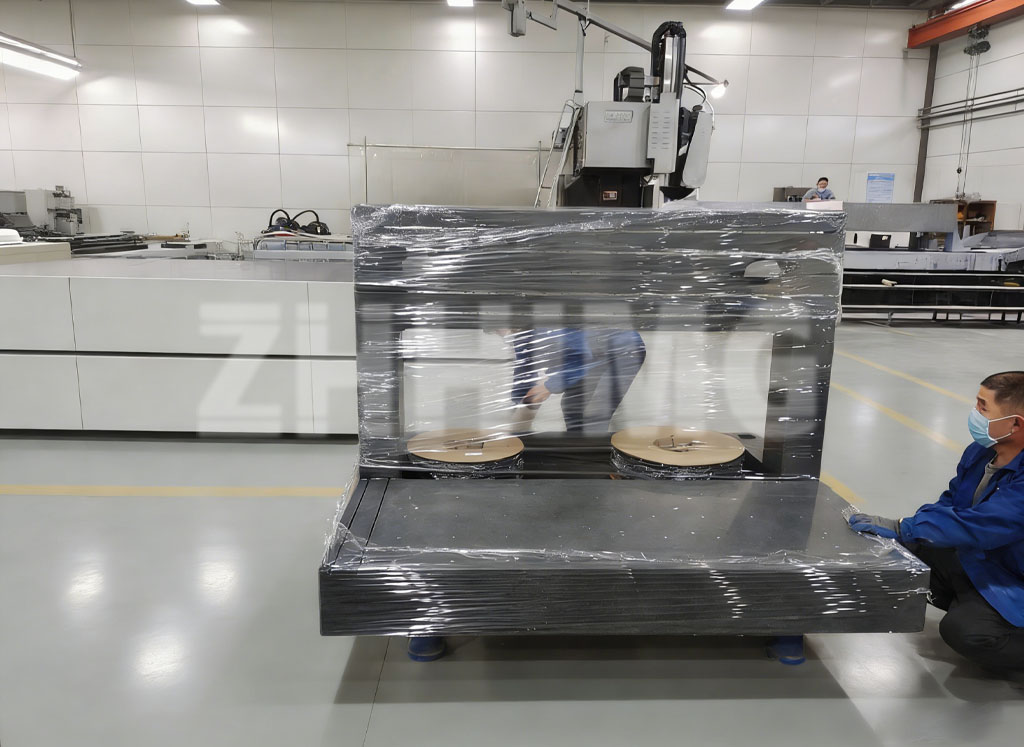
Finally, agree on on-site metrology acceptance conditions in advance. Granite bases are processed under constant temperature before delivery. After transportation to the customer’s site, there is a temperature difference between the stone and the workshop environment. Sufficient standing time must be reserved for thermal equilibrium before precision inspection. In the early stage, agree on standing duration, acceptance environment requirements, testing instruments and acceptance benchmarks to avoid disputes between the supplier and the buyer during on-site acceptance. Every granite base delivered by ZHHIMG is ground in a constant temperature and humidity workshop and inspected with high-precision instruments such as Mahr and Renishaw before shipment, with all precision indicators traceable.
Customizing a granite base is not simply machining stone according to drawings. Five dimensions including on-site foundation, environmental working conditions, assembly interfaces, hoisting & positioning and acceptance standards need to be confirmed in the early project stage. Completing the evaluation of installation conditions in advance ensures smooth delivery and assembly of the base, enables stable micron-level reference precision, and guarantees long-term reliable operation of the complete precision equipment.
Post time: Sep-15-2026