
Ordering a custom granite machine base involves more than sending a drawing and requesting a price. To evaluate quotations and agree on a suitable manufacturing and inspection plan, the buyer and manufacturer need a shared understanding of the component’s function, critical surfaces, mounting interfaces and acceptance requirements.
Whether your project involves a granite machine bed, a precision equipment base or an assembled granite structure, a clear technical specification helps both parties identify unanswered questions before production begins.
This guide provides a practical checklist for preparing your drawings, defining tolerances and reviewing inspection requirements when sourcing custom precision granite components.
1. Start with the Function of the Granite Base
Before discussing individual dimensions, explain how the granite base will be used.
Is it a structural foundation for equipment? Does it support precision guideways or measurement instruments? Will any granite surface function as a reference surface or an air-bearing guideway?
These questions help establish which features need particular attention during drawing review and inspection planning.
Your initial inquiry should describe:
- • The equipment or application.
- • The function of the granite component within the machine.
- • Overall dimensions and quantity.
- • Installation orientation.
- • Expected loads and their locations.
- • Planned support points.
- • Operating environment.
- • Components to be mounted on the base.
- • Whether you require an individual part or an assembly.
For example, a base intended to support a stationary inspection instrument should not automatically be specified in the same way as a structure supporting moving equipment. Explain the intended use rather than expecting the manufacturer to infer it from the part’s appearance.
If information is still preliminary, identify it as provisional so that assumptions can be reviewed before the design is released.
2. Prepare a Drawing Package with a Clear Revision Status
A quotation should refer to an identifiable drawing revision.
Provide a dimensioned drawing showing the requirements used for manufacturing and acceptance. Where available, include a matching 3D model to help communicate complex shapes, pockets, access features and assembly relationships.
Your drawing package should identify:
- • Part number and description.
- • Drawing revision and issue date.
- • Units of measurement.
- • Overall dimensions.
- • Datum references.
- • Critical dimensions and geometric tolerances.
- • Surface finish requirements.
- • Hole, slot and pocket details.
- • Insert specifications.
- • Edge treatments.
- • Inspection notes.
- • Applicable standards and their editions, where required.
State which document takes precedence if the drawing, model and purchase specification contain conflicting information.
Avoid leaving critical requirements only in an email conversation. Once agreed, incorporate them into the controlled drawing or an approved technical specification.
Distinguish critical features from general features
Not every surface necessarily needs the same manufacturing or inspection requirements.
Mark the surfaces that serve as mounting interfaces, reference planes, guideway supports or assembly datums. Apply separately agreed requirements to noncritical areas.
This gives the manufacturer a clearer basis for reviewing the project and reduces ambiguity when comparing quotations.
3. Define Geometric Requirements Individually
The word “precision” is not an acceptance criterion.
A requirement such as “high-precision granite base” leaves several important questions unanswered: Which surface is controlled? Relative to which datum? Across what area? Under what inspection conditions?
Where relevant to the design, define:
| Requirement | What the specification should clarify |
|---|---|
| Flatness | The controlled surface and the area over which it applies |
| Straightness | The controlled line, direction and measurement length |
| Parallelism | The controlled feature and its reference datum |
| Perpendicularity | The relationship between the specified features |
| Hole position | The datum system, location requirements and applicable tolerances |
| Surface finish | The surfaces concerned and the specified parameter |
Do not treat flatness, parallelism and perpendicularity as interchangeable requirements. A drawing should communicate each required relationship explicitly.
If a tolerance is particularly demanding, ask the supplier to review the proposed manufacturing and inspection approach before placing the order.
4. Specify Support, Loading and Inspection Conditions
For a large custom component, the inspection agreement should explain how the part will be supported and evaluated.
Discuss the following with your supplier:
- • Support-point locations.
- • Inspection orientation.
- • Whether inspection applies to the individual component or completed assembly.
- • Whether specified loads are present during acceptance testing.
- • Environmental conditions to be recorded.
- • Any agreed temperature-stabilization procedure.
- • The sequence of inspection and assembly.
If the component will be installed differently from the inspection arrangement, identify that difference during technical review.
The goal is to establish an agreed acceptance condition, rather than discovering after delivery that the buyer and supplier evaluated the component using different setups.
5. Review Inserts, Holes and Mounting Interfaces
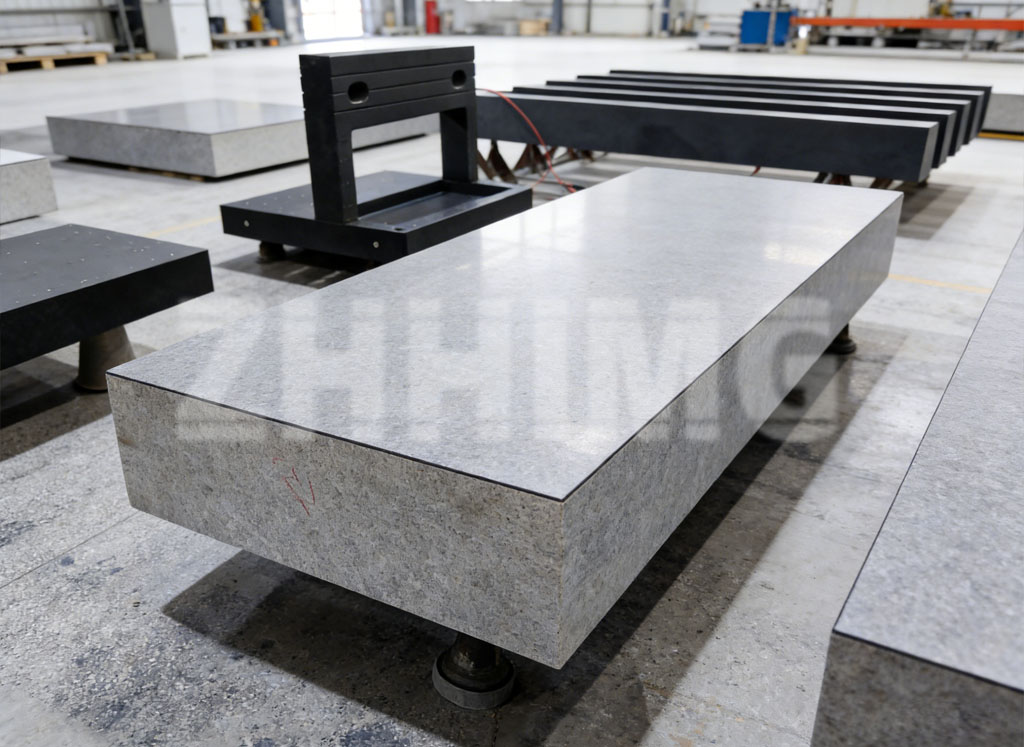
Custom granite machine bases may require threaded inserts, mounting holes, locating features, access openings or other interfaces.
These features deserve the same attention as the main granite surfaces.
For each insert or mounting interface, specify the relevant details:
- • Thread type, size and usable depth.
- • Insert material, where required.
- • Position and orientation.
- • Height relative to the surrounding surface.
- • Required mounting loads or tightening conditions.
- • Mating-component details.
- • Any prohibited materials or process restrictions.
Also explain how attached parts will be installed and serviced.
For example, a mounting location may appear accessible in a component drawing but become difficult to reach once the surrounding equipment is assembled. An assembly view can help clarify these requirements before manufacturing.
If inserts or attached hardware are included in the delivery, state whether inspection takes place before installation, after installation or at both stages.
6. Confirm Exactly What the Supplier Will Deliver
The phrase “granite machine base” can describe different delivery scopes.
A quotation might cover the granite component alone, or it might also include inserts, a support frame, mounted hardware, assembly work and additional inspection.
Before comparing prices, confirm whether each quotation includes:
- • Granite component manufacturing.
- • Threaded inserts and other specified hardware.
- • Support frame or stand.
- • Installation of customer-supplied components.
- • Assembly and alignment work.
- • Inspection reports.
- • Protective packaging.
- • Shipping arrangements.
- • Installation documentation or support.
Where equipment will be assembled onto the granite base, define responsibility for supplying, installing and accepting each item.
A clearly defined scope makes quotations easier to compare and helps prevent gaps between the purchase order and the expected delivery.
7. Agree on the Inspection Report Before Production
Do not wait until the component is ready to ship to discuss inspection documentation.
Request a sample report during supplier evaluation and confirm what information will accompany your order.
Depending on the agreed scope, the report may need to identify:
- • Part number and serial number.
- • Drawing revision.
- • Inspection date.
- • Features inspected.
- • Acceptance limits.
- • Measurement results.
- • Datum and measurement locations.
- • Support arrangement.
- • Environmental conditions.
- • Measurement equipment identification.
- • Relevant calibration references.
- • Inspection approval.
For critical features, ask whether the report will include a measurement layout or result map rather than only a pass/fail statement.
If your quality system requires a specific calibration service, measurement uncertainty statement or report format, include that requirement in the inquiry. Do not assume that every document described as a “certificate” provides the same information.
8. Plan Packaging, Lifting and Receiving
The delivery plan should be part of the technical discussion, particularly for large or complex granite components.
Before shipment, agree on:
- • Packed dimensions and weight.
- • Approved lifting or handling arrangements.
- • Protection for precision surfaces and exposed features.
- • Crate-opening instructions.
- • Receiving inspection procedure.
- • Temporary storage requirements.
- • Installation and support instructions.
Confirm that your receiving site has suitable access and handling equipment.
Ask the supplier to identify any restrictions on lifting, unpacking or supporting the component. Where necessary, include a handling drawing with the shipping documentation.
9. Use a Complete RFQ Checklist
To request a more clearly defined quotation, prepare the following information:
| RFQ item | Information to provide |
|---|---|
| Application | Equipment type and component function |
| Technical files | Controlled drawing and matching model, if available |
| Dimensions | Overall size and critical features |
| Quantity | Prototype quantity and expected repeat demand |
| Geometry | Required tolerances and datum references |
| Interfaces | Inserts, mounting holes and mating components |
| Installation | Orientation, supports and relevant loading |
| Inspection | Required checks, reports and acceptance conditions |
| Delivery scope | Individual component or assembly |
| Logistics | Destination, packaging and handling requirements |
| Schedule | Target delivery date and project milestones |
If a requirement has not yet been finalized, mark it as “to be confirmed.” A visible open question is easier to resolve than an undocumented assumption.
Discuss Your Custom Granite Machine Base with ZHHIMG
A well-prepared specification gives both the buyer and manufacturer a clearer starting point for technical review, quotation and acceptance planning.
For your next custom granite machine base project, send ZHHIMG your drawing revision, application details, quantity and inspection requirements. If the design is still under development, identify the features and interfaces that remain open for discussion.
Our commitment to customers is straightforward: no cheating, no concealment and no misleading.
The starting point is an accurate understanding of what your equipment needs—and a clear agreement on what will be delivered.
Post time: Nov-17-2026