
Custom Granite Machine Bases: What to Include in Your RFQ
A well-prepared RFQ is the fastest route to an accurate custom granite machine base quotation — and to a base that fits your machine the first time. When a supplier receives complete information, the reply typically arrives in days with a realistic price; when the RFQ is a single sentence (“please quote a granite base 2000 × 800 mm”), the supplier must either guess or push the enquiry back, and the quoted figure may change once the real requirements surface. This guide explains exactly what to include, section by section, and ends with a checklist you can copy directly into your next enquiry.
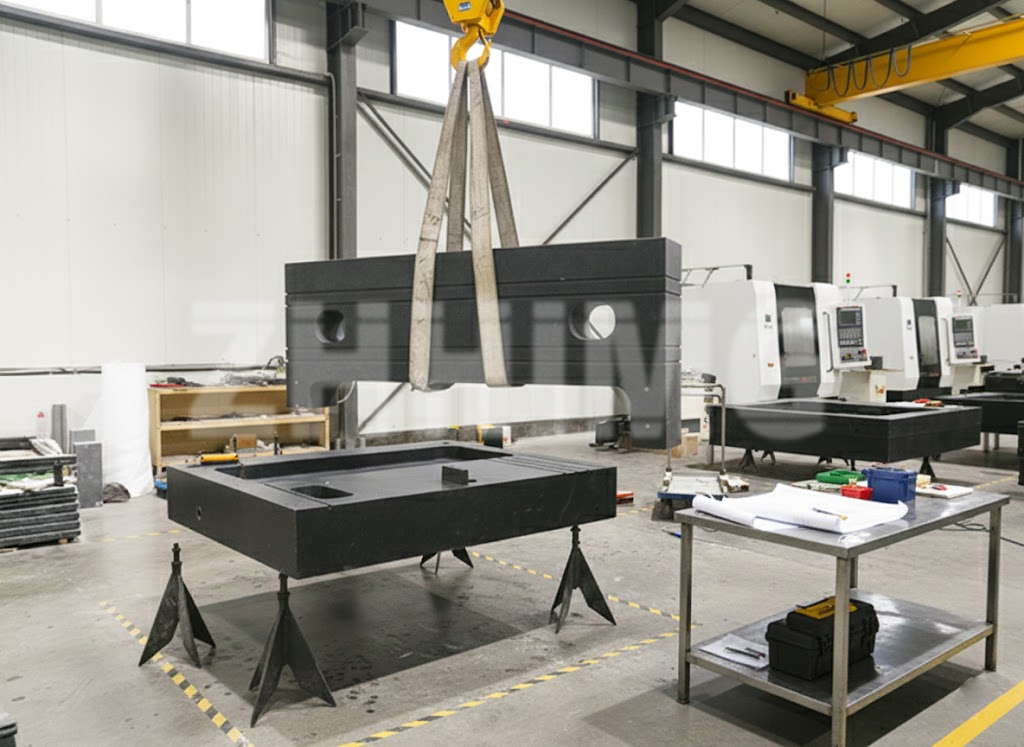
1. Describe the application and installation environment first
Two bases with identical outlines can be built very differently depending on what they carry and where they live. State clearly:
What the base supports: a CMM bridge, a laser cutting head, a semiconductor inspection stage, a linear motor table. The payload and its mass distribution decide wall thicknesses, rib layout and support-point design.
Where it will be installed: laboratory at 20 ± 0.5 °C, or a production floor with temperature swings, nearby presses or forklift traffic. Environment drives the grade of flatness that is economical, and whether thermal stability measures or extra vibration isolation matter.
Accuracy expectations: flatness and parallelism targets on the working surfaces, and — importantly — whether those targets follow a specific standard (for example DIN 876 grade 00/0/1) or your own internal specification. If you have a standard, name it; if you have internal values, attach the table.
2. Drawings: dimensions, datums and tolerances to define
Your drawing is the core of the RFQ. A manufacturable granite drawing does not need to be elaborate, but it must define:
Overall envelope (length × width × height) and wall thickness if you have a preference or a mass limit.
Datums: which surfaces are the reference faces, and in what priority. Granite parts are lapped against defined datums; a drawing without datum logic forces the supplier to choose for you.
Flatness, parallelism and perpendicularity values on each working surface, each tied to a datum. Values pulled from different standards onto one drawing without checking cross-compatibility are a common source of rework — mark which tolerances are functional (must be met) and which are cosmetic.
Support and lifting points: three-point or multi-point support scheme, and where slings or lifting inserts may contact the stone. Granite is strong in compression but unforgiving under wrong lifting practices, so this belongs on the drawing, not in a phone call.
A useful habit is to mark up your drawing the way an inspector will read it: every lapped face labelled with its tolerance and datum letter, every machined pocket noted as machined-only (not lapped), and every dimension with a tolerance rather than left “general”. Desensitised drawings with the critical callouts readable are enough for first quotation — full CAD can follow after NDA if needed.
3. Features: inserts, through holes, slots and rail seats
These features carry most of the cost and most of the risk, so describe each one precisely:
Threaded inserts: diameter and thread spec (for example M8 × 1.25), depth, and whether the insert is bonded into granite or screwed into a steel sleeve. Note load or torque requirements if the bolted joint carries force. If your design uses many inserts, review our precision threaded inserts for granite components to see standard options before specifying custom ones.
Through holes and pockets: position with true-position tolerance, edge distances, and whether the bottom of a pocket is machined only or needs accuracy.
T-slots and cable channels: width, depth, run direction, and whether the slot edges need deburring only or a tolerance.
Rail seats and guideway mounting faces: coplanarity and height tolerance across seats, because these values directly determine how much matching work your assembly team will need. Several seats ground to one another is a different operation from a single lapped face — say which you need.
For each feature, one line of “function” (what bolts to it, what aligns to it) is worth more than a page of generic GD&T, because it lets the supplier propose the economical process instead of defaulting to the most expensive one.
4. Inspection reports and delivery documents to request
Decide before quoting what documentation you require with delivery, and list it in the RFQ. Typical items:
Flatness / parallelism inspection report with instrument type, method and room temperature; material data sheet (density, water absorption, compressive strength) for the actual stone; dimensional report on agreed features; certificates of the supplier’s quality system; and calibration certificates for the measuring instruments used. If you need witness inspection or third-party inspection before shipment, say so — it affects schedule and price.
ZHHIMG ships every component with its inspection documentation, and supports assembly and calibration services as described on our assembly, calibration and inspection page. Naming your document requirements up front makes them quotable instead of negotiable.
5. Quantity, lead time, packaging and shipping conditions
Commercial conditions change the design of the offer as much as the technical ones:
Quantity: one prototype versus a series changes process planning (jigs, repeat-fixturing) and unit price. Give both the current need and the expected annual volume if known.
Lead time: granite lapping and stress-relief operations cannot be compressed indefinitely. State your target delivery and, crucially, the date the geometry must be frozen — changing features after material is cut is the most expensive kind of change.
Packaging and destination: granite parts travel in custom steel or timber crates with shock indicators for heavy components. Provide the delivery address, Incoterms preference, and any site constraints at the receiving end (dock height, crane availability, maximum crate weight) — a 5-tonne base with no crane at the dock needs a different packaging and delivery plan.
6. Complete versus incomplete RFQ: the practical difference
| RFQ item | Incomplete enquiry | Complete enquiry |
|---|---|---|
| Outline | “Base about 2000 × 800 mm” | Drawing with toleranced envelope and mass limit |
| Datums and flatness | “Very flat, like grade 00″ | Named standard + values per surface, tied to datums |
| Inserts and holes | “Some M8 holes as needed” | Table: position, thread, depth, sleeve or bonded |
| Rail seats | “Mounting faces for rails” | Seat positions with coplanarity and height tolerances |
| Application | “Machine base” | Carries CMM bridge, 400 kg payload, lab environment 20 ± 0.5 °C |
| Documentation | Not mentioned | Listed reports and certificates required at delivery |
| Quantity and delivery | “ASAP” | 2 prototypes, series of 12/year, geometry frozen on a stated date |
| Shipping | Not mentioned | Destination, Incoterms, dock and crane constraints |
The left column does not merely slow the quotation — it invites assumptions, and assumptions become engineering changes. The right column lets the supplier check manufacturability against real process capability and quote once, accurately.
Copy-and-use RFQ checklist
Application: machine type, payload and mass distribution, installation environment (temperature range, vibration sources), working surfaces that carry accuracy.
Geometry: 2D or 3D drawing (desensitised acceptable for first quote), overall size, wall thickness, mass limit.
Accuracy: standard by name (e.g. DIN 876 grade), flatness / parallelism / perpendicularity per surface, datum scheme.
Features: threaded inserts (spec, depth, type), through holes, pockets, T-slots, cable channels, rail seats with coplanarity tolerance.
Support and handling: support-point scheme, lifting points and permitted sling contact.
Documentation: inspection reports, material data sheet, instrument calibration certificates, witness or third-party inspection if required.
Commercial: quantity (prototype + annual volume), target delivery, geometry-freeze date, packaging requirements, destination, Incoterms, receiving-site constraints.
Send your drawings, application requirements, and inspection specifications to ZHHIMG® for a manufacturability review and quotation. Our engineers will respond with a process proposal and, for precision granite components of this kind, a firm delivery schedule.
Frequently asked questions
Can I get a quotation without a full CAD model?
Yes. A toleranced 2D drawing with datums and a feature list is enough for a first quotation of a custom granite machine base. Full CAD is mainly needed for complex internal pockets or when the base interfaces with many components.
How long does a custom granite base take to manufacture?
Typical custom bases run several weeks from drawing freeze to delivery, depending on size, number of inserts and seat accuracy. Stress relief and lapping cannot be safely shortened, so early geometry freeze is the best way to protect your schedule.
What tolerance grade should I choose for a machine base?
Choose the grade that satisfies the functional requirement, not the tightest available. Mounting faces for linear rails, CMM bridges and metrology references each have different economical grades — describe the function and let the supplier recommend, or name a standard and grade from the start.
How are granite bases packed for overseas shipping?
In custom crates (steel or timber) with the stone restrained against shifting, plus shock and tilt indicators for heavier components. Provide destination and site constraints in the RFQ so packaging is designed for the whole journey, not just the workshop exit.
Do you sign NDAs before receiving drawings?
Yes. Send a desensitised drawing for the initial manufacturability review, and full CAD after the NDA is in place — the quotation can be refined once complete data is released.
Post time: Oct-19-2026