
In the fields of gantry-type precision inspection equipment, laser micro-machining systems and long-travel automated precision machinery, temperature drift is a hidden core factor causing accuracy fluctuation, trajectory deviation and reduced repeatability. Many industry practitioners hold a misconception that natural stone structures are completely immune to temperature changes. In fact, no industrial material can fully isolate temperature influence. However, compared with traditional cast iron and aluminum gantry structures, granite gantries deliver superior thermal stability, restricting temperature-induced accuracy loss to a negligible nanometer level and fully meeting the stringent requirements of ultra-precision working conditions.
In terms of physical properties, granite features ultra-low thermal sensitivity rather than absolute zero thermal deformation. All solid materials expand and contract slightly with changes in ambient temperature and equipment operating heat. Traditional metal gantry structures have a high thermal expansion coefficient, leading to obvious structural stretching, shrinking and bending under minor temperature fluctuations. This results in deviations in beam parallelism, column verticality and travel straightness, accumulating micron-level or even larger accuracy errors that severely compromise the machining and inspection precision of long-travel equipment. In contrast, high-quality precision granite boasts an extremely low thermal expansion coefficient — approximately one quarter of aluminum and two thirds of steel. Under the same temperature difference, its deformation is minimal, fundamentally weakening temperature interference with structural accuracy.
The core advantage that distinguishes granite from ordinary structures lies in its uniform thermal deformation characteristics. Most conventional metal gantries adopt assembled composite structures. Differences in material thickness and heat dissipation efficiency between separate components easily cause local temperature differences and uneven thermal deformation, resulting in beam arching, column inclination and triaxial verticality drift. Such irregular deformation cannot be corrected through simple calibration, constituting a long-term accuracy pain point for high-end equipment. ZHHIMG’s integrated one-piece granite gantry structure features homogeneous material properties, no residual internal stress and uniform heat dissipation. When exposed to ambient temperature changes and continuous operating heat, the entire structure expands and contracts evenly without destructive local distortion, bending or deflection, thus maintaining a stable equipment reference coordinate system at all times.
Excellent temperature gradient resistance adapts to unconstant-temperature industrial workshop conditions. Absolute laboratory-grade constant temperature is rarely achievable in actual production environments. Temperature gradients caused by day-night temperature differences, equipment heat generation, human activity and ventilation fluctuations are major triggers for precision instability. Metal gantries are highly sensitive to temperature gradients; tiny regional temperature differences induce structural stress deformation and trajectory offset errors. Benefiting from its dense and uniform natural crystal structure, granite delivers balanced thermal conduction and delayed thermal response. It effectively resists ambient temperature gradient interference and maintains stable geometric parameters even in conventional workshops with a temperature fluctuation range of ±5℃, enabling consistent high-precision operation without strict constant-temperature environments.
Professional stabilization processes eliminate long-term thermal accuracy attenuation. Untreated natural stone may release subtle internal stress under alternating cold and heat conditions, gradually undermining structural precision. To solve this common industrial defect, ZHHIMG applies multi-stage natural aging and artificial constant-temperature stabilization treatments to all granite gantry components. Potential thermal stress is fully released in advance to stabilize structural geometric performance. Optimized gantry structures resist fatigue deformation caused by long-term temperature alternation and continuous equipment heating, ensuring consistent accuracy across seasons and diverse humidity conditions. This completely solves the industry problem of inconsistent measurement data between day and night or different seasons for ordinary stone-based gantry equipment. 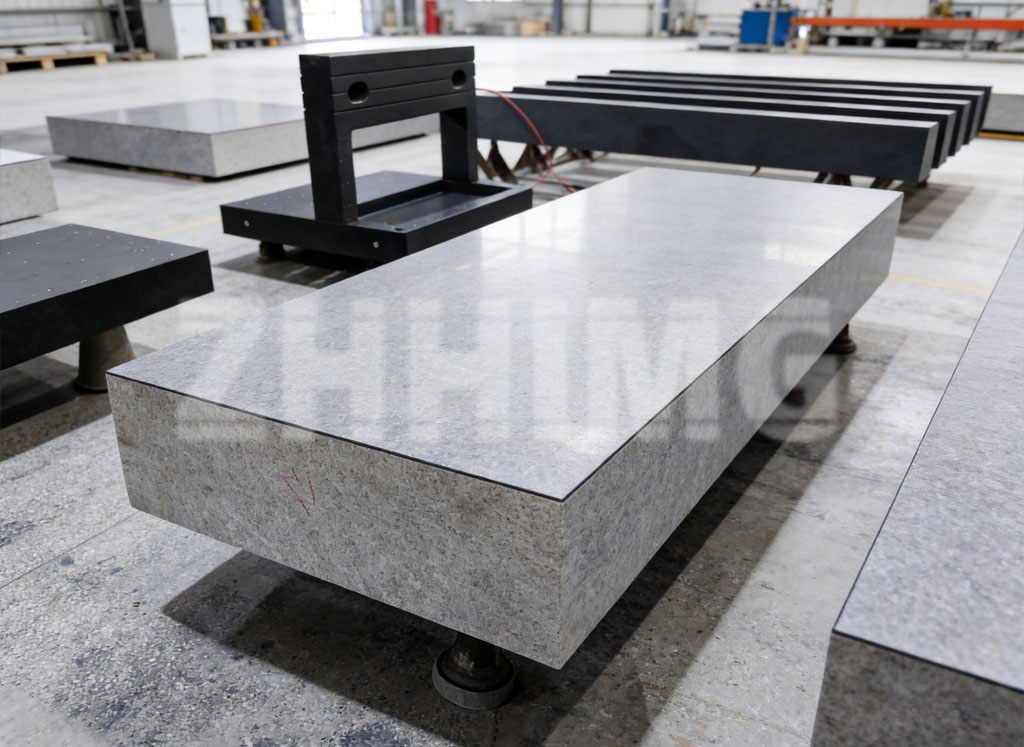
Perfect compatibility with thermal compensation systems forms a closed-loop ultra-precision guarantee. For nano-level ultra-precision scenarios, even the minimal thermal deformation of granite can be precisely compensated by intelligent temperature control systems. The homogeneous granite structure features predictable, traceable and stable thermal deformation rules. Cooperating with distributed temperature sensing systems, it enables accurate calculation of micro thermal deformation and reverse precision correction, nearly eliminating temperature-induced errors. Unlike metal structures with irregular and uncontrollable thermal deviation, granite gantries perfectly adapt to intelligent thermal compensation algorithms, sustaining ultra-high precision and stable operation in complex working conditions.
In conclusion, granite gantry structures are not completely unaffected by temperature, but their ultra-low thermal deformation, uniform thermal response, outstanding temperature gradient resistance and long-term stability confine temperature errors to a negligible, compensable and constant range — far surpassing the thermal stability performance of traditional metal gantries. Moving forward, ZHHIMG will continuously optimize granite structural stabilization techniques and temperature adaptation solutions, enhance the environmental adaptability and long-term precision stability of high-end gantry precision equipment, and consolidate the accuracy foundation for long-travel ultra-precision manufacturing and inspection industries.
Post time: Aug-31-2026