
Most industrial manufacturers suffer from obvious technical limitations in large-size granite processing. They directly deliver finished products after cutting, grinding and finishing, skipping essential procedures including natural aging, constant-temperature aging and stress-relief static conditioning. As a natural mineral polymer material, granite continuously accumulates cutting stress, structural extrusion stress and thermal stress during quarrying, cutting, splitting and precision grinding. Small plates carry minor stress with negligible deformation, whereas large-size plates feature larger bearing areas and longer structural spans. Residual stress releases slowly over time, causing subtle warpage, local height difference and flatness deviation, which further result in poor repeatability of inspection data and frequent benchmark calibration failures. Aging treatment serves as the fundamental solution to long-term accuracy attenuation of large-size granite inspection plates.
1. Stress Sources of Large-Size Granite Plates: The Necessity of Aging Treatment
The fundamental cause of unstable accuracy in large-size granite plates is micro-deformation triggered by unbalanced internal stress. First, quarrying and cutting stress: large granite raw stones maintain long-term static balance in the mountain. After quarrying and splitting, external restraint disappears, and internal stress begins gradual release. Second, mechanical processing stress: high-tonnage and long-stroke CNC equipment generates uneven mechanical force during cutting and grinding of oversized plates, altering local molecular structures and producing residual processing stress. Third, temperature variation stress: heat generated during machining and workshop temperature and humidity fluctuations cause tiny telescopic differences on large panel surfaces, forming hidden deformation risks.
Without aging treatment, large-size plates can achieve excellent surface accuracy after precision grinding upon delivery. However, continuous release of internal stress will induce invisible nano and micron-level deformation during service. For ultra-precision metrology that relies on nano and micron-level benchmarks, such subtle deformation is sufficient to cause inaccuracy of the entire inspection system. With in-depth expertise in ultra-precision stone processing and deformation rules of large-scale components, ZHHIMG regards aging treatment as an indispensable standard procedure for manufacturing large-size granite plates.
2. Multi-Stage Aging System to Eliminate Deformation Risks of Large Plates
Different from the simple single-stage static aging adopted by most manufacturers, ZHHIMG develops a complete multi-level aging process based on its large-scale production infrastructure and constant-temperature dust-free workshops. The system adapts to the stress relief requirements of super-large granite plates with a maximum processing length of 20 meters and weight of 100 tons, constituting one of the core advantages of the company’s superior large-size precision performance.
The first stage is raw material natural aging. ZHHIMG owns a dedicated 20,000 ㎡ stone storage yard exclusively used for long-term static conditioning of large granite blanks. Premium black granite raw materials are placed here for extended natural aging to release original quarry stress thoroughly. Only after the stone structure achieves complete stability and balanced stress will the blanks enter formal cutting and processing, eliminating structural deformation risks at the source — a professional pre-process unavailable for most small manufacturers.
The second stage is semi-finished constant-temperature aging. After rough cutting, plates are transferred to the constant-temperature, constant-humidity and shockproof dust-free workshop instead of directly entering fine grinding. Stable indoor conditions isolate secondary stress caused by external climate, vibration and temperature differences, enabling gradual release of machining residual stress, balanced structural density and uniform deformation performance, and effectively correcting unbalanced stress distribution on long-span large plates.
The third stage is post-finishing stability aging. After precision grinding and slotting processing and before final delivery, a final stabilization aging procedure is implemented to eliminate accuracy rebound risks. This ultimate stress balancing process fully equalizes internal stress and fixes the structural state of the plate, completely preventing long-term precision drift and surface deformation during application.
3. Core Functions of Aging Treatment on Precision Stability
Aging treatment does not improve the instantaneous surface accuracy of plates, but fundamentally determines their long-term precision retention capability, which is critical for high-end ultra-precision application scenarios. Primarily, it completely eliminates stress-induced micro-deformation, enabling oversized plates to maintain uniform flatness permanently without local protrusion, depression or warpage, and ensuring sustained stability of benchmark surfaces for large precision equipment.
Furthermore, aging treatment significantly improves the repeatability and consistency of inspection data. Large-size plates after multi-stage aging treatment feature fully stabilized structural performance. Accuracy errors remain controllable despite seasonal temperature changes, environmental fluctuations, long-term load-bearing and frequent calibration, effectively solving industrial pain points such as unstable benchmarks and fluctuating detection data for large precision inspection equipment, automated platforms and semiconductor tooling systems.
In addition, the process extends the precision service life and reduces operation and maintenance costs. Plates without professional aging treatment require frequent calibration and rework, while ZHHIMG granite inspection plates with complete aging procedures maintain stable nano-level accuracy for a long time without repeated debugging, fully meeting the long-term high-precision demands of metrology institutions, research institutes and Fortune Global 500 enterprises. 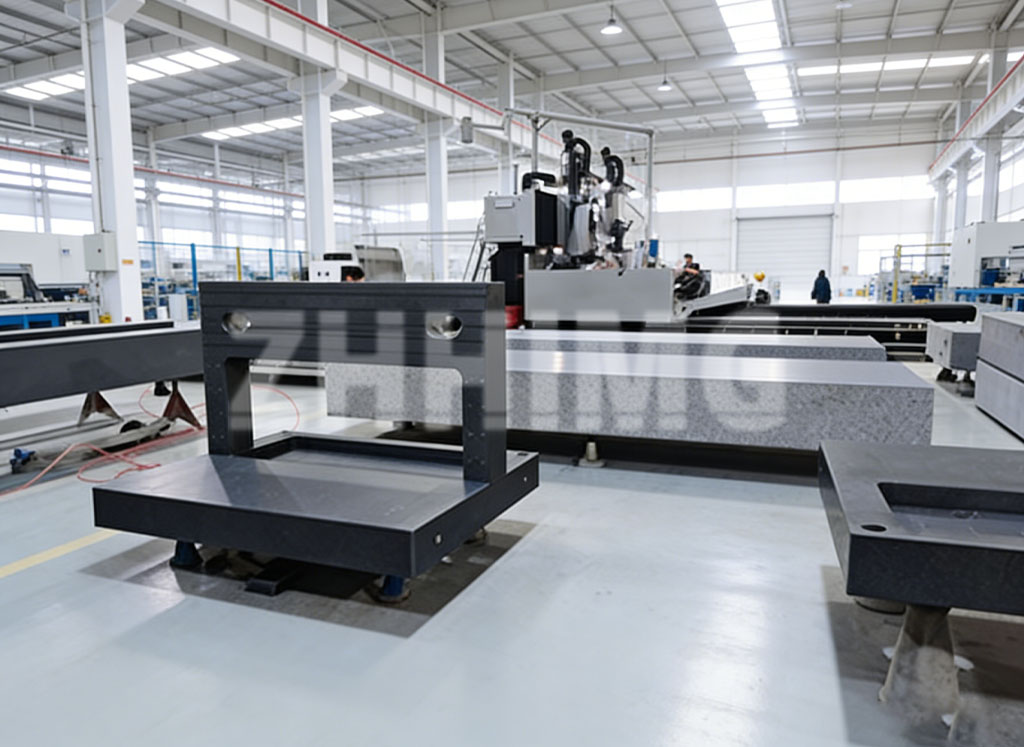
4. Traceable Precision Verification in Line with International Standards
After aging treatment, ZHHIMG conducts full-range precision verification on plate flatness, straightness, parallelism and overall deformation rate. Supported by world-class testing equipment and compliant with global standards including German DIN, American ASME, Japanese JIS and Chinese GB, all precision data can be traced back to national metrological benchmarks. Instruments such as laser interferometers, electronic levels and ultra-precision micrometers are adopted to fully verify the stability of aged plates, ensuring zero stress residue, zero precision drift and zero performance attenuation for all finished products.
Conclusion
For large-size granite inspection plates, precision grinding determines delivery accuracy, while professional aging treatment determines lifelong accuracy stability. As the ultra-precision manufacturing industry develops toward super-large dimensions and ultra-high stability, stress stabilization aging has become an irreplaceable core process for high-end granite precision components. Equipped with professional stone storage yards, shockproof constant-temperature dust-free workshops, mature multi-stage aging techniques and strict full-process quality inspection systems, ZHHIMG thoroughly solves the deformation challenges of large-scale stone components, providing reliable long-term ultra-precision benchmark support for large-scale precision inspection, semiconductor equipment and high-end automated manufacturing industries worldwide.
Post time: Aug-27-2026