
In the high-stakes arena of aerospace engineering, the margin for error is non-existent. From the assembly of satellite frames to the calibration of jet engine components, every measurement must be absolute. Achieving this level of certainty requires a foundation that is physically incapable of betrayal—a foundation that only large-scale, precision-machined granite can provide. As a factory-direct manufacturer specializing in these massive structures, we have seen a significant shift in how global aerospace leaders source their critical components. They are increasingly bypassing intermediaries to work directly with the source, seeking the rare combination of raw material scale and advanced machining expertise.
The journey of a multi-ton granite structure from a deep-earth quarry to a high-tech aerospace cleanroom is a masterclass in industrial capability. For procurement officers and lead engineers, understanding the internal processes of a direct manufacturer is essential to ensuring project success.
The Scale of Ambition: Selecting the Right Raw Material
The process begins long before a single drill bit touches the stone. For aerospace projects, the sheer scale of the components often requires granite blocks that weigh upwards of twenty or thirty tons. Not all granite is created equal; for these applications, we utilize specific varieties like Jinan Black, known for its extreme density and uniform mineral distribution.
When dealing with large-scale structures, internal consistency is the most critical factor. A single vein of softer mineral or a microscopic fissure can compromise the structural integrity of a five-meter-long machine bed. By operating as a direct factory, we maintain a strict selection process at the quarry level. Every block destined for an aerospace project undergoes ultrasonic testing to ensure there are no hidden defects within the stone. This “pedigree” of the raw material is the first step in guaranteeing that the final structure will maintain its flatness and stability under the immense weight of aerospace assembly jigs.
Precision at Scale: The Challenges of Large-Format Machining
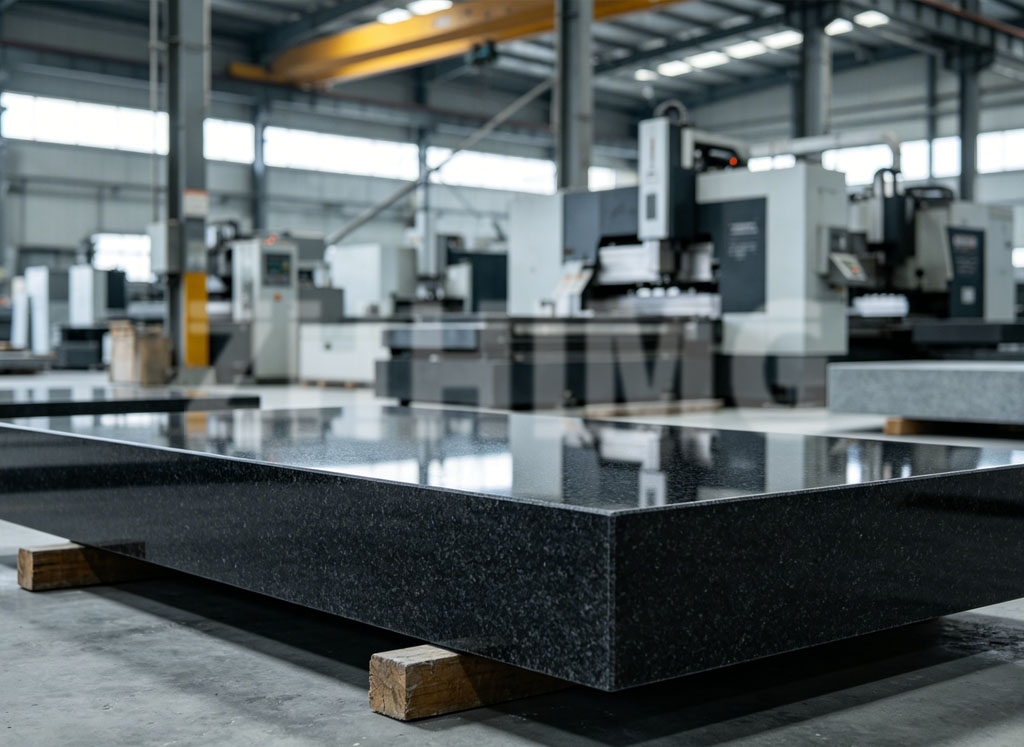
Machining a piece of granite that is several meters long requires a specialized infrastructure that few facilities possess. It is not simply a matter of having a large enough workspace; it is about maintaining micron-level precision across a massive envelope. Our factory utilizes oversized bridge-style milling machines and grinding centers specifically designed for heavy-duty stone processing.
The technical challenge in machining large granite structures is managing the heat and friction generated during the cutting process. Even though granite is thermally stable, the energy required to diamond-mill a surface can cause localized temperature spikes. As a direct manufacturer, we employ advanced synchronized cooling systems that keep the stone at a constant temperature throughout the machining cycle. This ensures that the dimensions recorded during the cutting phase remain accurate once the piece has cooled and is ready for final lapping.
Furthermore, aerospace components often require complex geometries—not just flat surfaces, but intricate patterns of threaded inserts, T-slots, and precision-bored holes for air bearings. Achieving the positional accuracy of these features across a large span requires high-resolution linear encoders and a deep understanding of the material’s behavior. Direct collaboration between the aerospace design team and our factory engineers allows for the optimization of these features, ensuring they are both manufacturable and functionally perfect.
The Art of Hand Lapping: The Human Element in High-Tech
Despite the advancements in CNC technology, the final stage of achieving aerospace-grade tolerances—often Grade 00 or higher—remains a human endeavor. This is where the “Factory Direct” advantage becomes most visible. Our master technicians perform manual hand-lapping, a meticulous process of grinding the surface with progressively finer abrasives to remove even the slightest imperfections left by the machines.
In the context of a five-meter granite structure, hand-lapping is an exhausting and highly skilled task. It requires a technician to interpret digital readings from electronic levels and laser interferometers, then manually apply pressure to specific areas to bring the entire surface into a single, cohesive plane of accuracy. This level of craftsmanship is what separates a standard industrial component from an aerospace-grade structure. By working directly with our factory, clients have direct access to the artisans who perform this work, ensuring that the specific nuances of the project’s tolerance requirements are understood and met.
Direct Logistics and Global Security
For a global aerospace project, the final challenge is moving a massive, fragile, and incredibly expensive precision component across borders. Intermediaries often struggle with the specialized logistics required for such items. As a factory-direct partner, we control the entire lifecycle, including the engineering of custom export crates and the coordination of specialized heavy-lift shipping.
Each structure is protected by a multi-layer defense system: moisture-barrier vacuum sealing to protect metal inserts from sea air, shock-absorbing mounting points based on the stone’s center of gravity, and reinforced steel-framed wooden housing. This direct control over the supply chain reduces the risk of handling damage and ensures that the precision we worked so hard to achieve in the factory is the same precision that arrives at the client’s facility.
Conclusion: Why Direct Collaboration is the New Standard
The aerospace industry is moving toward a model of extreme transparency and technical accountability. “Factory Direct” is no longer just a way to save on costs—it is a way to ensure quality. When an aerospace firm works directly with the manufacturer of their granite structures, they are gaining a partner who understands the material from the grain up.
Large-scale granite machining is a unique intersection of heavy industry and microscopic precision. By bridging the gap between the quarry and the cleanroom, we provide the aerospace sector with the stable, unwavering foundations they need to reach for the stars. Whether it is a base for an optical telescope or a platform for satellite alignment, the future of aerospace is being built on the solid ground of precision-machined granite.
Post time: Apr-28-2026