
The development of modern manufacturing has always been closely connected with advances in materials science.
From traditional metal structures to precision granite, ceramic components, mineral casting, UHPC structures, and carbon fiber composite systems, engineers continue exploring new materials to achieve higher accuracy, better stability, and improved performance.
In today’s industries, precision is no longer defined only by machining capability. The material itself has become a fundamental factor determining the performance of advanced equipment.
As industries such as semiconductor manufacturing, automation, optical technology, aerospace, and scientific research continue moving toward higher accuracy, the demand for advanced precision materials is growing rapidly.
The future of ultra-precision manufacturing will not rely on a single material. Instead, it will combine different materials based on specific engineering requirements.
The Evolution of Materials in Precision Manufacturing
For many decades, metals have been the primary structural materials used in industrial equipment because of their strength and availability.
However, as equipment accuracy requirements increased, engineers discovered that traditional metal structures could face challenges such as:
- thermal deformation
- residual stress release
- vibration transmission
- long-term dimensional changes
In ultra-precision applications, these factors can directly affect equipment performance.
This led to the increasing use of alternative materials designed specifically for stability and precision.
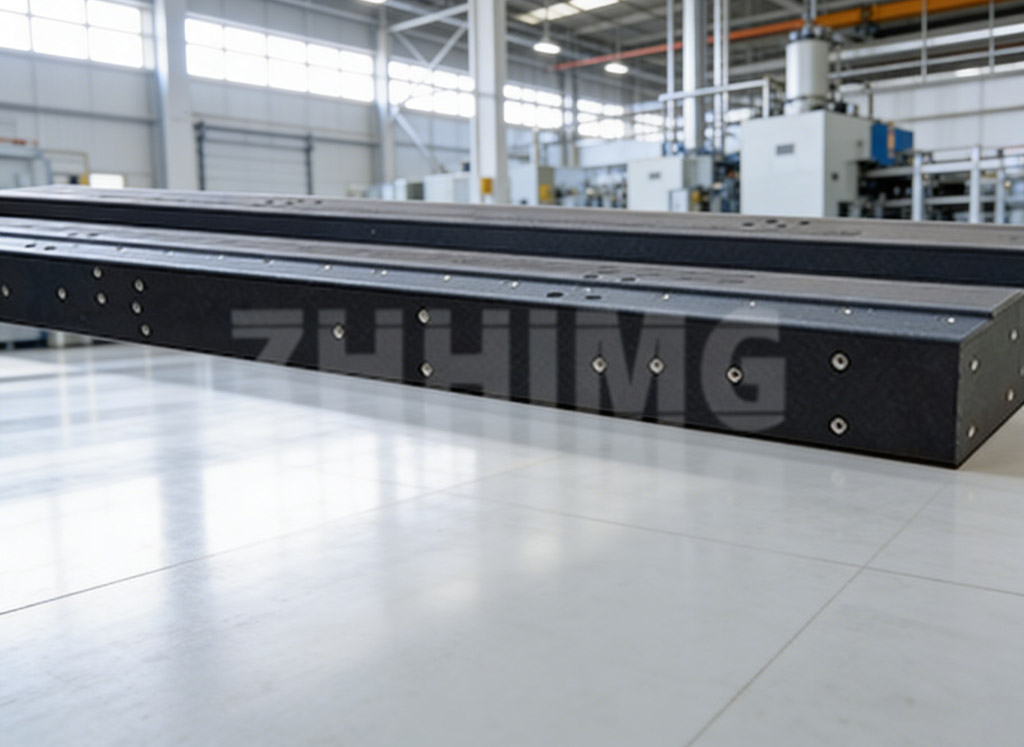
Precision granite became one of the most important materials in this transition because of its excellent dimensional stability, vibration damping capability, and long-term reliability.
Today, granite structures are widely used in precision machine bases, measurement systems, semiconductor equipment, optical platforms, and automation systems.
Precision Granite: A Stable Foundation for Modern Equipment
A precision machine requires a stable foundation before it can achieve accurate movement and measurement.
Precision granite provides an ideal solution because its natural properties make it highly suitable for demanding industrial environments.
High-quality precision granite offers:
- excellent dimensional stability
- high vibration absorption
- low thermal sensitivity
- reliable long-term accuracy
For equipment manufacturers, this means a more stable platform for:
- linear motion systems
- inspection equipment
- CMM machines
- semiconductor manufacturing tools
- optical measurement systems
The role of granite is not simply supporting the machine. It provides the reference foundation that allows the entire system to achieve its designed precision.
Beyond Granite: The Growth of Hybrid Precision Materials
Although precision granite remains an essential material, modern industries increasingly require structures with different performance characteristics.
Some applications require lightweight designs. Others require high damping, complex geometries, or special environmental resistance.
This has created opportunities for advanced materials such as:
- mineral casting
- ceramic materials
- UHPC precision structures
- carbon fiber composites
Each material provides unique engineering possibilities.
Mineral casting, for example, combines excellent vibration damping with flexible structural design, making it suitable for machine bases and precision equipment structures.
Ceramic materials provide outstanding hardness, wear resistance, and thermal performance for specialized precision components.
UHPC (Ultra-High Performance Concrete) introduces new possibilities for large precision structures requiring high strength and dimensional stability.
Carbon Fiber and the Future of Lightweight Precision Structures
As industries continue demanding faster movement and higher efficiency, reducing structural weight has become increasingly important.
Carbon fiber composite materials provide an attractive solution because they offer:
- high strength-to-weight ratio
- excellent stiffness
- low thermal expansion
- lightweight structural performance
In precision motion systems, reducing moving mass can improve:
- acceleration performance
- energy efficiency
- response speed
- positioning accuracy
Carbon fiber precision beams are becoming increasingly valuable in applications where both rigidity and lightweight design are critical.
Future generations of automation equipment, robotics, and advanced inspection systems will likely require more hybrid structures combining traditional precision materials with advanced composites.
The Importance of Selecting the Right Material for the Right Application
There is no single material that can solve every precision engineering challenge.
The correct choice depends on the specific requirements of the application.
For example:
A semiconductor inspection system may prioritize thermal stability and vibration control.
A high-speed automation system may require lightweight and rigid structures.
A measurement system may require an extremely stable reference surface.
A scientific instrument may require special material characteristics under controlled environments.
Successful precision engineering requires understanding how each material behaves and how it contributes to the complete system performance.
Material selection is not only a manufacturing decision. It is a design strategy.
Combining Material Technology with Manufacturing Capability
Advanced materials alone cannot guarantee precision.
The final performance depends on the complete manufacturing process, including:
- material selection
- structural design
- machining capability
- surface finishing
- measurement technology
- quality control
For example, producing a large precision granite component requires more than high-quality stone. It requires experience in precision machining, grinding, environmental control, and measurement verification.
The same principle applies to ceramic components, carbon fiber structures, and other advanced precision materials.
Precision is achieved when material science, manufacturing technology, and measurement capability work together.
ZHHIMG®: Developing Integrated Precision Manufacturing Solutions
ZHHIMG® continues to expand beyond traditional precision granite manufacturing by developing comprehensive ultra-precision solutions based on multiple advanced materials.
The company’s product technologies include:
precision granite components, granite measuring tools, granite air bearings, precision ceramic components, precision metal machining, precision glass, mineral casting, UHPC precision structures, carbon fiber precision beams, and precision 3D printing.
By combining advanced manufacturing equipment, professional measurement systems, and decades of precision engineering experience, ZHHIMG® supports customers from different industries with customized precision solutions.
The company’s mission is:
Promote the development of ultra-precision industry.
Through continuous innovation, ZHHIMG® aims to contribute to the future development of precision manufacturing worldwide.
The Future of Ultra-Precision Manufacturing
The next generation of industrial technology will require higher accuracy, faster response, and greater reliability.
Semiconductor equipment, artificial intelligence hardware, advanced robotics, optical systems, and scientific instruments will continue pushing the boundaries of precision engineering.
The future will belong to manufacturers who can understand not only how to process materials, but also how to select and combine the right materials for specific engineering challenges.
From precision granite foundations to lightweight carbon fiber structures, advanced materials will continue shaping the future of ultra-precision manufacturing.
Post time: Jul-27-2026