
When an OEM decides to build a large machine around a granite bed, the questions get very concrete very fast. How large can you actually manufacture? Can you lap a bed several meters long and hold it flat? Who machines the pockets, drills the holes, installs the inserts and assembles the final structure? And how does a ten-tonne stone travel across an ocean without losing a micron?
These are fair questions, because manufacturing a large granite machine bed is not a scaling problem – you cannot simply enlarge a toolroom plate process. This article walks through the full production chain at ZHHIMG, from raw block selection to final inspection and shipment, so you can see where the accuracy actually comes from.
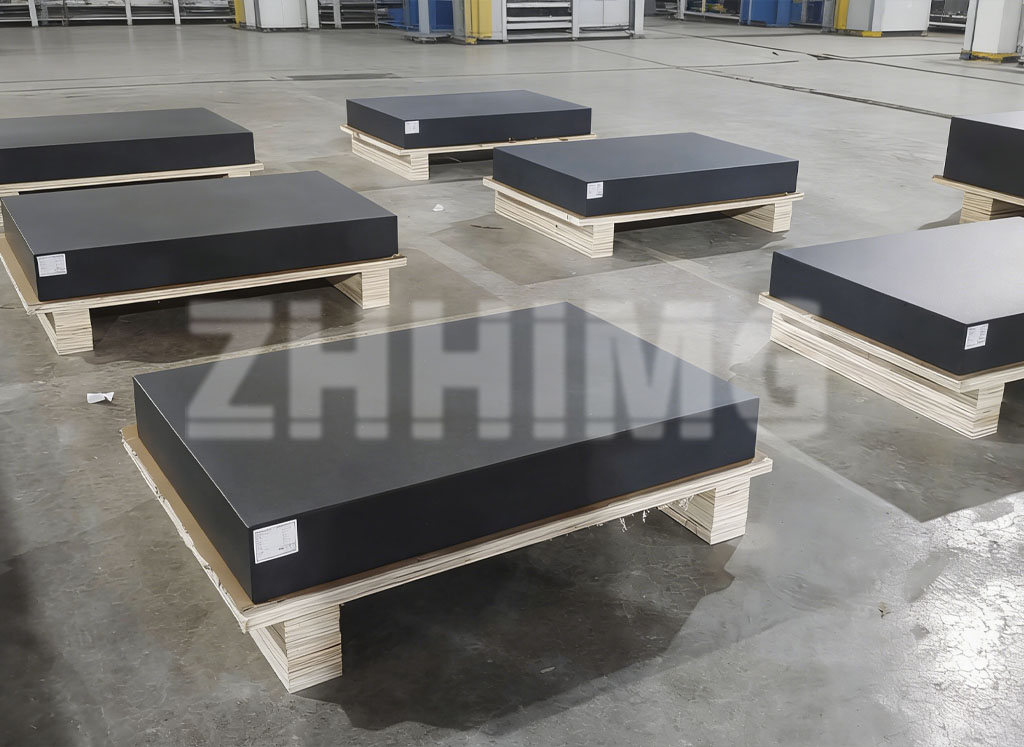
Machined granite plates resting on supports in the factory storage area – proper support begins the day the stone leaves the block, not the day it ships.
Why Large Granite Beds Are Hard to Manufacture
Size multiplies every difficulty. A longer bed means a longer lapping path where accumulated error grows; more machined features mean more positions that must hold tolerance; more weight means handling and support become engineering tasks of their own. Temperature is no longer a background condition – a gradient of a few degrees across a 20-metre surface will bend geometry by more than the tolerance band. And when measurement uncertainty is added across a large structure, the measurement itself becomes a project. Large-bed manufacturing is therefore a systems problem: material, handling, machining, environment and metrology have to be designed together.
Step 1: Raw Material Selection and Storage
Production starts at the raw block, not at the drawing. Each block is assessed for grain uniformity, colour consistency and internal defects before it is accepted for dimensional work. Accepted blocks are then seasoned – stored in the open air on the factory grounds, which ZHHIMG maintains at approximately 20,000 m², so that internal stresses relax naturally over time before any cutting begins. Rushing this stage is one of the classic causes of late deformation, which is why the storage yard is as much a part of the process as any machine.
Step 2: Engineering Review and Structural Design
Before a single cut, the customer’s drawing goes through engineering review: load paths, support positions, wall thicknesses, pocket layouts, insert patterns and the relationship between the accuracy grade requested and the geometry proposed. Large beds are rarely solid slabs – ribbed undersides, relief pockets and defined support stands are designed to hold geometry with the least mass. The review also settles the measurable questions early: which surfaces are critical, which tolerance applies to each, and how each will be inspected at full size.
Step 3: Rough Machining, Stress Relief and Pre-Machining
Large volumes of material are removed in stages, not in one pass. After rough machining, the part is allowed to rest and stabilize so machining-induced stress redistributes before finishing. Interfaces and mounting features are pre-machined while the structure is still robust enough to be handled aggressively. Sequencing matters: every stage leaves the part in a state that the next stage can build on without disturbing what is already correct.
Step 4: CNC Machining, Hole Machining and Insert Processing
Pockets, T-slots, dowel holes and threaded insert bores are machined on large CNC equipment to defined positions. For a bed several metres long, hole position accuracy is a coordinate problem – positions are machined against datums that the final inspection will use again, so machining and metrology share the same reference logic. Threaded inserts are bonded with controlled adhesives and torque procedures, and the finished inserts are checked so that a bolt tightened on site, a year later, loads the granite the way the design intended.
Step 5: Precision Lapping and Hand Fitting
Flatness at large size is still produced by lapping. ZHHIMG operates an extra-large lapping machine suited to metal and non-metal platforms up to approximately 6,000 mm in length, followed by hand-lapping for critical surfaces. Hand lapping is a measurement-driven craft: the lap plate, the plate surface and the measuring instrument work in a loop, with each cycle guided by the previous reading. On large surfaces, lappers work in defined zones and verify continuity across zone boundaries, so the final surface is one flat surface – not several local ones.
Step 6: Precision Measurement in a Temperature-Controlled Environment
Large parts are measured inside a temperature- and humidity-controlled workshop of approximately 10,000 m², built on high-strength concrete flooring at least 1,000 mm thick, with vibration-isolation trenches and low-noise overhead cranes. The floor, the trenches and the cranes exist for one reason: so that the measurement does not inherit the building’s movement. Instruments such as electronic levels and laser interferometers are used to characterize full-size geometry, and every critical surface is documented with measured results – the values, the instrument and the environmental conditions.
Step 7: Assembly of Metal, Ceramic, Air Bearing and Motion Components
Many customers now receive a structure, not a stone. In ZHHIMG’s temperature-controlled cleanroom assembly workshop, granite beds are integrated with metal parts, ceramic components, guideways, air-bearing elements and motion modules – a service aimed particularly at semiconductor and other high-precision equipment projects. Assembly under controlled conditions means the geometry verified at inspection is the geometry the customer’s modules see, and factory pre-assembly proves the interfaces before anything ships. More on this assembly, inspection and calibration capability is documented separately.
Step 8: Final Inspection, Packaging, Shipping and Installation Support
Final inspection repeats the full measurement against the agreed drawing and standard, and the report ships with the part. Packaging is engineered for sea freight: shock isolation, moisture protection and support fixtures that keep the bed in its certified support condition. From Jinan, with the port of Qingdao nearby, large precision structures move routinely in both domestic and export logistics. On request, ZHHIMG supports installation and re-verification at the customer’s site, because the final measurement that matters is the one taken where the machine will run.
What to Prepare Before Sending Your Drawing
A complete inquiry shortens the engineering review from weeks to days. Include:
- 2D/3D drawings with datums and tolerances stated
- Weight and overall dimensions, including envelope limits if any
- Accuracy grade or flatness requirement per surface
- Inserts, T-slots, holes and interface requirements
- Working environment – temperature range, vibration, cleanliness class
- Required inspections and documentation
- Destination port or site, for logistics planning
The honest answer to “why not choose the lowest quote” is arithmetic: on a large bed, material selection, stress control and measurement environment are invisible in a photograph but decisive over the machine’s life. A bed that drifts after installation is not a discount – it is a second purchase plus a schedule slip. ZHHIMG’s ultra-precision granite approach is to make each of those invisible decisions visible in writing, and the manufacturing process behind every shipment can be audited step by step.
For large granite machine beds, precision bases and integrated assemblies, ZHHIMG® offers engineering review before manufacturing. Send your drawing, weight, dimensions, accuracy requirement and destination port for evaluation.
Post time: Sep-18-2026