
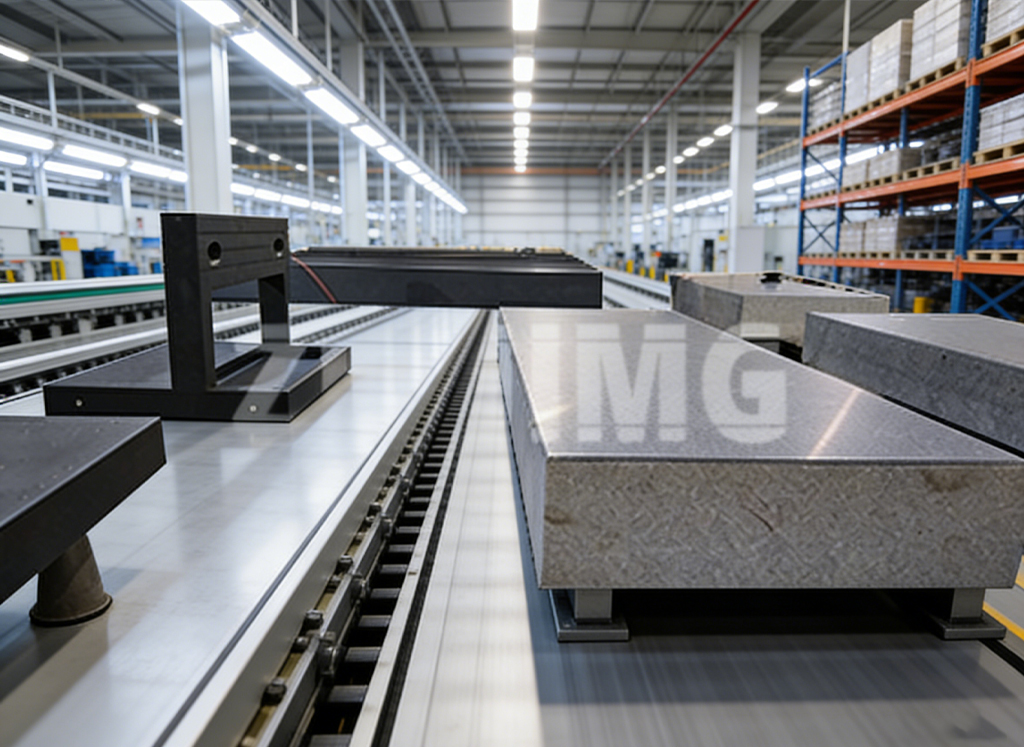
When a granite air bearing floats on a film of filtered air, friction and wear essentially disappear — and motion becomes smooth at the nanometre scale. But an air bearing never works alone. Its performance depends on the structure it rides on: the granite base, guideway and integrated assembly around it. This article explains what a granite air bearing system actually is, where it is worth using, and — most importantly — what design information you should prepare before requesting one.
1. What Is a Granite Air Bearing System?
A granite air bearing system is a precision motion architecture in which hardened, porous or orifice-fed air bearings glide over lapped granite surfaces instead of contacting them. Compressed air — typically filtered and regulated to a stable pressure — separates the bearing pad from the granite rail by a film only a few micrometres thick. The result is:
- Frictionless, wear-free movement — no stick-slip, no mechanical hysteresis from sliding contact.
- Sub-micron and even nanometre-level motion quality, because the air film averages out micro-irregularities of the surface.
- Very low vibration transmission, since there is no metal-to-metal contact to carry structure-borne noise.
- High straightness over long travel, because the moving carriage follows the geometry of the lapped granite rather than its own bearings.
In such a system, granite is not a passive slab. It is the functional counterpart of the air bearing: its lapped guideway faces, flatness and stability define the trajectory of everything that moves above them.
2. Why Air Bearings Are Almost Always Paired with Granite
Engineering logic keeps bringing these two together:
- Geometry retention. The air gap is only micrometres deep. Any material that creeps, warps or wears would close or distort the gap. Fine-grained black granite, with thermal expansion far below steel and no rust or creep, holds the gap geometry for years.
- Damping. Granite’s internal damping complements the squeeze-film damping of the air bearing itself, giving motion systems exceptional dynamic stability.
- Surface finish capability. Air bearing surfaces must be lapped to sub-micron flatness. Granite is one of the few engineering materials that can be lapped and polished to that level economically and repeatably.
- Non-magnetic, non-conductive behaviour. For linear motor stages, granite avoids eddy-current losses and electromagnetic interference that metal bases introduce.
- Integration. Rail seats, air supply channels, insert bosses and mounting interfaces can be machined directly into the same granite structure.
3. What a Complete System Typically Includes
A practical delivery is rarely “one granite block”. A typical scope includes:
- Granite base or bed — the machine datum, often with levelling inserts and seismic isolation mounts.
- Granite guideway bars or rails — lapped on the bearing faces, with defined straightness and parallelism over the travel length.
- Granite beam or bridge — for gantry configurations where the carriage crosses the guideways.
- Air bearing carriage or slider blocks — supplied by the stage builder, matched to the lapped surfaces.
- Air circuit features — drilled and plugged air passages, throttle orifices, and interface ports machined into the granite.
- Metal parts and inserts — stainless steel inserts, threaded bosses, brackets and frames assembled to the granite.
- Positioning and metrology hardware — reference scales, encoder mounts, probe or optics interfaces, depending on the machine.
4. Industries and Equipment That Use Them
Granite air bearing systems earn their cost where motion quality directly defines process capability:
- Semiconductor manufacturing and inspection — wafer inspection, lithography support stages and AOI equipment built on a semiconductor motion platform demand nanometre-scale smoothness over long travel.
- Linear motor stages — a granite linear stage with air bearings removes cogging-adjacent disturbances and stick-slip, exploiting the full resolution of the drive.
- Optical metrology and interferometry — where any mechanical noise corrupts measurement.
- Precision positioning and laboratory automation — scanning, dispensing and alignment systems that must repeat trajectories millions of times without wear.
5. What to Confirm Before the Design Begins
Air bearing systems are sensitive to air quality, installation accuracy and environment. Serious suppliers will ask for these conditions up front — prepare them before you request a quotation:
- Load and travel: payload mass, centre of gravity, travel range, moving mass and acceleration profile.
- Guideway layout: single rail, dual rail or gantry; number and preload of bearing pads.
- Geometric tolerances: required straightness, flatness, parallelism and angular errors over the full travel — and at what temperature they are certified.
- Air supply: available pressure, dew point, filtration class and consumption of the chosen bearings.
- Environment: temperature range and gradient, humidity, vibration of the floor, and cleanliness class if the system runs in a cleanroom.
- Interfaces: mounting drawings, insert positions, cable and air routing, and the measurement feedback scheme (scales, encoders, interferometers).
Underspecified air supply or an uncontrolled environment is the most common root cause of underperformance — not the granite, and not the bearings.
6. How Installation and Assembly Errors Are Controlled
The factory that laps the granite should also control the conditions under which errors are measured and the sequence in which the system is assembled:
- Constant-temperature inspection: flatness, straightness and parallelism verified in a temperature-controlled laboratory with traceable instruments, so the certified numbers match what the air bearing will actually see.
- Matched lapping: guideway pairs lapped for parallelism as a set, not as independent parts.
- Pre-assembly and trial fitting: inserts, metal frames and bearing seats assembled and checked before shipment, so on-site fitting does not introduce stress into the granite.
- Controlled installation: levelling procedures, support point definitions and torque sequences that keep the certified geometry once the system stands on your floor.
7. ZHHIMG® Custom Capability
ZHHIMG® manufactures precision granite assemblies for air bearing motion systems: CNC-machined bases, beds, beams and guideway bars from selected fine-grained black granite, with lapped air bearing surfaces, drilled and plugged air circuits, pre-embedded metal inserts, steel frame integration, constant-temperature inspection reports, and cleanroom-ready assembly. Whether you need a single air bearing granite base or a complete multi-axis granite motion structure, we build to your interface drawing and certification requirements.
Request a Custom Evaluation
For a custom granite air bearing base or precision motion assembly, please provide the travel range, payload, guideway layout, required straightness, flatness, environmental condition, and interface drawing. Our engineering team will review the feasibility, propose the granite structure and tolerance grades, and return a quotation with a certified inspection plan.
Post time: Sep-22-2026