
Granite air bearing systems are widely used in ultra-precision motion platforms for semiconductor manufacturing, optical alignment, and nanometer-scale metrology.
These systems eliminate mechanical contact by using a thin pressurized air film, achieving near-zero friction motion.
Air Bearing Principle
Air bearings operate by introducing compressed air between two surfaces, forming a 2–20 μm air film.
This eliminates:
- Mechanical friction
- Wear
- Stick-slip behavior
The system relies on fluid film dynamics and stable laminar flow.
Role of Granite
Granite provides:
- Structural stability
- Thermal drift suppression
- Vibration damping
It serves as the mechanical reference base for the motion system.
System Components
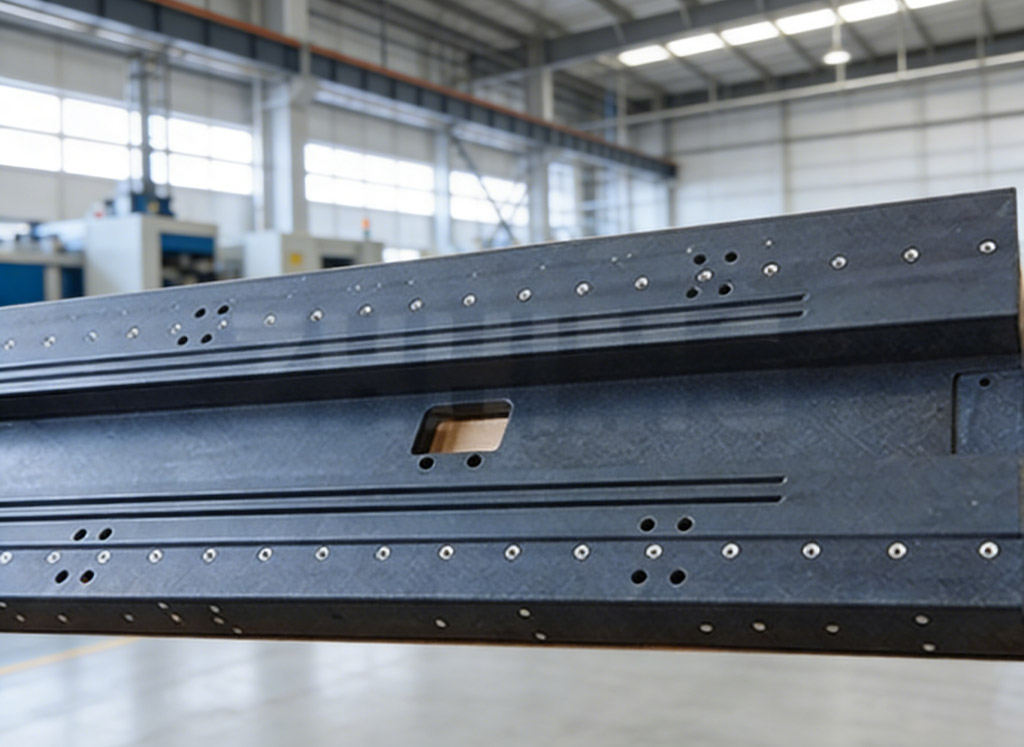
- Granite base
- Air bearing pads
- Air supply system
- Precision encoders
- Motion control system
Performance Characteristics
Typical performance includes:
- Sub-micron positioning accuracy
- High straightness over long travel
- Zero mechanical backlash
Key error sources include air pressure instability, thermal drift, and encoder error.
Applications
- Semiconductor wafer inspection
- Lithography systems
- Optical alignment platforms
- High-end metrology machines
FAQ
Do air bearings wear out?
No mechanical contact eliminates wear.
Why use granite?
For stability and vibration damping.
What limits accuracy?
Air stability and thermal effects.
Can they carry heavy loads?
Yes, depending on design.
Post time: Jul-03-2026