
Ultra-precision motion systems are fundamental to modern high-tech manufacturing, particularly in semiconductor lithography, wafer inspection, optical alignment, and nanometer-scale metrology. At the core of these systems lies a critical engineering challenge: achieving smooth, frictionless, and highly repeatable motion without mechanical contact-induced error.
Air bearing technology, when integrated with high-stability granite structures, provides one of the most advanced solutions to this challenge. A granite air bearing system replaces traditional mechanical rolling or sliding contact with a thin film of pressurized air, enabling near-zero friction motion and exceptional geometric accuracy.
In advanced manufacturing environments, companies such as ZHHIMG integrate high-density granite bases with precision-engineered air bearing components to achieve motion systems capable of sub-micron and even nanometer-level positional control.
1. Fundamental Principle of Air Bearing Technology
Air bearings operate on the principle of fluid dynamic separation. Instead of allowing two solid surfaces to come into contact, a controlled layer of pressurized air is introduced between them.
1.1 Formation of Air Film
A typical air bearing system consists of:
- A stationary granite base
- A moving carriage or stage
- Precision air nozzles or porous media
- Controlled air supply system
Compressed air is introduced through micro-orifices or porous ceramic materials, forming a thin film typically ranging from 2 to 20 micrometers in thickness.
This air film supports the load and eliminates direct mechanical contact.
1.2 Zero Contact Mechanics
Unlike ball bearings or linear guides, air bearings operate in a regime where:
- Friction coefficient approaches zero
- Wear is theoretically eliminated
- Stick-slip motion is absent
This makes air bearings ideal for ultra-precision positioning systems where mechanical hysteresis is unacceptable.
1.3 Laminar Flow Behavior
The performance of air bearings depends heavily on laminar flow stability. Turbulence introduces:
- Pressure fluctuations
- Positional instability
- Increased noise in measurement systems
Therefore, precision air bearing design requires computational fluid dynamics (CFD) optimization to ensure stable flow distribution across the bearing surface.
2. Role of Granite in Air Bearing Systems
Granite is not simply a structural support material; it is a functional component of the motion system.
2.1 Structural Stability
High-density black granite provides:
- High modulus of elasticity stability
- Long-term dimensional integrity
- Resistance to deformation under load
These properties are critical because air bearings rely on maintaining uniform gap height across the entire travel surface.
2.2 Thermal Stability and Drift Control
Thermal drift is one of the dominant error sources in precision motion systems.
Granite has:
- Low thermal expansion coefficient (~4–7 × 10⁻⁶ /°C)
- High thermal inertia
- Slow thermal gradient propagation
This reduces:
- Stage tilt due to uneven heating
- Z-axis drift in long-duration measurements
- Alignment errors in optical systems
2.3 Vibration Damping
Granite’s natural damping reduces high-frequency vibration transmission from external sources such as:
- Floor vibration
- Nearby machining equipment
- Air handling systems
This is essential for maintaining positional stability in nanometer-scale applications.
3. System Architecture of Granite Air Bearing Platforms
A typical granite air bearing system integrates mechanical, pneumatic, and control subsystems.
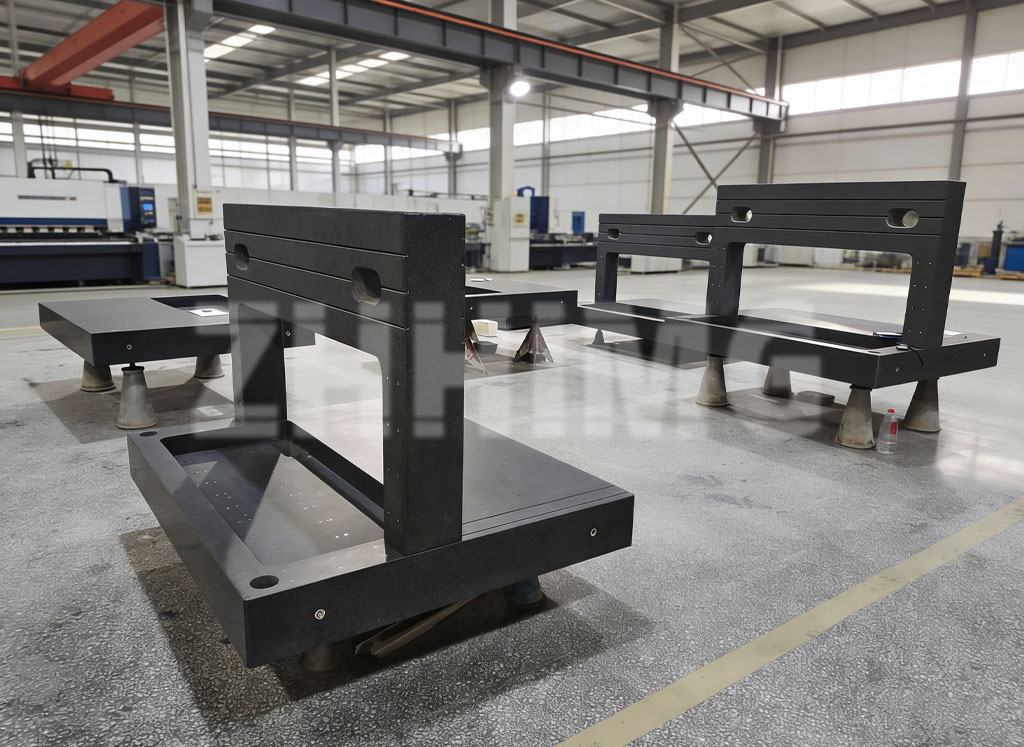
3.1 Mechanical Structure
Key components:
- Granite base platform
- Precision-ground motion rails
- Air bearing pads (porous ceramic or orifice type)
- Moving stage assembly
Flatness of the granite base is typically controlled to micron or sub-micron levels depending on application class.
3.2 Pneumatic Control System
The air supply system includes:
- High-pressure air compressor
- Precision regulators
- Flow restrictors
- Filtration units (removal of oil, moisture, particulates)
Even minor contamination can significantly affect bearing stability.
3.3 Feedback and Control Systems
High-end systems integrate:
- Laser interferometers
- Linear encoders
- Capacitive displacement sensors
These systems allow closed-loop motion control with nanometer-scale resolution.
4. Metrology and Precision Performance
Air bearing systems are evaluated based on several key metrology parameters.
4.1 Straightness and Flatness
Straightness errors typically arise from:
- Granite base deviation
- Air film thickness variation
- Load distribution asymmetry
High-end systems can achieve:
- Sub-micron straightness over meter-scale travel
- Nanometer-level repeatability in controlled environments
4.2 Positioning Accuracy
Positioning accuracy depends on:
- Encoder resolution
- Control loop stability
- Air film stiffness
Unlike mechanical systems, air bearings eliminate backlash entirely.
4.3 Dynamic Stiffness
Dynamic stiffness defines how the system responds to external forces.
Air bearings exhibit:
- High stiffness at low frequencies
- Reduced stiffness at high frequencies due to air compressibility
This trade-off is managed through system design and preload optimization.
5. Industrial Applications
Granite air bearing systems are widely used in advanced manufacturing sectors.
5.1 Semiconductor Industry
Applications include:
- Wafer inspection stages
- Lithography alignment systems
- Photomask positioning
These systems require nanometer-level repeatability.
5.2 Precision Optics
Used in:
- Lens alignment systems
- Laser beam positioning
- Interferometric measurement setups
5.3 Coordinate Metrology
Air bearing granite platforms are used in:
- High-end CMM systems
- Optical coordinate measurement machines
- Multi-sensor inspection systems
5.4 Advanced Manufacturing
Including:
- Micro-machining systems
- Femtosecond laser processing platforms
- Additive manufacturing calibration systems
6. Material Integration Challenges
Designing a granite air bearing system involves multiple engineering trade-offs.
6.1 Surface Flatness Requirements
Air bearings require extremely uniform air gap distribution. Any deviation in granite flatness directly affects:
- Load distribution
- Motion smoothness
- Positional accuracy
6.2 Air Supply Sensitivity
System performance is sensitive to:
- Pressure stability
- Flow uniformity
- Contaminant levels
Even micron-scale particles can disturb airflow dynamics.
6.3 Thermal-Mechanical Coupling
Thermal expansion of granite and structural components must be carefully matched to prevent:
- Stage tilt
- Z-axis drift
- Geometric distortion
7. Manufacturing and Calibration Processes
High-precision granite air bearing systems require controlled manufacturing environments.
Typical process stages include:
- Rough granite machining
- Thermal stabilization cycles
- Precision grinding and lapping
- Air bearing integration
- Metrology verification
- Laser calibration alignment
Advanced manufacturers such as ZHHIMG operate controlled environments with temperature stability typically within ±1°C to ensure repeatable geometric accuracy.
8. Advantages Over Mechanical Bearing Systems
| Feature | Air Bearing System | Mechanical Bearing |
|---|---|---|
| Friction | Near zero | Present |
| Wear | None | Continuous |
| Backlash | None | Present |
| Maintenance | Low | High |
| Precision | Nanometer-scale possible | Limited |
Air bearings eliminate many fundamental limitations of mechanical systems.
Conclusion
Granite air bearing systems represent one of the most advanced solutions for ultra-precision motion control in modern manufacturing. By combining the structural stability of high-density granite with the frictionless characteristics of air film separation, these systems achieve exceptional levels of accuracy, repeatability, and long-term stability.
As semiconductor and precision engineering industries continue to push toward nanometer and even sub-nanometer tolerances, granite air bearing platforms will remain a core enabling technology for next-generation metrology and manufacturing systems.
Post time: Jul-03-2026