
Granite surface plates are foundational reference instruments in dimensional metrology. They serve as the primary physical datum for inspection, calibration, and assembly alignment in high-precision manufacturing environments. Industries such as aerospace, semiconductor fabrication, optical systems, and advanced machine tool engineering rely on these structures to maintain geometric accuracy at micrometer and sub-micrometer levels.
Unlike metallic reference tables, granite provides a naturally stable crystalline structure with extremely low internal stress, excellent vibration damping characteristics, and long-term geometric stability. These properties make it one of the most widely used materials for precision metrology bases globally.
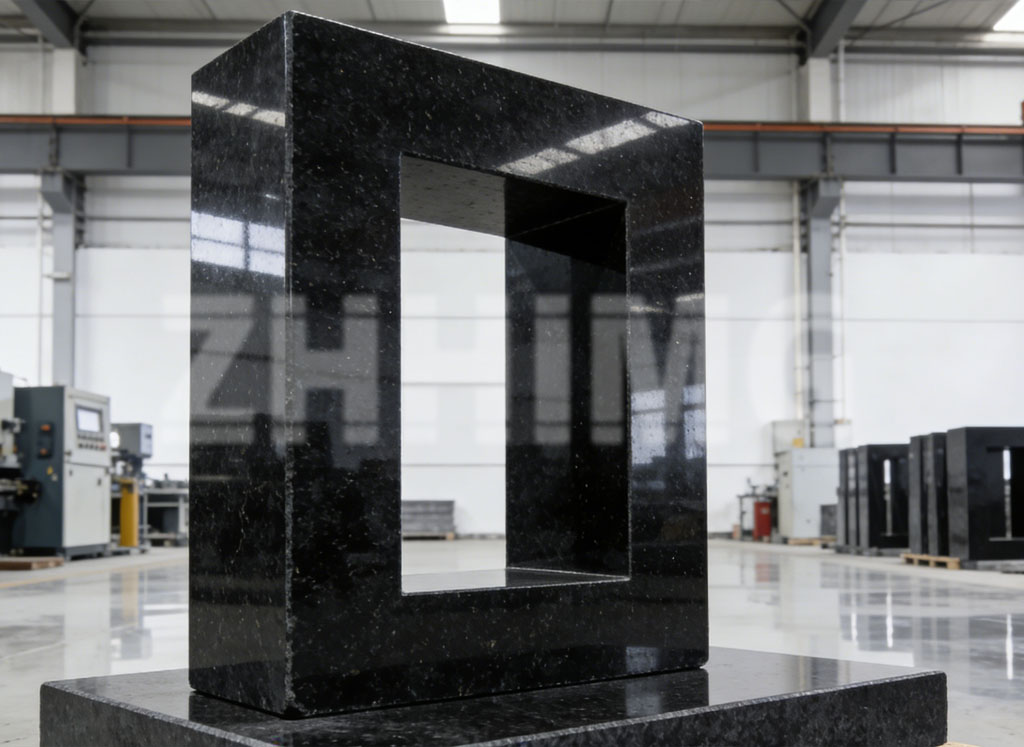
In advanced manufacturing ecosystems, organizations such as ZHHIMG utilize high-density black granite to produce surface plates designed for ultra-stable measurement environments where repeatability and uncertainty control are critical.
1. Material Science Behind Granite Surface Plates
Granite is an igneous rock primarily composed of quartz, feldspar, and mica. Its suitability for precision engineering applications is not accidental but derived from its microstructural characteristics.
1.1 Crystalline Structure and Stability
The interlocking crystal matrix of granite provides:
- High compressive strength
- Minimal elastic deformation under load
- Low residual stress compared to cast metals
- Excellent long-term dimensional stability
Unlike steel or aluminum, granite does not undergo phase transformations or plastic deformation under typical metrology loads, making it ideal for reference surfaces.
1.2 Thermal Behavior
Thermal stability is one of the most critical parameters in metrology systems.
Typical properties of high-density black granite:
- Coefficient of thermal expansion: ~4–7 × 10⁻⁶ /°C
- High thermal inertia
- Low thermal conductivity
This means temperature gradients propagate slowly through the material, reducing localized distortion during measurement operations.
In contrast, steel structures can exhibit thermal expansion values up to 12 × 10⁻⁶ /°C, making them significantly less stable for precision reference applications.
1.3 Damping Characteristics
Granite exhibits natural vibration damping due to its heterogeneous mineral composition. This property is essential in environments where:
- External machine vibrations exist
- Coordinate Measuring Machines (CMM) operate
- Laser interferometry is performed
Vibration energy is dissipated through internal grain boundaries rather than being transmitted across the structure.
2. Precision Standards for Granite Surface Plates
Granite surface plates are not arbitrary flat slabs; they are manufactured and verified under strict international metrology standards.
2.1 DIN 876 Standard (Germany)
The DIN 876 standard defines flatness tolerance grades:
| Grade | Typical Application | Flatness Tolerance (approx.) |
|---|---|---|
| Grade 00 | Master reference labs | Highest precision |
| Grade 0 | Calibration labs | Ultra precision |
| Grade 1 | Industrial inspection | High precision |
| Grade 2–3 | Workshop use | General inspection |
Flatness is typically evaluated using electronic levels, laser interferometry, or autocollimators.
2.2 ASME B89 (United States)
ASME B89 defines:
- Measurement uncertainty requirements
- Calibration procedures
- Traceability to national standards
It is widely used in aerospace and defense manufacturing systems.
2.3 ISO 9001 / ISO-based Quality Systems
While ISO 9001 does not define metrology tolerances directly, it governs:
- Quality management systems
- Calibration traceability
- Process control requirements
Manufacturers operating under ISO frameworks must ensure repeatability and documented calibration chains.
3. Flatness Engineering and Measurement Methods
Flatness is the defining parameter of a surface plate. However, flatness is not a single point measurement but a derived geometric property.
3.1 Measurement Techniques
Common methods include:
- Electronic spirit levels (e.g., WYLER systems)
- Laser interferometry (Renishaw systems)
- Autocollimators
- Mechanical comparison using master straight edges
Each method introduces different uncertainty contributions.
3.2 Error Sources in Flatness Measurement
Key uncertainty contributors:
- Temperature gradients across surface
- Probe repeatability
- Airflow-induced micro-vibration
- Operator handling variability
- Instrument calibration uncertainty
In high-end laboratories, total measurement uncertainty can be controlled within sub-micron levels.
3.3 Long-Term Stability Behavior
Unlike metallic plates, granite does not exhibit:
- Stress relaxation
- Plastic creep deformation
- Fatigue-induced distortion
This makes granite surface plates suitable for long-term reference applications without frequent re-machining.
4. Industrial Applications of Granite Surface Plates
Granite surface plates serve as foundational elements in multiple high-tech industries.
4.1 Coordinate Measuring Machines (CMM)
Used as:
- Base reference datum
- Machine calibration platform
- Workpiece inspection foundation
4.2 Semiconductor Equipment
Applications include:
- Wafer alignment systems
- Lithography positioning stages
- Inspection metrology platforms
4.3 Precision Machine Tool Calibration
Used for:
- CNC machine alignment
- Linear guide calibration
- Spindle runout verification
4.4 Optical and Laser Systems
Granite bases support:
- Laser interferometers
- Optical alignment benches
- Photonics assembly systems
5. Granite vs Alternative Materials
A critical engineering decision is material selection for reference bases.
| Property | Granite | Cast Iron | Steel |
|---|---|---|---|
| Thermal stability | Excellent | Moderate | Low |
| Vibration damping | Excellent | Good | Poor |
| Corrosion resistance | Excellent | Low | Low |
| Long-term stability | Very high | Moderate | Moderate |
Granite consistently outperforms metallic alternatives in metrology environments.
6. Industrial Manufacturing Considerations
High-end granite surface plates require controlled manufacturing environments:
- Precision lapping processes
- Multi-stage scraping and grinding
- Environmental temperature control (20°C ±1°C typical)
- Stress-relief stabilization cycles
Advanced manufacturers such as ZHHIMG integrate large-scale machining systems capable of producing plates exceeding several meters in length while maintaining micron-level flatness control.
Conclusion
Granite surface plates remain a cornerstone of modern precision metrology due to their unique combination of mechanical stability, thermal neutrality, and vibration damping characteristics. When combined with strict adherence to international standards such as DIN 876 and ASME B89, granite-based systems provide the foundation for reliable, repeatable, and traceable measurement infrastructure.
As manufacturing precision continues to advance into nanometer-scale tolerances, granite will remain a critical enabling material in the global metrology ecosystem.
Post time: Jul-03-2026