
Precision height gauges operate within micron or even nanometer accuracy ranges. Quite often, the probe and reading module are fully functional, yet measurement data keeps fluctuating, and repeated readings on the same workpiece show obvious discrepancies. Many inspectors recalibrate the instrument and adjust probe pressure repeatedly, but such fluctuations cannot be eliminated. The root cause usually lies in omnipresent micro-vibrations in workshops.
Vibrations generated by air compressors, conveyors, adjacent machine tools and even footsteps travel through the floor to the height gauge. Metal bases transmit vibrations rigidly; tiny tremors directly affect the contact point between the probe and workpiece and cause unstable readings. To suppress such disturbances, the base itself must have vibration absorption and buffering capacity. Granite bases for height gauges are developed to solve exactly this pain point.
Unlike metal and cast iron, dense granite features natural damping properties thanks to its unique internal mineral structure, making it a passive vibration-damping material. When vibration waves reach the granite base, energy dissipates and decays continuously at mineral boundaries inside the stone, instead of being directly transferred to the height gauge above. It acts like a natural buffer layer for the whole measurement system, weakening various micro-vibrations from the ground and keeping the height gauge mounted on the base in a relatively static measuring state.
One key distinction needs to be clarified: vibration damping is not simply adding weight. Simply thickening metal blocks can only reduce part of low-frequency vibration by dead weight and barely suppress high-frequency micro-tremors commonly seen in inspection workshops. Inferior marble, by contrast, has abundant pores and uneven mineral distribution, resulting in unstable vibration absorption. It may work for a short period, yet its damping performance gradually degrades once it deforms under long-term temperature and humidity changes. Precision granite with carefully selected raw materials and thorough aging treatment features uniform and compact texture with stable damping performance. It suppresses low-frequency shaking via dead weight and absorbs high-frequency micro-vibrations at the same time. This dual effect ensures a stable measurement reference.
In continuous batch inspection, the impact of vibration interference accumulates. Vibrations persist during frequent workpiece loading and unloading and nonstop operation of surrounding equipment. The granite base absorbs vibration energy and reduces instantaneous jitter of the probe, enabling readings from each contact measurement to converge quickly. It lowers discrete errors between repeated measurements and improves data repeatability. This is especially critical for precision metrology tools such as height gauges that rely on static references. 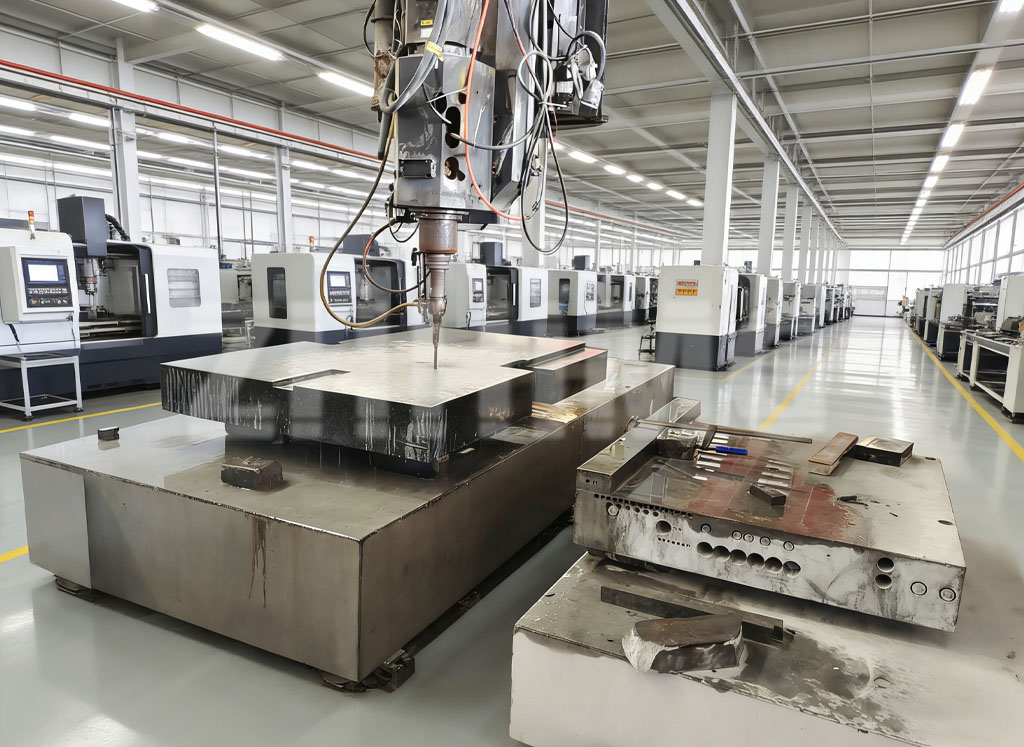
This vibration buffering characteristic also mitigates instantaneous impacts on the probe. Minor knocks generated during workpiece placement and retrieval are cushioned by the granite base. It reduces accidental damage to precision probes, extends probe service life and cuts instrument maintenance frequency.
Of course, vibration damping performance depends on qualified processing techniques. Only granite bases with precision lapped reference surfaces and fully released internal stress can deliver stable vibration suppression. If stone blanks retain internal stress and deform slowly over time, system measurement errors will still arise despite excellent damping performance.
Within inspection environments where workshop vibrations cannot be completely eliminated, granite height gauge bases leverage natural damping to buffer vibrations and block the transmission path of micro-vibrations to the probe, stabilizing the measurement reference. Without complicated external vibration isolators, they deliver smoother readings and higher repeatability for height gauges, making them a preferred solution to improve measurement stability for precision height measurement applications.
Post time: Sep-16-2026