
In precision metrology laboratories and inspection workshops, height gauges serve as core instruments to capture height data at micron and even nanometer levels. Engineers often encounter a type of hard-to-diagnose measurement anomaly: the hardware is intact, temperature and humidity meet requirements, yet readings fluctuate frequently and data repeatability is poor. The issue persists even after repeated calibration. Many overlook a hidden source of interference — magnetism from base materials. Ferrous metal bases generate magnetic fields that disturb internal sensors of height gauges, leading to reading drift and compromised measurement results.
To avoid magnetic interference, non-magnetic reference bases become critical for height gauge systems. Premium granite bases are natural mineral aggregates free of magnetically conductive metals such as iron and nickel. They carry no inherent magnetism and cannot be magnetized by external magnetic fields. When a height gauge is mounted on a granite base, the base produces no extra magnetic field and will not create electromagnetic interference with the gauge’s probe and sensing elements, ensuring clean and stable measurement signals.
Many buyers confuse concepts, assuming non-magnetic metal alloys can replace granite bases. Though non-magnetic alloys do not attract magnets, they may still induce faint electromagnetism under alternating working conditions. For nanoscale height measurement, this tiny signal disturbance is enough to trigger measurement deviations. Dense black granite, by contrast, is an inert non-metallic stone with no electromagnetic induction effect, eliminating data fluctuations caused by magnetic fields at the source.
Still, not all stone materials qualify as non-magnetic bases for height gauges. Low-cost marble available on the market has complex mineral composition. Some marble contains trace magnetic minerals that bring latent interference in high-precision measurement scenarios. Meanwhile, marble features large pores and insufficient stability, prone to deformation under temperature and humidity changes and introducing extra measurement errors. Precision granite tailored for height gauges uses carefully screened raw materials with magnetic impurities removed. Boasting ultra-high density, it is non-magnetic, low-deformation and vibration-absorbent, delivering dual assurance for reliable measurement results.
Vibration, temperature variation and electromagnetic interference often coexist during long-term height gauge operation. On one hand, granite bases block magnetic disturbance; on the other hand, their material damping absorbs micro-vibrations from workshops and prevents vibration transfer to the probe. Precision lapping creates a flat reference plane for height gauge installation. Measurements are free from reading jumps caused by magnetism and systematic deviations triggered by base deformation.
Compared with metal bases, granite bases remove the need for additional electromagnetic shielding. Metal bases often require shielding components to eliminate magnetic interference, raising equipment costs and occupying extra installation space. Granite bases need no shielding structures, enabling simpler setup and commissioning. Their performance remains consistent over time without magnetization or demagnetization. 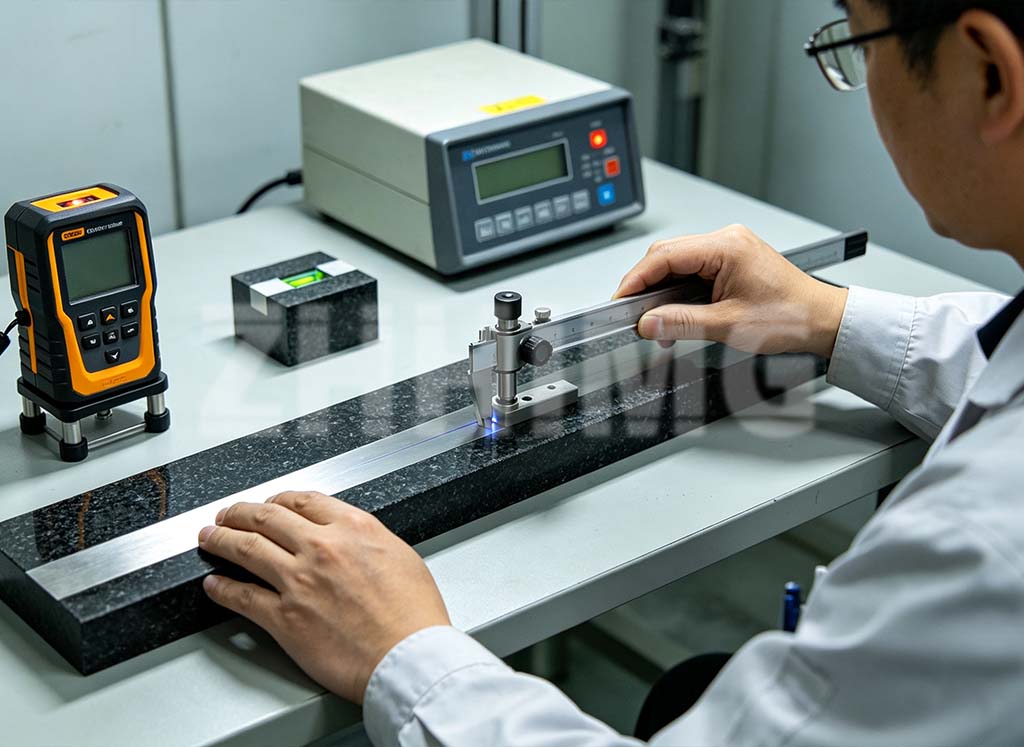
Of course, non-magnetism is merely one advantage of granite bases. Stable long-term height gauge measurement also requires qualified flatness and fully released internal stress of the base. Only precision granite bases processed and calibrated rigorously can combine non-magnetic property, high flatness, vibration resistance and low deformation to fit height gauges and other precision metrology tools.
To sum up, for highly sensitive precision measurement scenarios such as height gauges, granite bases leverage natural non-magnetic characteristics to completely prevent magnetic disturbance to sensors and guarantee stable, repeatable height measurement data. They simplify measurement system design and cut extra shielding costs, acting as an ideal reference support solution for high-precision height measuring equipment.
Post time: Sep-16-2026