
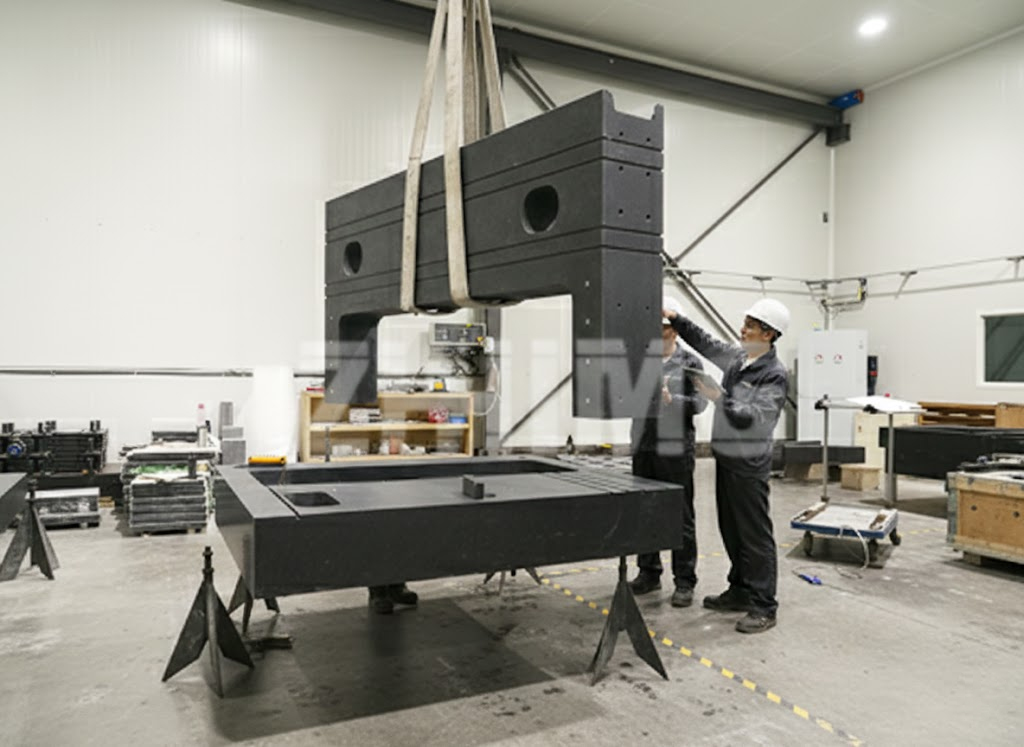
When engineers specify the foundation of a precision machine, the real question is rarely “is granite good?” It is: what will this specific equipment demand of its base over ten years of service — and which material meets those demands at a rational cost? Steel, cast iron, aluminium and welded structures all have legitimate places in machine design. This article gives you an objective framework for choosing between a granite machine base and a metal base, dimension by dimension.
1. Start From the Machine’s Requirements, Not From the Material
Before comparing materials, write down what the base actually must do:
- Does the machine rely on the base as a measurement datum, or only as a structural carrier?
- How sensitive are positioning accuracy and repeatability to temperature drift and vibration?
- Are there EMI, electrical isolation, or chemical exposure requirements?
- How much modification flexibility will the equipment need during its life cycle?
- What are the constraints on weight, transport, and installation?
The answers usually point clearly toward one material — or toward a hybrid design.
2. The Dimension-by-Dimension Comparison
| Dimension | Precision Granite Structure | Metal / Cast Iron Structure | Selection Note |
|---|---|---|---|
| Thermal stability | Well suited to applications requiring long-term geometric stability | Strongly affected by material, heat source layout and cooling design | Critical for temperature-drift-sensitive metrology, optical and semiconductor equipment |
| Vibration behaviour | Natural stone offers excellent damping characteristics | Can be improved through structural design, filling and isolation | Evaluate dynamic response for high-speed motion, optical inspection and micron-level positioning |
| Corrosion resistance | Does not rust; suitable for some chemical and humid environments | May require coatings, rust protection and maintenance | Confirm against cleaning agents, coolants and the chemical environment |
| Electromagnetic properties | Non-magnetic, non-conductive | Metals are typically conductive; some are magnetic | Relevant where EMI control or electrical isolation is required |
| Structural integration | Holes, slots, inserts and mounting faces can be machined directly | Welding, milling and threading are highly flexible | Complex metal structures can be combined with granite in hybrid designs |
| Transport and installation | Heavy; lifting, support and shipping must be planned in advance | Relatively easy to weld, modify or adjust on site | For large equipment, complete logistics and installation assessment at the design stage |
One honest clarification on the frequently cited granite properties — low thermal expansion, vibration damping, wear resistance, non-conductivity and resistance to acids and alkalis — all are real and well documented in public engineering literature, which is why precision granite is widely used in semiconductor, industrial automation, medical technology, machine tool, measurement and test-bench applications. But each of these advantages only converts into machine performance if the whole structure around the base is designed to preserve it.
3. When Granite Is the Better Choice
Precision granite tends to win when the base is the reference:
- CMM and vision measurement machines, where the base carries guide rails whose straightness directly defines measurement accuracy.
- AOI and wafer inspection systems, where a flat, damped, thermally quiet platform underlies both the optics and the motion system — a typical setup combines a granite base with an integrated granite beam, as shown in the photo above during assembly.
- Laser processing equipment, where beam pointing stability and path geometry depend on a thermally stable structure.
- Linear motor and air bearing stages, where the non-magnetic, non-conductive base avoids eddy-current and EMI issues, and granite’s damping improves scan stability.
- Laboratory and calibration benches, where decades of geometry retention matter more than weight.
4. When Metal — or a Hybrid — Is the Better Choice
Objectivity cuts both ways. Metal structures are often preferable when:
- The equipment requires frequent modification — welded and machined metal can be cut, re-welded and adapted on site far more easily than granite.
- The design involves complex enclosed cavities or pressure-bearing volumes that welding handles naturally.
- The base must absorb special impact loads or crash energy — a ductile metal structure deforms visibly and repairably where brittle materials may crack.
- Weight or cost budgets exclude large granite monoliths.
In practice, many high-end machines resolve this with a granite–metal hybrid: a granite datum plate or beam providing the reference geometry, mounted on or into a steel support frame that carries loads, services and integration with other machine modules. The two materials are complements, not competitors — the design task is deciding which material owns which function.
5. A Practical Decision Example
Consider a high-accuracy AOI or CMM machine. Its requirements: a flat datum surface, low vibration transmission to optics, precise guide rail mounting faces, and long-term repeatability. Here the granite base — with lapped rail seats and pre-embedded inserts in one setup — is usually the priority solution. Now consider a machine that must be reconfigured every product generation, with welded enclosures, fluid galleries and frequent retrofit: a metal structure, or a granite–metal hybrid where only the metrology-critical surfaces are granite, may serve better. Same factory, different answers — that is what professional material selection looks like.
6. How ZHHIMG® Supports the Selection Process
ZHHIMG® manufactures precision granite machine bases, beams and integrated assemblies from selected fine-grained black granite, with CNC-machined features, lapped datum surfaces, pre-embedded inserts, in-house traceable inspection, and a controlled manufacturing process from block selection to final certification. Because we also deliver hybrid granite–metal solutions, we have no incentive to push granite where it does not fit — our engineers will tell you honestly when steel belongs in your structure, and where granite earns its place.
Get an Objective Evaluation
Sending your application requirements costs nothing. Share your equipment type, accuracy targets, load cases, environment and life-cycle plans with ZHHIMG®, and our engineering team will help you weigh granite, metal and hybrid options — then quote the variant that fits. Visit our precision granite components page and submit your drawing for a technical evaluation.
Post time: Sep-22-2026