
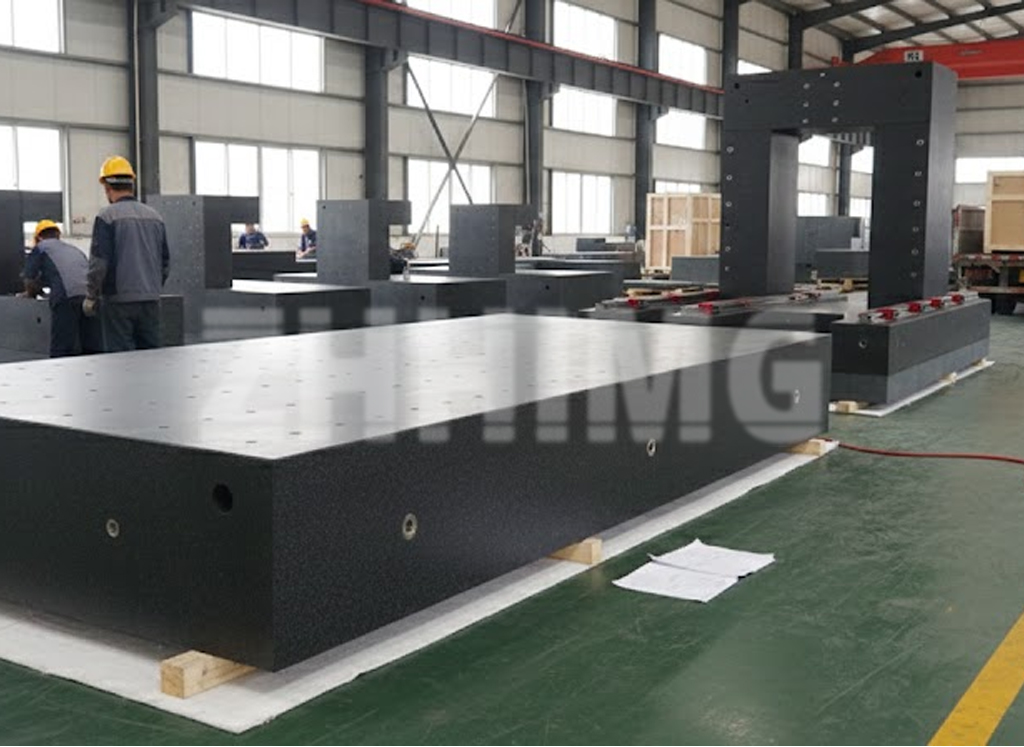
Here is a question machine builders hear from customers all the time: “If my linear motor has nanometre-scale feedback, my encoder is sub-micron accurate and my interferometer can measure anything — why does the machine base matter at all?” The answer is that every one of those high-precision components is referenced to the base. A linear motor generates heat and magnetic forces; the encoder scales are mounted on structures that expand and contract; the measuring system reports motion relative to the frame, not relative to “truth”. If the precision machine base drifts, vibrates or relaxes internally, the world’s best metrology simply records that drift with great accuracy. The base is the only machine element that touches every other one — which is why material choice is an engineering decision, not a cost line.
Thermal Stability
Thermal error remains the largest single source of geometric error in precision machines, typically accounting for 40–70 % of total error budget in precision machining and metrology equipment. Granite’s thermal expansion coefficient is roughly 5–6 × 10⁻⁶/°C — about half that of steel — and, just as importantly, granite has low thermal conductivity, so temperature changes propagate slowly and gradients form gradually rather than instantaneously. Steel and cast iron bases respond quickly to ambient swings: a workshop door opening, a coolant line, the sun through a window. This does not mean metal bases are unusable — a well-designed steel base with symmetric structure and active cooling can perform excellently — but the machine builder must actively manage what granite passively resists.
Vibration Damping
The internal crystalline structure of granite dissipates vibrational energy roughly ten times faster than steel. For equipment with linear motors, high-speed scanning probes or femtosecond laser optics, damping determines whether disturbances decay in milliseconds or persist as blurry edges and noisy measurements. Cast iron can be engineered with ribs and filled cavities to damp well, but its performance depends on design skill and wall thickness. A granite machine base provides high damping by material nature, independent of geometry — a significant advantage when the structure must be open, thin or deeply pocketed for cable routing and stage travel.
Dimensional Stability Over Time
Cast iron castings and welded steel frames carry residual stresses from casting, welding and heavy machining. Over months and years, these stresses relax and the structure moves — usually a few micrometres, occasionally more after a rough transport or a thermal shock. That is why metal bases require stress-relief heat treatment and often a “settling” period before final calibration. Granite, formed over hundreds of millions of years and quarried in giant blocks, has no manufacturing-induced residual stress to relax: once lapped, its geometry stays. Honed granite components calibrated today are routinely re-verified years later within a fraction of their original tolerance.
Corrosion Resistance and Magnetic Behaviour
Granite is non-corrosive: coolant mist, cutting fluids and humid air leave it unaffected, so no protective coatings or oil films are required — a genuine benefit in semiconductor cleanrooms where outgassing and particle generation are tightly controlled. Granite is also non-magnetic, which matters for linear-motor machines (no attraction of ferrous debris into the magnet track area) and for magnetic-sensitive metrology. Steel, by contrast, needs plating, painting or oiling, and every coating is a potential contamination or wear source.
Side-by-Side Comparison
| Property | Granite | Steel / Cast Iron |
|---|---|---|
| Thermal stability | Excellent (low CTE, low conductivity) | Depends on structure and environment |
| Vibration damping | Excellent (intrinsic) | Depends on design (ribs, fill, mass) |
| Corrosion | Non-corrosive | Requires protection |
| Magnetic behaviour | Non-magnetic | Material dependent |
| Long-term dimensional stability | Excellent when properly selected and manufactured | Depends on material and stress relief |
| Load capacity per mass | Lower (needs greater thickness) | Higher (thin walls + ribs) |
| Design flexibility | Machined pockets, inserts, slots | Welded/fabricated shapes, thin walls |
An Honest Engineering View: When Does Metal Still Make Sense?
Granite is not automatically the right answer, and a technically credible supplier will say so. Metal wins when the base must be very large but lightweight, when complex fabricated shapes or thin walls are needed, or when cost pressure dominates and the accuracy requirement is modest. Hybrid designs are increasingly common and often the best engineering compromise: a welded steel frame carrying a precision granite reference surface, mineral-cast structures bonded to granite rails, or granite columns bolted to damped steel sub-frames. The correct question is not “granite or metal?” but “which property — thermal, damping, stability — limits this machine’s accuracy, and which material delivers it at acceptable mass and cost?”
What Large-Format Capability Makes Possible
Material theory only becomes real when a manufacturer can actually produce the base your machine needs. Precision granite fabrication at industrial scale is defined by a few benchmark capabilities: machining single granite bases up to 100 tons, machining lengths up to 20 m, widths up to 4000 mm and thicknesses up to 1000 mm, with large-format surface grinding up to 6000 mm. These limits determine whether a lithography-stage base, a full-size CMM table or a laser-gantry foundation can be made as one stress-free monolith — instead of being spliced from smaller pieces with joints that become thermal and damping weak points. When evaluating any precision granite supplier, ask for the actual machine-tool envelope and the inspection uncertainty of their largest grinder, not only the brochure tolerances for a 500 mm plate.
Conclusion: Stability Is the Whole Machine’s Foundation
Linear motors, encoders and interferometers measure and compensate — but they can only compensate for errors the control system knows about, referenced to a base that holds still. Granite’s thermal stability, intrinsic damping, corrosion immunity and freedom from residual stress make it the reference material for precision machine bases in metrology, semiconductor and laser equipment; properly engineered metal and hybrid structures remain valid where mass, shape or cost dominate. The engineering win comes from matching material properties to the machine’s error budget — and from choosing a manufacturer with the proven large-format capability to deliver that material at the size your machine requires.
ZHHIMG® manufactures precision granite machine bases up to 100 t / 20 m with large-format grinding to 6000 mm, including CMM tables, semiconductor-stage foundations and laser-gantry bases. Contact us to discuss your base design.
Post time: Sep-29-2026