
Walk through a semiconductor fab or an optical inspection line and you’ll notice something the equipment vendors don’t advertise heavily: a lot of the machines are sitting on stone. Not steel castings, not welded frames — granite. It’s an odd-looking choice to anyone outside precision manufacturing, until you understand what these machines are actually trying to hold still.
Semiconductor and optical testing equipment — AOI systems, wafer inspection tools, XY stages, linear motor platforms, industrial CT and X-ray inspection units — share a common enemy: motion the machine didn’t intend to make. A vibration measured in microns, a thermal drift of a few tenths of a degree, a base that flexes almost imperceptibly under its own moving parts — any of these can push a measurement or an alignment outside tolerance on equipment working at sub-micron resolution. Granite earns its place in this industry because it resists all three problems better than metal alternatives, though it’s worth being specific about why, rather than treating it as a given.
Vibration Damping Is the Real Differentiator
Cast iron and welded steel bases transmit vibration efficiently — that’s part of what makes metal useful in structural applications generally, but it’s a liability in equipment trying to hold a laser spot or an image sensor perfectly still. Granite’s crystalline, non-homogeneous internal structure damps vibration internally rather than propagating it, which is why it became the base material of choice for coordinate measuring machines decades ago and has since carried over into semiconductor tooling, where the tolerances are, if anything, even tighter.
This matters most in machines with moving stages — linear motor platforms, wafer handling systems, XY tables — where the base has to absorb the reaction forces of rapid acceleration and deceleration without transmitting that energy back into the measurement or inspection point. A granite base that’s well-matched in mass and geometry to the stage it supports will settle faster after a move than an equivalent steel base, which translates directly into shorter cycle times for high-throughput inspection equipment.
Thermal Stability Without Constant Compensation
Semiconductor fabs typically run tight environmental control, but even in a well-regulated cleanroom, localized heat sources exist — motor housings, illumination systems, nearby process equipment. Granite’s relatively low and uniform coefficient of thermal expansion means a base reacts more slowly and more predictably to these local heat sources than metal would, buying the system time before thermal drift becomes a measurable problem. It doesn’t eliminate the need for thermal management in ultra-precision applications, but it reduces how aggressively that management has to compensate.
Scale and Machining Capability Matter More Than Buyers Expect
Where this gets practical for purchasers is machining capability. A large-format inspection platform or a multi-stage wafer handling system often needs a granite base well beyond typical surface plate dimensions — sometimes several meters long, with mounting features, T-slots, or cutouts machined to tight positional tolerance relative to the reference surface. Not every granite shop can handle that scale accurately; large-format machining on stone requires heavy-duty CNC equipment and gantry cranes rated for the tonnage involved, and a shop under-equipped for the job will often subcontract the large cuts, introducing an extra handling step and an extra source of alignment error.
We’ve built our own large-format capability specifically around this gap — our CNC and crane equipment handles single components up to 100 tons, with machining lengths to 20 meters, which covers most of what semiconductor and optical equipment builders ask for in base structures. It’s a capital-intensive part of the business that’s easy to underestimate until a customer needs a base larger than a standard supplier’s equipment can physically handle.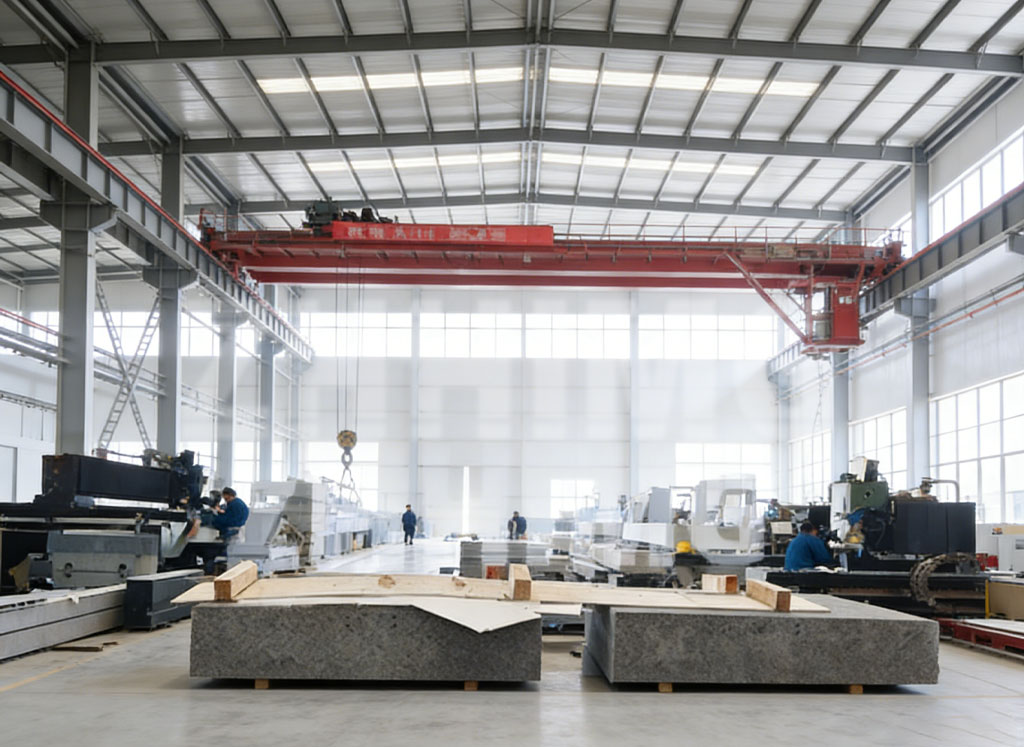
What to Ask a Granite Base Supplier
For engineering teams specifying granite bases for semiconductor or optical equipment, a few questions tend to separate capable suppliers from ones stretching their catalog:
- What’s the maximum single-piece dimension and tonnage the shop can actually machine, not just quote?
- Can they hold positional tolerance between mounting features and the reference surface, not just flatness on the surface itself?
- Is the granite sourced consistently enough that thermal and mechanical behavior is predictable across multiple units in a production order?
- What vibration damping or resonance data, if any, do they have for bases of similar mass and geometry?
Granite isn’t an exotic material choice in this industry anymore — it’s closer to a default for anything demanding sub-micron stability. The differentiation between suppliers shows up less in the material itself and more in machining precision at scale, and in whether the finished base performs as predictably in a customer’s cleanroom as it did on the shop floor where it was ground.
Post time: Aug-05-2026