
In precision cutting, grinding and micro-machining applications, machining chatter remains a stubborn challenge for process engineers. Self-excited vibration occurring between the cutting tool and workpiece during machining creates ripples and chatter marks on workpiece surfaces, degrading surface finish. In severe cases, it accelerates tool wear and limits the upgrade of cutting parameters. Many manufacturers still struggle to eliminate chatter marks even after optimizing spindles and adjusting cutting parameters. The root cause often lies in insufficient dynamic performance of the machine tool bed. Benefiting from unique dynamic damping advantages, granite machine tool beds effectively suppress machining chatter, optimize cutting conditions from the reference base of the whole machine, and directly improve the surface quality of finished workpieces.
Machining chatter essentially refers to resonance generated by the machine structural system under the excitation of cutting force. Although cast iron beds deliver acceptable static rigidity, their damping coefficients are relatively low. Once critical cutting conditions are reached, vibrational energy can hardly dissipate rapidly. Vibration continues to amplify and transmits to the cutting zone, forming periodic chatter marks on workpiece surfaces. Even fine-tuning feed rates and spindle speeds can only temporarily avoid chatter within a narrow process window, failing to solve the issue fundamentally at the structural level. In contrast, granite features an interlocked dense internal crystal structure with much higher internal damping than cast iron. When vibration generated by cutting transfers to the bed, vibrational energy dissipates and decays quickly inside the stone, restraining vibration amplification and breaking conditions for self-excited vibration to achieve smoother cutting.
However, simply selecting granite material does not guarantee inherent chatter suppression. The dynamic performance of the bed results from the synergy of material, structural design and precision machining. When designing granite machine tool beds, ZHHIMG conducts comprehensive whole-machine dynamic simulation. Reinforcing ribs, weight-reducing cavities and support points are rationally arranged according to spindle load, cutting force direction and layout of motion axes. The natural frequency of the structure is optimized while controlling self-weight to avoid common cutting frequency bands and prevent whole-machine resonance. Different from simple solid stone blanks, our structural matching amplifies the inherent damping advantages of granite, weakens dynamic disturbances transmitted from spindles, ball screws and linear guides, and stops vibration from propagating upward to the tool tip.
Different machining processes have distinct requirements for chatter suppression. High-speed milling, ultra-precision grinding and micro-machining of optical components are extremely sensitive to vibration. Minor chatter deteriorates surface roughness and produces visible wavy textures. Machine tools equipped with granite beds feature stable reference bases that reduce micro-displacement fluctuation at the tool tip. Workpieces after machining obtain uniform surface textures and less workload for subsequent polishing. For machining hard materials and thin-walled parts, such workpieces have low inherent rigidity and are prone to jitter induced by cutting vibration. The vibration-damping capacity of granite beds reduces relative vibration between tools and workpieces, minimizing thin-wall deformation and edge chipping defects and raising finished product yield.
Many equipment manufacturers hold a misunderstanding that chatter can be eliminated merely by improving static rigidity. Static rigidity measures deformation under static load, while chatter is a dynamic problem. Even with superior static rigidity, insufficient structural damping still easily triggers vibration during cutting. The core value of granite beds lies in excellent dynamic vibration absorption while maintaining high static rigidity, satisfying both static and dynamic key indicators — an effect hardly achieved by simply thickening cast iron beds. ZHHIMG selects high-density granite blanks with a density of approximately 3100 kg/m³. Sufficient aging removes residual stress to prevent drift of structural characteristics after long-term operation, ensuring long-term stable chatter suppression performance without attenuation over the service life of equipment.
During component manufacturing, ZHHIMG attaches great importance to the lapping accuracy of each assembly reference surface on the bed. Integrally lapped reference surfaces guarantee the fitting quality of guide rails and spindle modules and reduce dynamic looseness caused by assembly gaps. Flatness deviation on reference surfaces creates hidden gaps after assembly. These gaps open and close repeatedly under cutting impact and induce extra vibration. High-precision granite references enable smoother operation of moving parts and further cut secondary vibration sources, forming dual chatter suppression together with material damping. 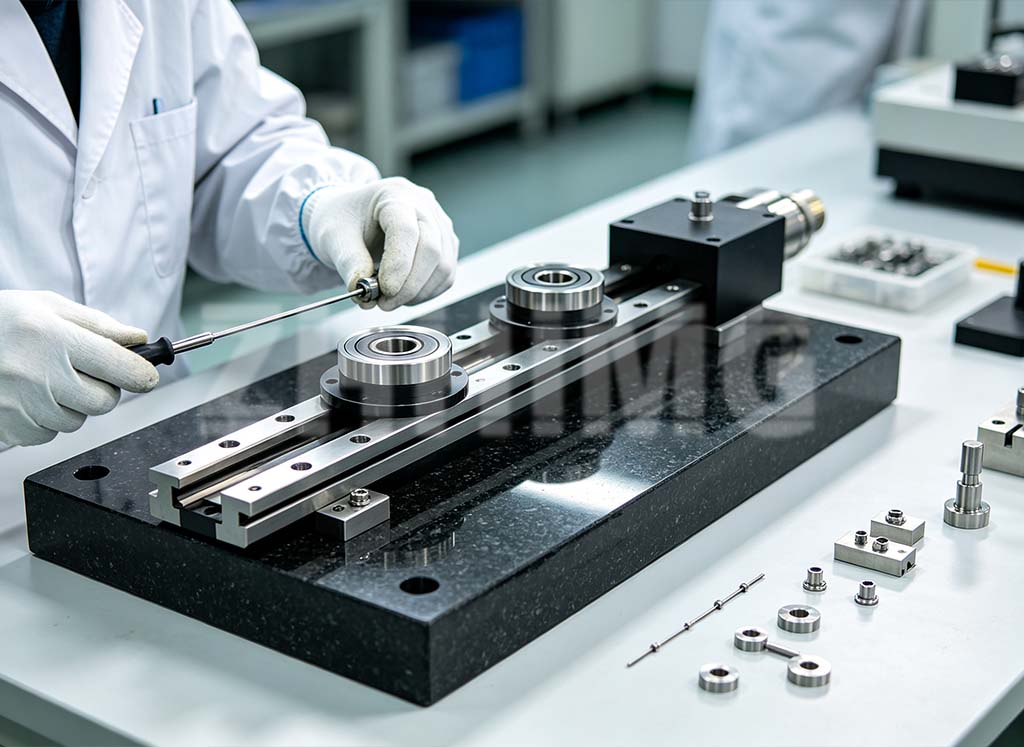
ZHHIMG not only supplies standalone granite bed components, but also collaborates with complete machine manufacturers on dynamic simulation analysis to optimize bed structural schemes for specific machining conditions. Resonance risks are predicted in the project evaluation phase. The bed shape, layout of weight-reducing grooves and support positions are customized according to workpiece types and spindle parameters of customers. Besides granite solutions, we can compare the dynamic characteristics of alternative base materials such as mineral castings and match the most suitable structural scheme for customers.
The core advantage of granite machine tool beds lies in outstanding dynamic damping properties. They serve not only as static load-bearing bases, but also as vibration suppression units for the whole machine. By rapidly dissipating cutting vibrational energy, restraining machining chatter, reducing surface chatter marks on workpieces and lowering tool consumption, they broaden the process window for stable cutting, steadily improve workpiece surface processing quality, and meet stringent requirements for surface topography in ultra-precision machining.
Post time: Sep-17-2026