
For linear motor stages, optical scanning and semiconductor inspection equipment, dynamic jitter caused by slide start-stop and high-speed scanning is often the key bottleneck limiting equipment resolution and repeat positioning capability. Many equipment manufacturers suppress jitter by optimizing servo algorithms and upgrading guide rail modules. However, compensation at the electrical level delivers limited results if the hardware frame lacks sufficient rigidity. Welded or cast metal gantries, even with acceptable static rigidity, produce elastic deformation the moment acceleration and deceleration switch. The rebound of deformation turns into persistent micro-jitter, disturbing optical imaging and probe signal acquisition. With inherent material damping and optimized monolithic structural design, granite moving gantries suppress such dynamic jitter from the source and deliver smoother motion for moving mechanisms.
The mechanical configuration of the frame forms the first line of defense against jitter. Unlike segmented stone gantries assembled from multiple parts, the integrated granite beam and columns form a closed force-bearing structure. Inertial loads generated by moving slides are evenly distributed across the whole frame, avoiding localized stress concentration and structural flutter. When the slide changes direction at high speed, inertial impact will not concentrate on a small number of fastening bolts or splicing gaps, greatly reducing torsional and bending micro-deformation of the frame. On ordinary spliced gantries, joints become mechanically weak points. Every acceleration and deceleration triggers tiny elastic reciprocating swing, manifested as continuous jitter during equipment operation. Integrated granite gantries eliminate weak points caused by splicing interfaces. The whole frame bears alternating loads as a single unit and suppresses jitter induced by deformation rebound.
Natural damping from the stone’s crystalline structure rapidly dissipates vibration energy and prevents continuous build-up of jitter. After receiving shock vibration, metal materials reflect most energy and vibrate for a long time before settling. The densely interlaced mineral crystal interfaces inside granite create natural energy dissipation channels. Once vibration generated by slide start-stop or motor operation enters the granite frame, vibration energy is quickly consumed by internal friction among crystals instead of sustaining residual oscillation. This passive vibration reduction does not require complicated additional vibration dampers. Under high-frequency reciprocating scanning conditions, it effectively stops jitter from growing and prevents resonance. For optical inspection and laser processing applications, this fast settling characteristic ensures the frame stabilizes rapidly after each scanning pass without residual jitter interfering with subsequent measurements.
Mass inertia further suppresses jitter induced by external disturbances. Greater structural mass improves the frame’s resistance to perturbation. Minor floor vibration and lateral pull from cable routing in the workshop can hardly swing heavy granite frames. Metal gantries need thick material stacks to achieve equivalent inertia, which occupies more space and brings higher risk of thermal deformation. With optimized cross-section geometry, granite moving gantries leverage high-density substrate to increase overall mass. They resist external disturbance without introducing extra thermal expansion risks. Even if slight floor vibration exists in the workshop, the frame will not synchronously shake, protecting optical assemblies and inspection probes mounted on the gantry.
Stress relief during structural processing prevents jitter from worsening after long-term operation. Residual stress remains inside some stone components after machining. With continuous equipment operation and alternating ambient temperature and humidity, stress releases slowly and alters frame geometry. The matching condition of guide rails drifts accordingly, and operating jitter becomes more severe over time. During manufacturing, components undergo sufficient aging to release internal stone stress before grinding. After machining, multiple precision metrology tools collect deformation data at multiple points to confirm stable stress status before assembly. Granite gantries stabilized by stress treatment maintain consistent geometry during long reciprocating operation. They will not degrade guide rail fit due to gradual stress release and avoid recurring jitter after equipment commissioning. 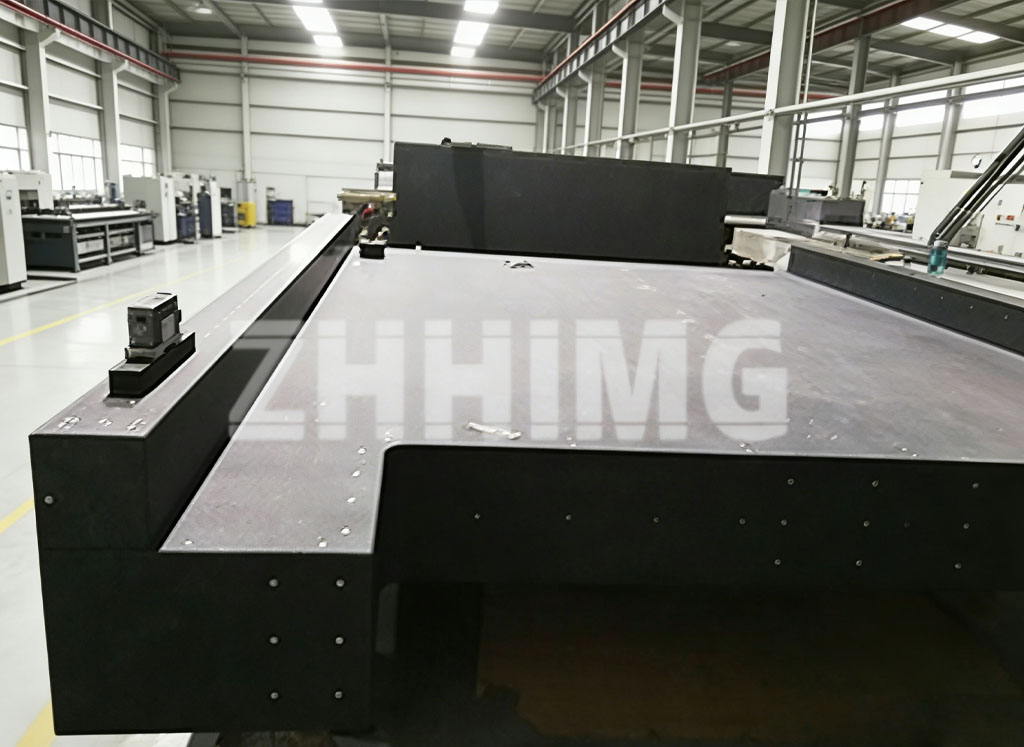
Fine-tuned cross-section design balances rigidity, self-weight and vibration damping to prevent jitter amplification at specific frequencies. Simply thickening stone increases cost and machining difficulty. Thin cross-sections lead to insufficient rigidity and bending jitter during slide movement. Mechanical simulation optimizes the cross-section of beams and columns. Sufficient stone thickness is retained at key stress positions while non-load-bearing areas are reasonably lightened. The natural frequency of the gantry avoids overlap with excitation frequencies from equipment servo systems and motors. This modal tuning prevents jitter amplification and violent oscillation at commonly used operating speeds. Many metal gantries skip modal matching, resulting in sudden jitter spikes at certain travel speeds due to resonance. Granite gantries avoid such frequency overlap during structural design.
Low thermal expansion further reduces indirect jitter sources. Temperature fluctuations cause expansion and contraction of metal frames, altering guide rail parallelism. Uneven force during slide travel triggers friction-induced jitter. Granite features an ultra-low thermal expansion coefficient. Minor ambient temperature changes barely deform the frame, and the guide rail assembly reference remains stable for extended periods. Slide travel resistance stays uniform, reducing friction jitter caused by datum deformation. In cleanrooms and semiconductor production lines sensitive to temperature variation, this characteristic maintains stable motion pair performance and keeps jitter within a consistent low level during long continuous equipment runs.
Post time: Sep-20-2026