
In precision manufacturing workshops, equipment bases are constantly exposed to various corrosive agents: cutting fluids, chemical cleaners, dust, acid and alkali fumes, coupled with alternating fluctuations in temperature and humidity between day and night. Many precision equipment manufacturers face a tough problem. Metal frames and cast iron bases quickly suffer chemical corrosion and pitting. Once the protective coating peels off, the reference surface gets damaged gradually, equipment accuracy keeps declining, and frequent shutdowns for maintenance and calibration seriously disrupt production schedules. Many engineers turn to stone reference parts, yet doubts remain: can granite support blocks withstand complex factory operating conditions and resist the long-term erosion of various corrosive media?
The answer is yes. High-quality precision granite support blocks feature outstanding chemical corrosion resistance and can operate stably for a long time in multi-media, multi-interference complex factory environments. Corrosion essentially refers to material damage caused by chemical reactions with external substances. Steel, cast iron and other metal materials are highly susceptible to electrochemical corrosion once exposed to acid-alkali cutting waste liquid and moisture. Even with spray-on protection, once the surface protective film is scratched or chipped, corrosion will spread inward continuously from the damaged point.
Precision black granite, by contrast, is a naturally inert mineral aggregate without metal phases prone to chemical reactions. It does not react with conventional cutting fluids, weak acid and alkali cleaners or workshop fumes. If the raw material has high density and minimal internal pores, corrosive agents can hardly penetrate into the stone. They only stay on the surface and can be wiped off easily, without penetration corrosion or surface peeling. This is fundamentally different from ordinary marble with loose porous structures. Ordinary marble contains high calcium carbonate content and will be slowly etched by weak acids, destroying flatness over time and making it completely unsuitable for long-term use as precision reference parts.
Nevertheless, corrosion resistance does not mean any stone can be directly put into production. In complex factory environments, support blocks must not only resist corrosion but also preserve reference accuracy under long-term combined interference from dust, vibration and temperature changes. If raw materials have insufficient density or tiny internal cracks, even without immediate corrosion, contaminants will accumulate in crevices and gradually alter internal stone stress, leading to deformation of the reference surface. Premium granite undergoes thorough natural aging and features a uniform and stable material structure. It will not suffer slow deformation induced by stress release under overlapping workshop conditions including corrosive media, vibration and temperature variation.
Machining processes also determine service life in complex working environments. Rough machining followed by precision lapping and constant-temperature calibration produces a dense and uniform reference plane, reducing micro pits and lowering the risk of contaminant adhesion. Such smooth and dense surfaces are easy to clean daily and further mitigate potential impacts from adhered media. With simple regular dust removal and wiping, the reference accuracy of support blocks can be maintained for a long time even in complex workshop conditions.
Compared with the maintenance model of metal bases, the advantages are obvious. Metal components require periodic inspection of anti-corrosion coatings, rust removal, repainting and repeated calibration. The maintenance workflow is cumbersome. Once corrosion damage occurs, replacement of the whole component is often necessary. Granite support blocks need no anti-corrosion coating, eliminating plenty of periodic maintenance work. After one-time installation, they maintain stable reference performance in complex working conditions over extended periods and greatly cut the full-lifecycle operation and maintenance costs of equipment. 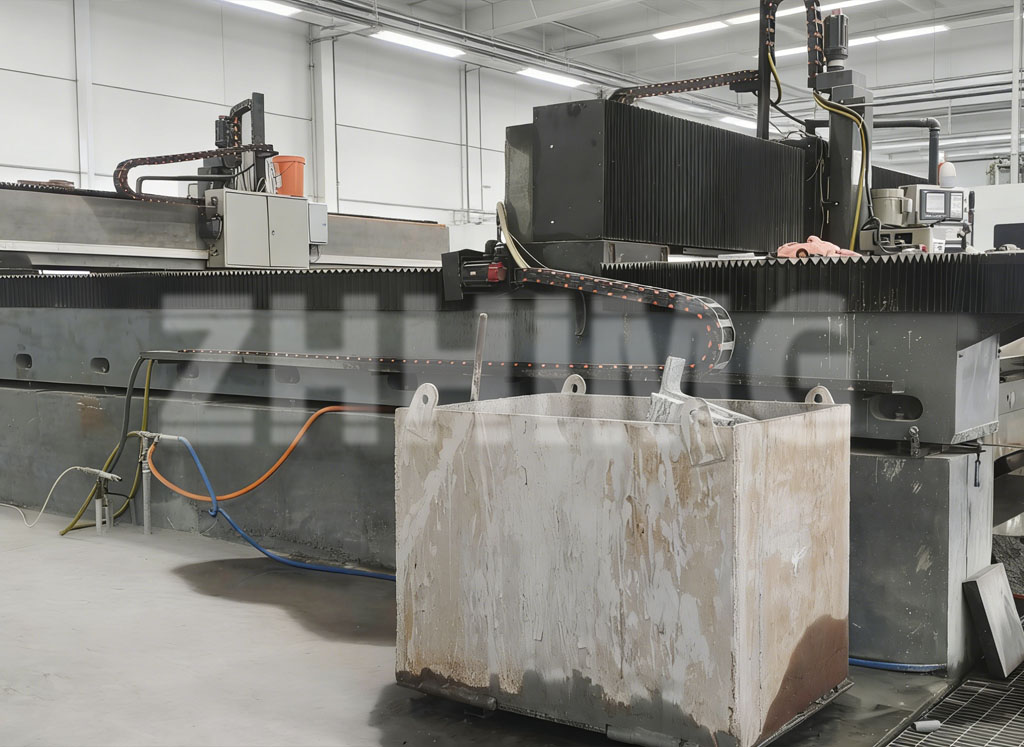
That said, granite support blocks are not omnipotent. Special highly corrosive reagents such as high-concentration hydrofluoric acid can still etch granite surfaces. Isolation protection should be adopted under such extreme working conditions. However, conventional media found in most precision machining, inspection and semiconductor supporting workshops will not damage qualified precision granite support blocks.
In complex factory environments filled with cutting waste liquid, dust and chemical fumes, high-quality granite support blocks rely on naturally inherent chemical corrosion resistance and dense, stable material structure to resist erosion from most workshop media and sustain stable reference accuracy for years. They address the pain points of easy corrosion and heavy maintenance for traditional metal bases, delivering lasting and stable reference support for precision equipment. They are an ideal choice for ultra-precision equipment operating in complex industrial environments.
Post time: Sep-16-2026