
When a quality engineer tells you their coordinate measuring machine is producing inconsistent readings, the problem often isn’t the instrument itself. More often than not, the culprit lies beneath the workpiece: the surface plate serving as the measurement reference. In precision metrology, the foundation upon which measurements are taken matters almost as much as the measurement tools themselves. This is why selecting the right surface plate material has become a critical decision for laboratories, manufacturing facilities, and calibration services worldwide.
For decades, the choice boiled down to two primary contenders: natural granite and gray cast iron. While both materials can provide a stable reference plane, their underlying physical properties create vastly different performance characteristics that directly impact measurement accuracy, maintenance costs, and long-term reliability. Understanding these differences is essential for anyone responsible for dimensional inspection equipment, whether you’re outfitting a new laboratory or reevaluating your current setup.
Why Surface Plate Material Matters in Precision Measurement
A surface plate serves as the datum plane against which all other measurements are referenced. The flatness of this reference directly propagates into every measurement taken upon it. If the plate itself drifts, warps, or introduces environmental errors, no amount of expensive measuring equipment can compensate.
The material composition of a surface plate determines how it responds to temperature fluctuations, vibrations from nearby machinery, humidity changes, and the mechanical stresses of daily use. These factors might seem minor individually, but in precision metrology where tolerances are measured in microns, they compound quickly. A plate that performs admirably in a climate-controlled calibration laboratory might fail spectacularly in an uncontrolled shop floor environment.
Professionals in aerospace, semiconductor manufacturing, and medical device production have largely gravitated toward granite for these demanding applications. Meanwhile, cast iron continues to serve well in heavy manufacturing contexts where its unique properties address different priorities. The key is matching the material to the application.
The Case for Granite Surface Plates
Granite owes its metrological advantages to its geological origin. Formed over millions of years under extreme pressure, natural granite possesses a dense, uniform crystalline structure with internal stress patterns that have long since stabilized. This maturity translates directly into dimensional stability that manufactured metals simply cannot match.
The thermal expansion coefficient of granite typically measures between 3 and 8 × 10⁻⁶ per degree Celsius. Cast iron, by contrast, expands at approximately 11 × 10⁻⁶ per degree Celsius under the same conditions. That threefold difference means a cast iron plate subjected to a 10°C temperature swing will experience dimensional changes roughly three times greater than its granite counterpart. For operations where room temperature fluctuates by even a few degrees during the day, this distinction can mean the difference between passing and failing components that must meet tight tolerances.
Beyond thermal behavior, granite demonstrates superior vibration damping characteristics. The interlocking crystal structure absorbs and dissipates mechanical energy rather than transmitting it. When heavy machinery operates nearby, a granite surface plate remains relatively isolated from these disturbances. Cast iron, being metallic, conducts vibration more readily, potentially introducing subtle errors into sensitive measurements.
Corrosion resistance represents another practical advantage. Granite is chemically inert and completely immune to rust or oxidation. A granite surface plate requires no protective coatings, no periodic oiling, and no anxiety about humidity levels in the workspace. Cast iron, however, will oxidize readily if exposed to moisture or even high atmospheric humidity. Facilities using cast iron plates must implement rigorous maintenance schedules involving rust prevention compounds, or they risk iron oxide particles contaminating their measurement surfaces and degrading accuracy over time.
The wear characteristics of granite also favor long-term precision maintenance. While granite can chip if subjected to sharp impact, such damage tends to be localized and visually obvious. The surrounding material maintains its geometry, and the plate continues to provide reliable flatness across undamaged regions. Cast iron, when worn or damaged, often develops raised material around wear spots due to the deformation characteristics of the metal. This creeping distortion gradually compromises measurement accuracy across the entire surface.
These combined properties explain why granite has become the default choice for coordinate measuring machine bases, optical inspection stations, and calibration reference plates in industries where measurement integrity is non-negotiable.
Where Cast Iron Still Holds Value
Despite granite’s many advantages, cast iron surface plates haven’t disappeared from the metrology landscape. Understanding their appropriate applications helps avoid the common mistake of assuming one material suits all purposes.
The most significant advantage of cast iron lies in its load-bearing capacity and impact resistance. With tensile strength exceeding 300 MPa, cast iron handles heavy workpieces and rough handling better than granite, which is inherently brittle. For operations involving large, heavy castings or forgings that must be measured but cannot easily be transported to a clean measurement environment, cast iron’s durability becomes valuable. Dropping a heavy part on a granite plate risks catastrophic chipping; cast iron will simply dent.
Cast iron also offers something granite cannot: repairability through scraping. Skilled tradespeople can restore a worn cast iron plate to its original flatness tolerance using traditional scraping techniques. The Whitworth three-plate method allows qualified technicians to generate fresh reference surfaces indefinitely, extending the plate’s service life across decades of use. When budget constraints preclude purchasing new equipment, this repairability factor sometimes justifies the ongoing maintenance investment.
In controlled laboratory environments specifically designed for master standard propagation, cast iron finds its niche. Temperature control to fractions of a degree eliminates thermal expansion concerns, while the unique deformation behavior of cast iron under scraping produces a bearing surface that some practitioners prefer for hand-scraped gauge work. The optical uniformity of cast iron also offers advantages for certain vision-based inspection systems.
Comparing Performance Across Critical Parameters
Looking at these materials side by side reveals the tradeoffs involved in selection.
Thermal sensitivity stands out immediately. A granite plate maintains its dimensional geometry across a wide temperature range without special accommodation. The same cannot be said for cast iron, which requires either strict environmental control or acceptance of measurement uncertainty during temperature excursions. In most industrial settings, maintaining laboratory-grade temperature stability proves expensive or impractical, making granite’s thermal robustness a significant practical advantage.
Vibration transmission follows a similar pattern. Running a milling machine adjacent to a cast iron surface plate will introduce measurable vibration into the measurement reference. The resulting oscillation superimposes dynamic error onto static measurements, particularly problematic when using hand-held instruments like dial indicators. Granite’s damping properties isolate the reference plane from such disturbances, preserving measurement integrity even in challenging mechanical environments.
Wear progression differs qualitatively between the materials. Granite, when worn, tends to develop localized high spots that remain stable and detectable. Cast iron wear patterns tend to be more diffuse and unpredictable. Both materials require periodic calibration verification, but granite typically maintains its certified flatness between calibrations for longer periods under equivalent usage patterns.
Maintenance requirements diverge significantly. A granite surface plate needs only regular cleaning with mild detergent and soft materials. No consumables, no hazardous materials, no special training. Cast iron demands vigilance against corrosion, typically requiring rust-prevention compounds that must be reapplied according to maintenance schedules. These compounds can transfer to workpieces and measurement instruments if not carefully managed, introducing contamination risks.
Matching Material to Application
Selecting between granite and cast iron ultimately depends on understanding your specific operational context.
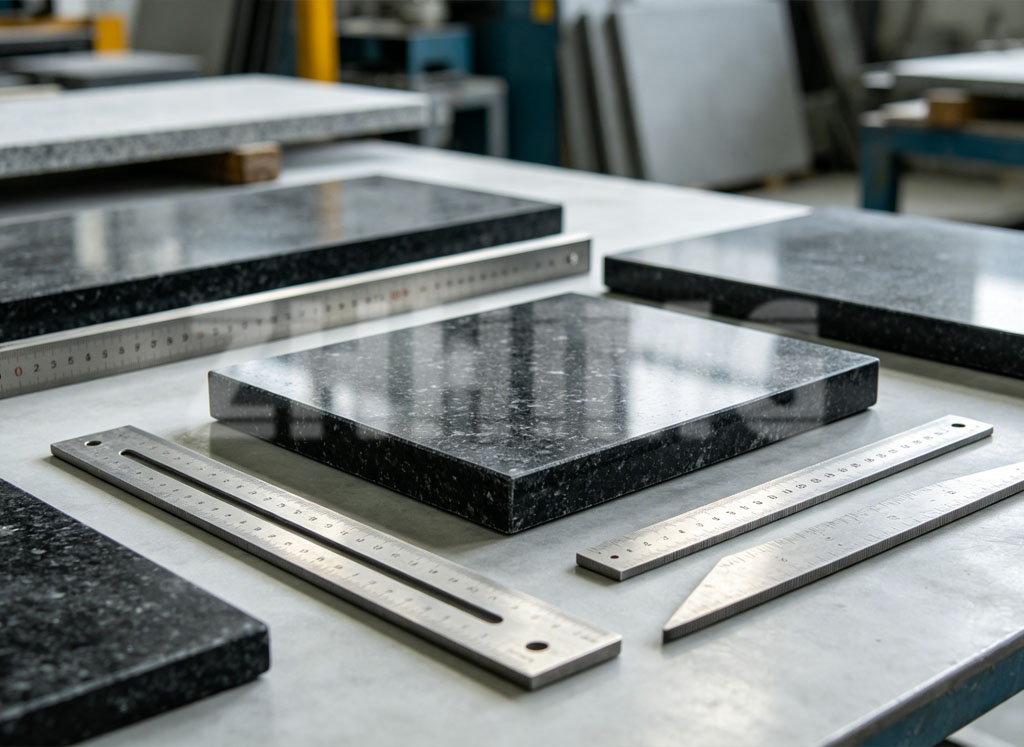
For calibration laboratories, reference standard propagation, and precision measurement facilities where temperature control exists and accuracy requirements approach the limits of available instrumentation, granite provides the stable foundation these applications demand. The non-magnetic nature of granite also benefits electronic measurement systems and environments where magnetic interference would compromise results.
For heavy manufacturing environments where large workpieces require measurement in-place, where temperature control is impractical, and where the measurement tolerances are comparatively relaxed, cast iron’s durability and repairability offer practical value. The initial cost advantage can also matter for facilities outfitting multiple measurement stations on tight budgets.
Modern quality-conscious operations increasingly standardize on granite throughout their metrology infrastructure. The long-term cost of ownership, factoring in maintenance labor, consumables, and replacement frequency, often favors granite despite higher initial purchase prices. More importantly, the measurement confidence that comes from a stable, predictable reference surface reduces the risk of quality escapes that could prove far more costly than any surface plate premium.
Manufacturing Excellence in Precision Granite
For organizations seeking granite surface plates that meet the most demanding international standards, the manufacturing source matters considerably. ZHHIMG® Group has established itself as a leading precision granite manufacturer, operating two production facilities spanning 200,000 square meters with monthly capacity exceeding 20,000 precision machine beds in sizes up to 5,000 millimeters.
What distinguishes ZHHIMG® is their vertical integration of quality assurance. Their craftsmen work with ZHHIMG® black granite, a high-density material approximately 3,100 kilograms per cubic meter, with physical properties that exceed typical specifications for European and American black granites. Every plate undergoes verification using German-made Mahr precision instruments capable of 0.5-micrometer resolution and Renishaw laser interferometers for dimensional traceability.
The company’s commitment to global standards demonstrates through their quality certifications. ZHHIMG® is the only precision granite manufacturer simultaneously holding ISO 9001, ISO 45001, ISO 14001, and CE certifications. Their technical teams regularly train on international standards including DIN, ASME, JIS, and GB specifications, ensuring products meet destination market requirements without ambiguity.
For custom applications requiring unusual dimensions or specialized features, ZHHIMG® maintains single-piece machining capability up to 20 meters in length, 4,000 millimeters width, and 1,000 millimeters thickness. Four Taiwan-manufactured ultra-large grinding machines enable surface grinding up to 6,000 millimeters. This combination of traditional craftsmanship and modern capacity addresses applications from small laboratory standards to massive machine tool foundations.
Their quality philosophy, articulated as “The precision business can’t be too demanding,” reflects an organizational culture that prioritizes accuracy over throughput. The master craftsmen who hand-finish precision surfaces bring over 30 years of experience to each piece, producing results that customers describe as approaching the precision of “walking electronic levels.”
Making Your Selection
The comparison between granite and cast iron surface plates ultimately reduces to a question of fit. If your operations prioritize measurement accuracy in controlled or semi-controlled environments, if long-term stability matters more than initial cost, and if you value low maintenance requirements and predictable performance, granite surface plates represent the clear choice.
For applications involving extreme loads, rough handling, or controlled laboratory master standard work, cast iron retains legitimate advantages worth considering.
When you’re ready to explore precision granite solutions for your metrology infrastructure, ZHHIMG® Group invites inquiries through their website at www.ZHHIMG-group.com. Their engineering teams can discuss specific application requirements and recommend appropriate configurations from standard product lines or custom manufacturing capabilities.
The right surface plate won’t solve all your measurement challenges, but starting from a stable, reliable reference foundation eliminates one significant source of uncertainty from your quality processes.
Post time: May-12-2026